
Erecting the barrier, August 1961
On the night of August 13, 1961, East German forces began sealing off West Berlin with barbed wire and hastily erected concrete blocks. What started as a razor-wire cordon soon became a permanent, fortified boundary. The official aim from the German Democratic Republic (GDR) was to stop the flow of people to the West; the effect was to split neighborhoods, families, and workplaces overnight. Photographs from those first days—soldiers climbing, residents staring, a young border guard named Conrad Schumann famously leaping over barbed wire—captured the shock of a city walled in.
Life with the Wall, 1961–1980s
The Berlin Wall was not a single structure but a shifting series of barriers. Early concrete blocks were replaced in the mid-1960s by a wider, more elaborate system: a ‘death strip’ of sand, floodlights, watchtowers, and inner and outer walls. Checkpoint Charlie became the most visible flashpoint; in October 1961, tanks faced off in a tense standoff that underscored how close Berlin came to armed conflict.
Daily life adjusted in small, stubborn ways. Commuters rerouted their journeys, mail took longer, and office friendships dissolved across an invisible seam. Some people risked tunnels, false-bottomed cars, or forged papers. Others paid the ultimate price: more than a hundred people died trying to reach West Berlin, and each death added to a quiet tally of grievance and grief that spanned generations.
Despite the repression, the Wall also became a stage. Western leaders visited to show solidarity—most famously President John F. Kennedy’s 1963 trip—and artists used the concrete as a canvas for protest. Inside East Berlin, citizens lived under a surveillance state that tightened and loosened with political tides, from harsh crackdowns in the 1950s and 1960s to the cautious openings of détente and Ostpolitik in the 1970s.
The unmaking, 1989
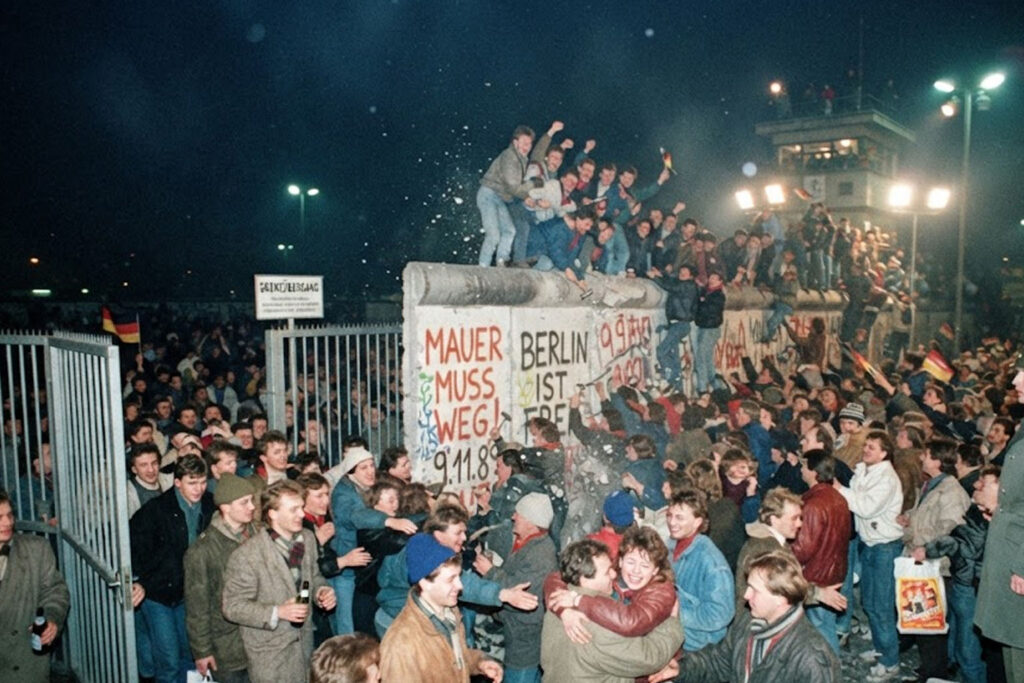
By the late 1980s economic stagnation, reform movements in other Eastern Bloc countries, and rising public demonstrations in East Germany changed the mood. Mass protests swelled in Leipzig and elsewhere through 1989. On November 9, a confused announcement by an East German official about new travel rules led thousands to gather at border crossings. Faced with crowds and mounting pressure, border guards opened the gates. People poured through in jubilant waves, chipping at concrete with hammers, embracing strangers, and carrying away pieces of the Wall as souvenirs. What had begun as a sudden closure three decades earlier ended in a sudden, exuberant unravelling.
Conclusion
The Berlin Wall’s life—erected fast, fortified slowly, brought down faster—left a visible scar on the city and an intangible one on memory. Where concrete once cut the map, parks, memorials, and painted murals now trace a timeline of division and reunion. The Wall remains an object lesson: political lines can be drawn quickly, but their social consequences last long after the concrete is gone.