Uncover History’s Secrets with Daily Updates!
Daily News Entertainment
  • Home
  • History
  • Biographies
  • Eras
  • Regions
  • Timeline
No Result
View All Result
History Ours
  • Home
  • History
  • Biographies
  • Eras
  • Regions
  • Timeline
No Result
View All Result
History Ours
No Result
View All Result
Home History

Apprenticeship, Play, and Youth Life in Market Towns

in History
Apprenticeship, Play, and Youth Life in Market Towns

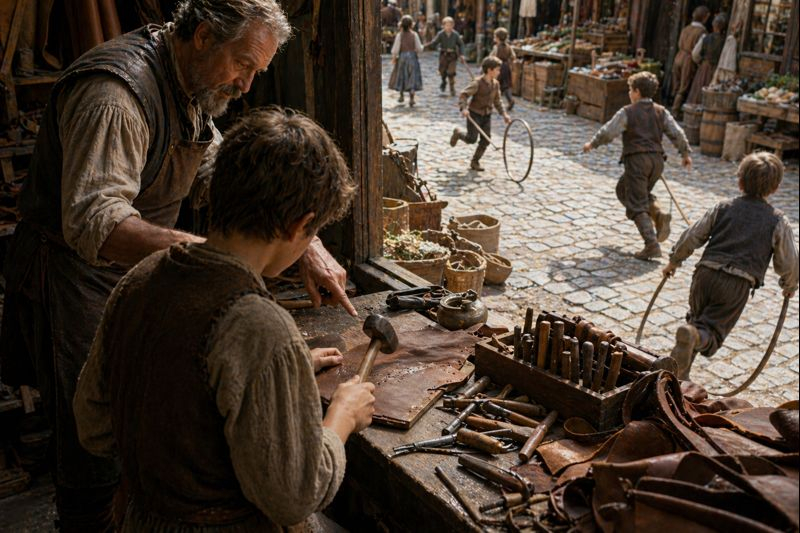
In historic market towns, the rhythms of childhood and youth were inseparable from commerce and community. Apprentices, errand children, and neighborhood youngsters shaped and were shaped by streets, stalls, and workshops. Their movements, games, and responsibilities offer a window into daily life beyond elite institutions. Examining youth experience reveals how skills, social ties, and leisure were woven into economic life.

Apprenticeship and Household Economy

Apprentices entered workshops as part of family strategies and urban economies, often living with masters and contributing to production. Contracts formalized training while also binding young people into household routines and neighborhood networks. The apprenticeship year structured daily schedules, exposure to techniques, and opportunities for social mobility in modest ways. Workplaces doubled as sites of learning and socialization for both technical skills and civic norms.

Beyond training, apprentices supported household consumption through labor and trade connections. Their presence affected shop layouts, sleeping arrangements, and how time was organized around markets and festivals.

Play, Learning, and Urban Space

Children’s play in alleyways, market squares, and courtyards was a form of informal education that taught local rules and spatial awareness. Games often mimicked adult occupations, blending imitation with skill development that later proved useful in trades. Public spaces were both playgrounds and classrooms where young people practiced negotiation, risk-taking, and cooperation. These activities reinforced neighborhood boundaries and forged friendships across age groups.

Play also helped regulate tensions between work and leisure, giving youth a voice in communal life and shaping expectations about adulthood.

Networks, Mentors, and Community Order

Mentors, guild members, and neighborhood figures monitored youth through a mix of formal oversight and everyday interaction. Apprenticeships created ties that extended into marriage markets, patronage, and informal credit relationships. Local authorities and guild regulations aimed to maintain discipline, but much learning occurred through observation, correction, and communal storytelling. These networks balanced opportunities with obligations, producing reputations that lasted into later life.

Informal ceremonies, apprentices’ displays, and public chores reaffirmed social order while giving young people visible roles in civic rituals. The community thus became a teacher as much as a regulator.

Conclusion

Youth life in market towns blended labor, learning, and leisure in ways that sustained both economies and social fabrics. Apprentices and children were active participants whose daily practices shaped urban culture and continuity. Understanding their roles deepens our view of historic towns as living communities where generations learned to work and belong.


Previous Post

Turning Chronology into Insight: Practical Timeline Planning

Next Post

Daily Networks: Social Fabric of Historic Market Communities

Related Posts

Anne Bonny: The Pirate Who Broke Rules and Expectations
History

Anne Bonny: The Pirate Who Broke Rules and Expectations

September 15, 2026
How the Crystal Palace Turned Glass and Iron into a Modern Stage
History

How the Crystal Palace Turned Glass and Iron into a Modern Stage

September 15, 2026
Mary Anning and the Coast That Revealed Lost Worlds
History

Mary Anning and the Coast That Revealed Lost Worlds

September 15, 2026
When Mount Pelée Erased Saint-Pierre, 1902
History

When Mount Pelée Erased Saint-Pierre, 1902

September 15, 2026
Next Post
Daily Networks: Social Fabric of Historic Market Communities

Daily Networks: Social Fabric of Historic Market Communities

Search..

No Result
View All Result

Recent Articles

How the Ruhr Became Germany’s Engine and Then Its Archive

How the Ruhr Became Germany’s Engine and Then Its Archive

September 17, 2026
Salt, Walls, and Ships: How Dalmatia Became a Maritime Frontier

Salt, Walls, and Ships: How Dalmatia Became a Maritime Frontier

September 17, 2026
Edo: Japan’s Urban Revolution of Lanterns and Printshops

Edo: Japan’s Urban Revolution of Lanterns and Printshops

September 16, 2026
How the Little Ice Age Changed Everyday Life in Europe

How the Little Ice Age Changed Everyday Life in Europe

September 16, 2026
The Disguise That Broke Chains: Ellen and William Craft

The Disguise That Broke Chains: Ellen and William Craft

September 15, 2026

Subscribe Us

By clicking submit, I authorize History Ours and its affiliated companies to: (1) use, sell, and share my information for marketing purposes, including cross-context behavioral advertising, as described in our Terms of Service and Privacy Policy, (2) supplement the information that I provide with additional information lawfully obtained from other sources, like demographic data from public sources, interests inferred from web page views, or other data relevant to what might interest me, like past purchase or location data, (3) contact me or enable others to contact me by email with offers for goods and services from any category at the email address provided, and (4) retain my information while I am engaging with marketing messages that I receive and for a reasonable amount of time thereafter. I understand I can opt out at any time through an email that I receive, or by clicking here

Subscribe To Our Newsletter

By clicking submit, I authorize History Ours and its affiliated companies to: (1) use, sell, and share my information for marketing purposes, including cross-context behavioral advertising, as described in our Terms of Service and Privacy Policy, (2) supplement the information that I provide with additional information lawfully obtained from other sources, like demographic data from public sources, interests inferred from web page views, or other data relevant to what might interest me, like past purchase or location data, (3) contact me or enable others to contact me by email with offers for goods and services from any category at the email address provided, and (4) retain my information while I am engaging with marketing messages that I receive and for a reasonable amount of time thereafter. I understand I can opt out at any time through an email that I receive, or by clicking here.

© 2026 History Ours | All Rights Reserved

  • Contact Us
  • Privacy Policy
  • Terms of Service
  • Unsubscribe
  • Privacy Choices
  • Contact Us
  • Privacy Policy
  • Terms of Service
  • Unsubscribe
  • Privacy Choices

© 2026 History Ours | All Rights Reserved

No Result
View All Result
  • Home
  • History
  • Biographies
  • Eras
  • Regions
  • Timeline

© 2026 History Ours | All Rights Reserved

Skip to content
Open toolbar Accessibility Tools

Accessibility Tools

  • Increase TextIncrease Text
  • Decrease TextDecrease Text
  • GrayscaleGrayscale
  • High ContrastHigh Contrast
  • Negative ContrastNegative Contrast
  • Light BackgroundLight Background
  • Links UnderlineLinks Underline
  • Readable FontReadable Font
  • Reset Reset