Uncover History’s Secrets with Daily Updates!
Daily News Entertainment
  • Home
  • History
  • Biographies
  • Eras
  • Regions
  • Timeline
No Result
View All Result
History Ours
  • Home
  • History
  • Biographies
  • Eras
  • Regions
  • Timeline
No Result
View All Result
History Ours
No Result
View All Result
Home Timeline

Turning Chronology into Insight: Practical Timeline Planning

in Timeline
Turning Chronology into Insight: Practical Timeline Planning

Well-planned timelines do more than list dates; they guide readers through cause, consequence, and continuity. Defining scope and audience at the start keeps content focused and legible for intended users. Early decisions about scale, periodization, and whether to favor chronological or thematic structure determine research and design priorities. A concise orientation helps visitors engage meaningfully with the sequence of events.

Clarify Scope and Audience

Begin by defining what you want the timeline to communicate and who will use it. A public exhibit requires different pacing and labeling than a research tool, and community-focused timelines benefit from accessible entry points and clear narratives. Limiting the chronological span or breaking content into phases prevents overload and supports better annotation. Identifying core questions—such as change over time, turning points, or continuity—keeps curation purposeful.

These early choices reduce later revisions and make research tasks more manageable. They also guide how to present uncertainty or contested events so users understand limits.

Organize Events into Narrative Arcs

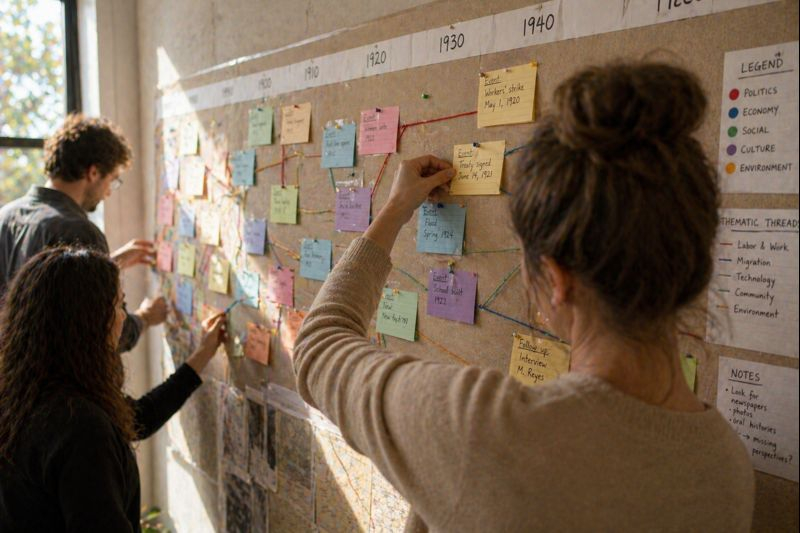
Group events into thematic threads or causal chains to reveal connections without sacrificing chronology. Use anchors—milestones, representative artifacts, or emblematic dates—to help readers orient within dense sections. Consider parallel tracks for political, social, and cultural developments to show simultaneity and interaction. Limiting text on each entry preserves attention and encourages readers to follow larger patterns.

Clear arcs help audiences move from isolated facts to overarching patterns. This structure supports concise captions and optional deeper layers for further reading.

Design for Readability and Scale

Visual hierarchy—size, color, and spacing—signals what to read first and what is background. Scale choices determine how granular dates can be and whether microhistories or long-term trends will dominate the display. Use consistent typography and a restrained color palette for categories, and provide a legend to reduce cognitive load. Prototype layouts at actual display sizes to test legibility across devices or panels.

  • Legend and color codes explain categories quickly.
  • Interactive layers can reveal extra detail without cluttering the main view.

Iteration with representative users catches common confusions before final production. Responsive adjustments to spacing and labeling improve accessibility for diverse audiences.

Conclusion

A timeline that balances scope, narrative, and visual clarity turns dates into insight. Begin with audience and purpose, organize events into intelligible arcs, and prototype design choices early. Regular review and community feedback keep the timeline accurate and relevant to its readers.


Previous Post

How to Prioritize Clarity in Multi-Scale Timelines

Next Post

Apprenticeship, Play, and Youth Life in Market Towns

Related Posts

1453: The Fall of Constantinople — A Brief Timeline
Timeline

1453: The Fall of Constantinople — A Brief Timeline

November 2, 2026
How Penicillin Went from Petri Dish to Battlefield Medicine
Timeline

How Penicillin Went from Petri Dish to Battlefield Medicine

November 2, 2026
How the Black Death Spread Across Europe, 1347–1351
Timeline

How the Black Death Spread Across Europe, 1347–1351

October 28, 2026
The Great Stink of 1858: How London Smell Rebuilt Itself
Timeline

The Great Stink of 1858: How London Smell Rebuilt Itself

October 28, 2026
Next Post
Apprenticeship, Play, and Youth Life in Market Towns

Apprenticeship, Play, and Youth Life in Market Towns

Search..

No Result
View All Result

Recent Articles

1453: The Fall of Constantinople — A Brief Timeline

1453: The Fall of Constantinople — A Brief Timeline

November 2, 2026
How Penicillin Went from Petri Dish to Battlefield Medicine

How Penicillin Went from Petri Dish to Battlefield Medicine

November 2, 2026
How Carrara’s Marble Carved a Peculiar Mountain Region

How Carrara’s Marble Carved a Peculiar Mountain Region

November 1, 2026
The Great Dismal Swamp: Refuge, Labor, and a Hidden Region

The Great Dismal Swamp: Refuge, Labor, and a Hidden Region

November 1, 2026
The Salon Era: How Conversation Shaped the Enlightenment

The Salon Era: How Conversation Shaped the Enlightenment

October 31, 2026

Subscribe Us

By clicking submit, I authorize History Ours and its affiliated companies to: (1) use, sell, and share my information for marketing purposes, including cross-context behavioral advertising, as described in our Terms of Service and Privacy Policy, (2) supplement the information that I provide with additional information lawfully obtained from other sources, like demographic data from public sources, interests inferred from web page views, or other data relevant to what might interest me, like past purchase or location data, (3) contact me or enable others to contact me by email with offers for goods and services from any category at the email address provided, and (4) retain my information while I am engaging with marketing messages that I receive and for a reasonable amount of time thereafter. I understand I can opt out at any time through an email that I receive, or by clicking here

Subscribe To Our Newsletter

By clicking submit, I authorize History Ours and its affiliated companies to: (1) use, sell, and share my information for marketing purposes, including cross-context behavioral advertising, as described in our Terms of Service and Privacy Policy, (2) supplement the information that I provide with additional information lawfully obtained from other sources, like demographic data from public sources, interests inferred from web page views, or other data relevant to what might interest me, like past purchase or location data, (3) contact me or enable others to contact me by email with offers for goods and services from any category at the email address provided, and (4) retain my information while I am engaging with marketing messages that I receive and for a reasonable amount of time thereafter. I understand I can opt out at any time through an email that I receive, or by clicking here.

© 2026 History Ours | All Rights Reserved

  • Contact Us
  • Privacy Policy
  • Terms of Service
  • Unsubscribe
  • Privacy Choices
  • Contact Us
  • Privacy Policy
  • Terms of Service
  • Unsubscribe
  • Privacy Choices

© 2026 History Ours | All Rights Reserved

No Result
View All Result
  • Home
  • History
  • Biographies
  • Eras
  • Regions
  • Timeline

© 2026 History Ours | All Rights Reserved

Skip to content
Open toolbar Accessibility Tools

Accessibility Tools

  • Increase TextIncrease Text
  • Decrease TextDecrease Text
  • GrayscaleGrayscale
  • High ContrastHigh Contrast
  • Negative ContrastNegative Contrast
  • Light BackgroundLight Background
  • Links UnderlineLinks Underline
  • Readable FontReadable Font
  • Reset Reset