

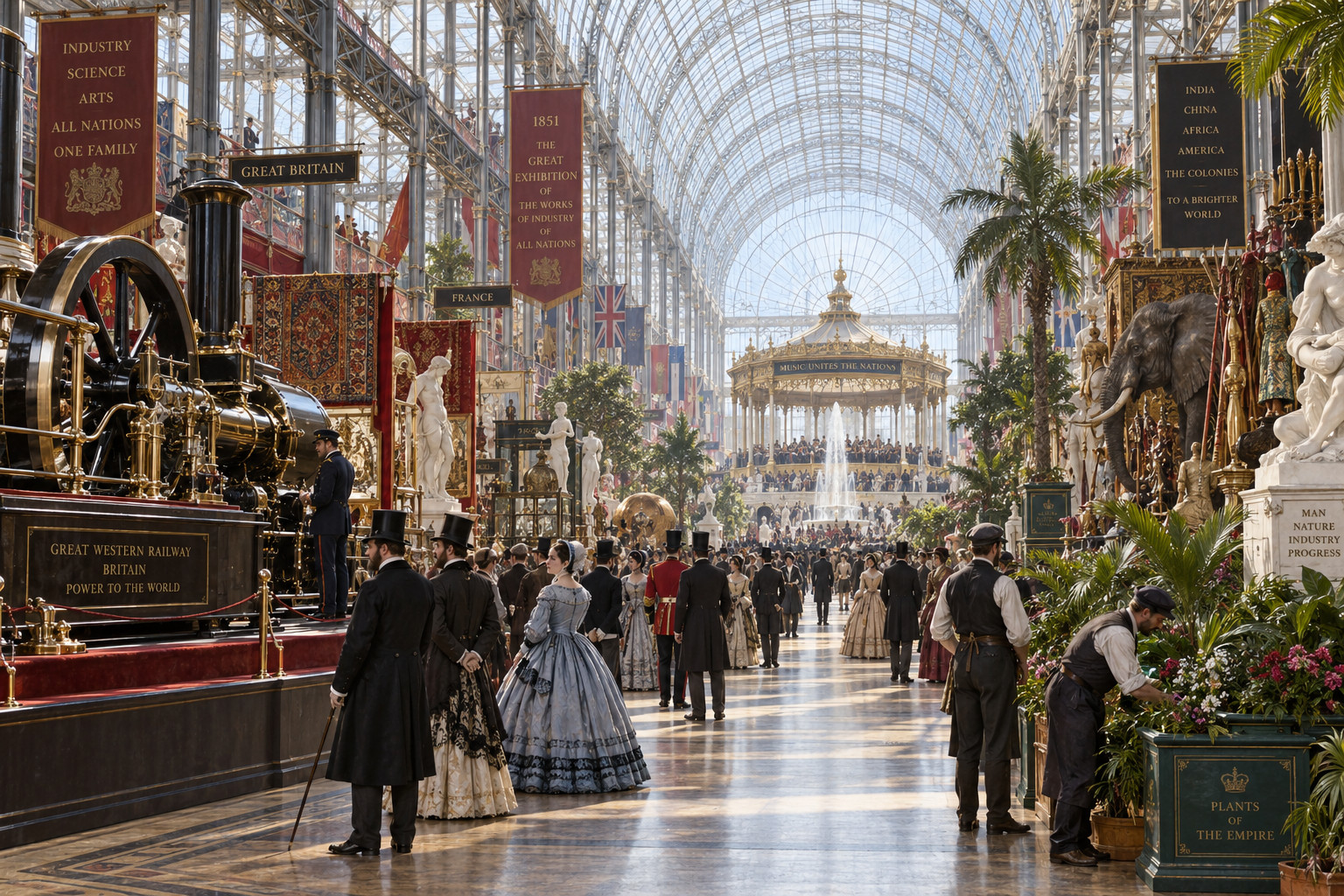
A revolutionary greenhouse becomes a national spectacle
When London’s Great Exhibition opened in Hyde Park in 1851, the building that held it looked nothing like the stone-fronted institutions people expected. Joseph Paxton, long known as the head gardener at Chatsworth House, proposed something based on greenhouses—long spans of iron framed with vast sheets of glass. The result was a structure that felt more like a machine for seeing than a traditional museum: light poured in, floors stretched away under a cathedral of iron ribs, and the objects on display—steam engines, textiles, colonial curiosities—were lit as if on a theatrical stage.
Design, speed, and a new way to build
What made the Crystal Palace remarkable was how it was made. Paxton translated horticultural technology into architecture: standardized components, repetitive frames, and prefabricated parts that could be assembled quickly. The method cut building time dramatically—erected in under a year—and suggested that buildings could be produced in the manner of industrial goods. The lightness of glass and the strength of iron let architects imagine roofs and spans previously impossible with masonry. For visitors used to dim, enclosed museums, the airy openness felt like a glimpse of something new—architecture responding to industry rather than imitating old styles.
After the Exhibition: spectacle, relocation, and influence
The Crystal Palace did not vanish with the exhibition. Officials dismantled and relocated it to Sydenham, south London, where it reopened in 1854 as a park-like destination of concerts, sericultural displays, and public promenades. It became a laboratory of 19th-century spectacle: model villages, fountains, illuminated nights, and botanical exhibitions filled its galleries. Architects and engineers watched and borrowed. Railway stations, department stores, and later conservatories echoed its vocabulary—large glass surfaces, iron frameworks, and internal spaces organized for crowd movement and display. In that way the Palace was less an isolated marvel than the prototype for an architectural language of the modern city.
Conclusion
The Crystal Palace’s story is a tidy illustration of how material innovation reshapes imagination. A gardener’s solution for growing plants became a building that framed an empire’s products and a public’s curiosity. Though the Palace itself was destroyed by fire in 1936, its legacy survived in skylines and station roofs, in glass-fronted shops and public halls. It didn’t just house the modern age—it helped invent the forms in which that age would present itself.