Uncover History’s Secrets with Daily Updates!
Daily News Entertainment
  • Home
  • History
  • Biographies
  • Eras
  • Regions
  • Timeline
No Result
View All Result
History Ours
  • Home
  • History
  • Biographies
  • Eras
  • Regions
  • Timeline
No Result
View All Result
History Ours
No Result
View All Result
Home History

Public Rituals and Everyday Networks in Historic Towns

in History
Public Rituals and Everyday Networks in Historic Towns

Historic towns were shaped as much by recurring public rituals as by formal institutions, and those rituals knitted residents together across class and occupation. Everyday practices—market mornings, church bells, street bargaining, and seasonal processions—created predictable rhythms that structured social life. These patterns gave ordinary places meaning and allowed people to recognize obligations, reputations, and opportunities without centralized records. Understanding those rituals helps explain how communities sustained trust and coordinated action before modern bureaucracy.

Reading accounts, inventories, and civic records reveals how routines regulated behavior and signaled status in subtle ways. The rest of this article explores how spaces, networks, and material culture reinforced those shared habits.

Public Spaces and Everyday Rituals

Public squares, market crosses, and thoroughfares served as stages for daily interaction, where visibility and proximity produced social accountability. Vendors arranged wares according to custom, craftsmen displayed tools that advertised skill, and neighbors used public corners to exchange news both mundane and urgent. Ritualized activities—opening markets at a set hour, tolling bells for communal labor, or assembling for proclamations—converted space into a predictable social machine. These patterned actions reduced friction in transactions and clarified expectations for newcomers.

Over time such rituals became normative: deviations were noticed and could weaken trust. Maintaining these routines was thus an important form of civic labor.

Networks of Exchange and Obligation

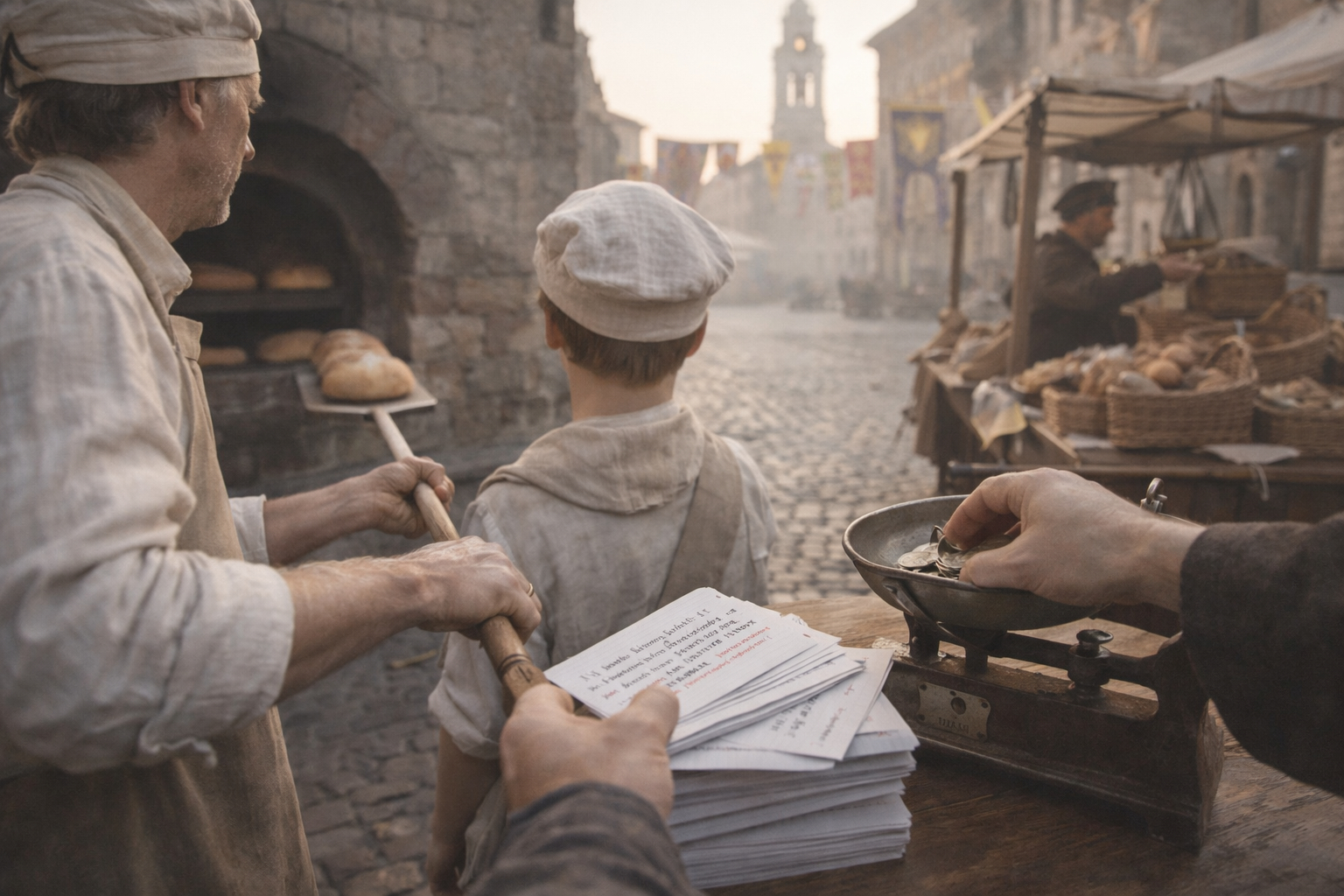
Beyond visible rituals, informal networks linked households through credit, kinship, apprenticeship, and patronage, creating webs of mutual dependence. A baker might extend credit to a regular customer who in turn recommended the baker to travelers; an apprentice learned not only a trade but also the social codes of the town. Records of disputes, fines, and oaths show that reputation travelled quickly along these ties, reinforcing compliance with local norms. These networks often blurred public and private spheres, as neighbors mediated conflicts or coordinated collective responses to shortages.

Such interdependence shaped who could access resources and how decisions were enforced without formal policing. Social obligation thus underpinned economic activity.

Material Culture and Temporal Rhythms

Objects and schedules anchored rituals: signage, weighing scales, communal ovens, and timekeeping devices all directed behavior. Material items signaled professional identity and enabled predictable exchanges, while calendrical markers—harvest festivals, market weeks, religious observances—paced labor and leisure. The physical layout of streets and workshops reinforced lines of sight and conversation, which in turn shaped how people allocated time and attention. Archaeological finds and inventories illuminate how possessions and tools were integrated into everyday ceremonial practice.

Through these artifacts and schedules, towns preserved continuity even as individual lives changed. Tangible culture made routines legible and repeatable.

Conclusion

Historic towns depended on a mix of ritual, spatial arrangement, and social networks to coordinate daily life and manage conflict. These mechanisms fostered resilience and allowed communities to function with limited formal infrastructure. Studying them reveals the practical intelligence embedded in ordinary practices and how shared routines produced social order.

Previous Post

Designing Accessible Timelines for Community History

Next Post

Commerce, Kinship, and Movement in Historic Town Life

Related Posts

How the Crystal Palace Turned Glass and Iron into a Modern Stage
History

How the Crystal Palace Turned Glass and Iron into a Modern Stage

September 15, 2026
Anne Bonny: The Pirate Who Broke Rules and Expectations
History

Anne Bonny: The Pirate Who Broke Rules and Expectations

September 15, 2026
Mary Anning and the Coast That Revealed Lost Worlds
History

Mary Anning and the Coast That Revealed Lost Worlds

September 15, 2026
When Mount Pelée Erased Saint-Pierre, 1902
History

When Mount Pelée Erased Saint-Pierre, 1902

September 15, 2026
Next Post
Commerce, Kinship, and Movement in Historic Town Life

Commerce, Kinship, and Movement in Historic Town Life

Search..

No Result
View All Result

Recent Articles

Edo: Japan’s Urban Revolution of Lanterns and Printshops

Edo: Japan’s Urban Revolution of Lanterns and Printshops

September 16, 2026
How the Little Ice Age Changed Everyday Life in Europe

How the Little Ice Age Changed Everyday Life in Europe

September 16, 2026
The Disguise That Broke Chains: Ellen and William Craft

The Disguise That Broke Chains: Ellen and William Craft

September 15, 2026
Bass Reeves: The Marshal Who Hunted Outlaws in Indian Territory

Bass Reeves: The Marshal Who Hunted Outlaws in Indian Territory

September 15, 2026
How the Crystal Palace Turned Glass and Iron into a Modern Stage

How the Crystal Palace Turned Glass and Iron into a Modern Stage

September 15, 2026

Subscribe Us

By clicking submit, I authorize History Ours and its affiliated companies to: (1) use, sell, and share my information for marketing purposes, including cross-context behavioral advertising, as described in our Terms of Service and Privacy Policy, (2) supplement the information that I provide with additional information lawfully obtained from other sources, like demographic data from public sources, interests inferred from web page views, or other data relevant to what might interest me, like past purchase or location data, (3) contact me or enable others to contact me by email with offers for goods and services from any category at the email address provided, and (4) retain my information while I am engaging with marketing messages that I receive and for a reasonable amount of time thereafter. I understand I can opt out at any time through an email that I receive, or by clicking here

Subscribe To Our Newsletter

By clicking submit, I authorize History Ours and its affiliated companies to: (1) use, sell, and share my information for marketing purposes, including cross-context behavioral advertising, as described in our Terms of Service and Privacy Policy, (2) supplement the information that I provide with additional information lawfully obtained from other sources, like demographic data from public sources, interests inferred from web page views, or other data relevant to what might interest me, like past purchase or location data, (3) contact me or enable others to contact me by email with offers for goods and services from any category at the email address provided, and (4) retain my information while I am engaging with marketing messages that I receive and for a reasonable amount of time thereafter. I understand I can opt out at any time through an email that I receive, or by clicking here.

© 2026 History Ours | All Rights Reserved

  • Contact Us
  • Privacy Policy
  • Terms of Service
  • Unsubscribe
  • Privacy Choices
  • Contact Us
  • Privacy Policy
  • Terms of Service
  • Unsubscribe
  • Privacy Choices

© 2026 History Ours | All Rights Reserved

No Result
View All Result
  • Home
  • History
  • Biographies
  • Eras
  • Regions
  • Timeline

© 2026 History Ours | All Rights Reserved

Skip to content
Open toolbar Accessibility Tools

Accessibility Tools

  • Increase TextIncrease Text
  • Decrease TextDecrease Text
  • GrayscaleGrayscale
  • High ContrastHigh Contrast
  • Negative ContrastNegative Contrast
  • Light BackgroundLight Background
  • Links UnderlineLinks Underline
  • Readable FontReadable Font
  • Reset Reset