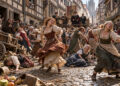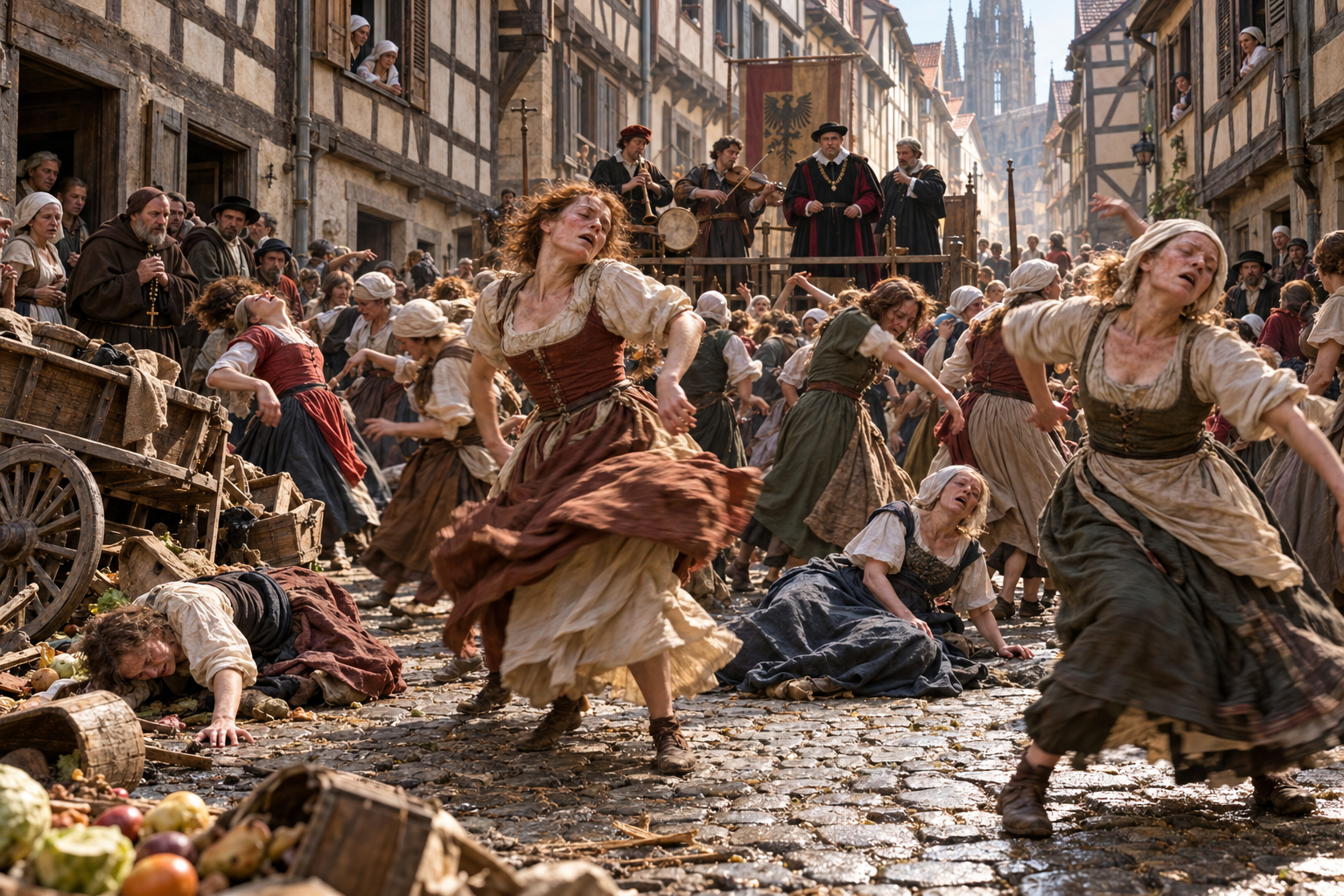
In July 1518 a woman in Strasbourg—then a city of the Holy Roman Empire—stepped into the street and began to dance. The woman, recorded in municipal chronicles as Frau Troffea, did not stop after an hour or a day. Within a week others had joined. Contemporary accounts and city records describe a swarm of dancers filling the alleys: not a festival, but a compulsion that would last for weeks.
How the city reacted
Authorities at first treated the outbreak like a medical curiosity. Some local leaders believed the dancing might be a kind of illness that needed to be encouraged out of the body; they rented a hall, built a wooden stage and hired musicians so the afflicted could dance more safely. That policy changed when reports grew that people were collapsing from exhaustion, and some chronicle entries mention fatalities. Eventually the city turned to more punitive and religious remedies—banishment, confinement, processions and prayers.
What might have caused it?
The dancing plague resists tidy explanation. One older hypothesis points to ergot, a fungus that can contaminate rye and produces convulsions and hallucinations; it was a plausible medical culprit in an era of poor grain storage. Modern scholars warn that ergotism would not easily explain why so many participants danced in rhythmic, organized ways or why the affliction hit particular social groups.
Another explanation is mass psychogenic illness: under extreme stress—poor harvests, disease, poverty, superstition—people in tightly knit communities sometimes develop shared somatic symptoms. The majority of the recorded dancers were women, many of them from lower social classes, which matches other historical incubators of collective behavior. Religious belief, extreme fasting, or local cultic practices might also have amplified a pre-existing tendency toward ecstatic movement.
Medical diagnoses such as epilepsy or neuromuscular disorders have been offered, and some scholars suggest an interaction of physiological and social triggers. Importantly, the surviving accounts are fragmentary and filtered through the concerns of clergy and city officials, who shaped what they recorded.
Conclusion
The 1518 dancing plague stands out because it was public, prolonged and documented by officials who struggled to make sense of it. It refuses a single explanation and so serves as a small, sharp example of how bodies, beliefs and stressors can collide in unpredictable ways. Two centuries later, historians and scientists still debate the episode: not because the facts are dramatic—people danced, authorities reacted—but because the event forces us to consider how communities respond when ordinary life turns inexplicably strange.