
London in July 1858 smelled awful in a way that stopped people in their tracks. Weeks of unseasonably hot weather reduced the Thames to a sluggish, bubbling avenue of excrement and industrial waste. The river, long treated as an open sewer, sent a fetid cloud upriver; the stench reached the Westminster district and invaded the Houses of Parliament. Londoners called it the “Great Stink”: not a single dramatic catastrophe, but a civic embarrassment that made politics and daily life unbearable.
The moment mattered because the city already lived with recurring cholera outbreaks. John Snow’s 1854 work on waterborne disease had pointed to contaminated water as a source, but scientific findings had not yet forced large-scale action. The intolerable smell, however, made the problem visible — and painfully immediate — to lawmakers who could no longer ignore the river’s role in public health and urban life.
An engineer, a bold plan, and ornate pump houses
Into this crisis stepped Joseph Bazalgette, the chief engineer for the Metropolitan Board of Works. He proposed not simple repairs but an audacious reworking of the city’s drainage: intercepting sewers that would catch waste before it reached the Thames, carrying it downstream, and using pumping stations to lift and move sludge away from the central city. Parliament, jolted by the stench and alarm, authorized emergency funds that summer.
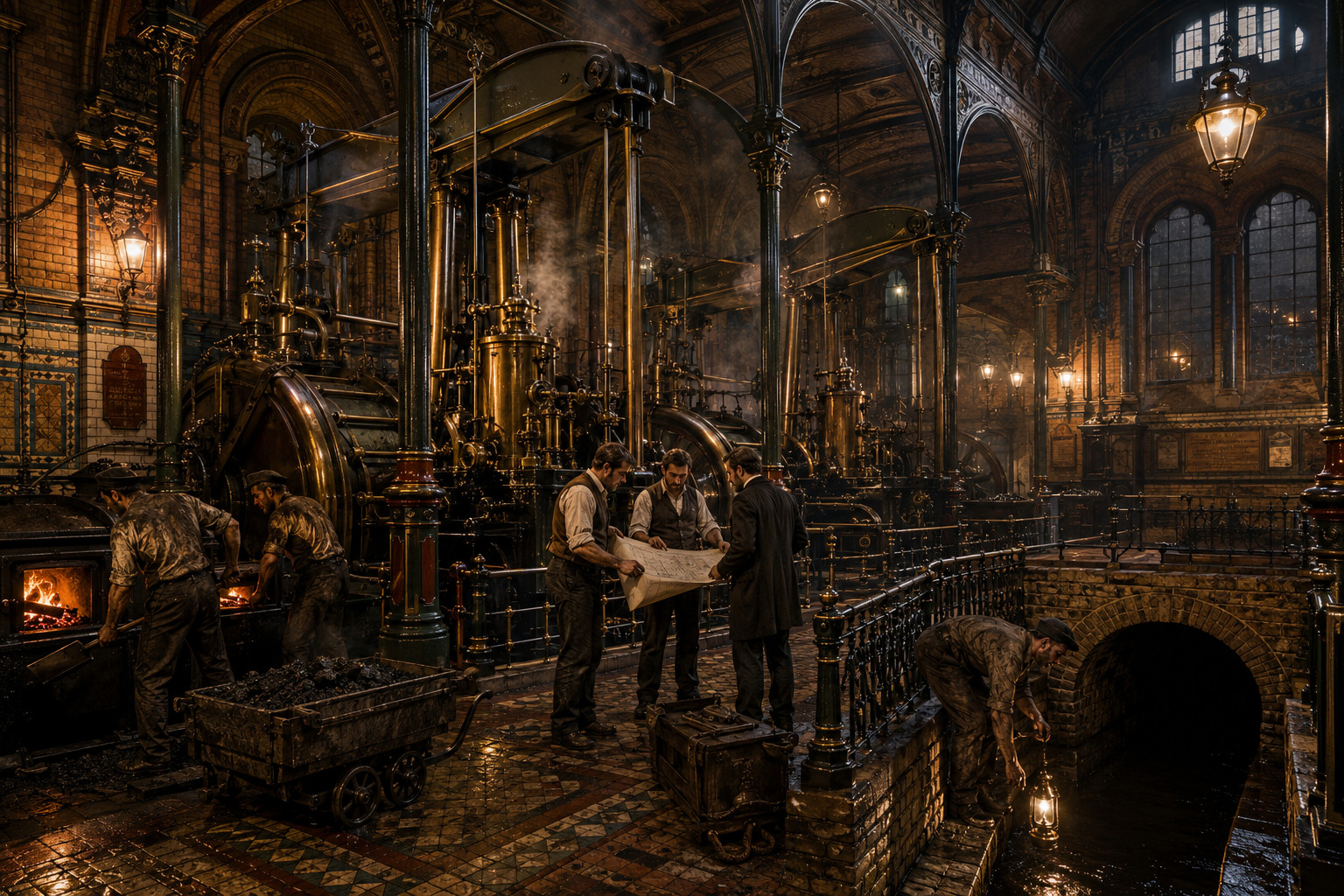
The resulting Victorian infrastructure was both functional and surprisingly grand. Brick-lined tunnels, enormous brick sewers, and pumping stations such as Crossness and Abbey Mills — called by some the “cathedrals of sewage” because of their decorative cast-iron and brickwork — embodied a new civic confidence. Bazalgette also reclaimed land along the riverbank, creating the Victoria Embankment and giving Londoners new streets and parks built atop essential utilities.
What changed — and what lasted
The new sewer network did not make London spotless overnight, but it transformed the relationship between the city and its river. The most immediate payoff was a dramatic reduction in the stench and a lower risk of waterborne disease where clean water supplies were secured. The project also set an example: municipal engineering on a metropolitan scale, paid for and overseen by public authorities, rather than piecemeal private fixes.
Today the Great Stink reads like a parable about civic attention: a foul summer forced a modern solution. The ornate pumping stations survive as industrial heritage, portions of the embankments remain busy thoroughfares, and much of Bazalgette’s underground network still carries London’s waste — a hidden legacy born of a very public nuisance.
Conclusion
What began as a summer nobody wanted to remember reshaped the capital. The Great Stink turned smell into policy, embarrassment into engineering, and an overburdened river into the spine of a modern sewer system — one of the Victorian era’s quietest but most enduring achievements.