
An invisible blast in the taiga
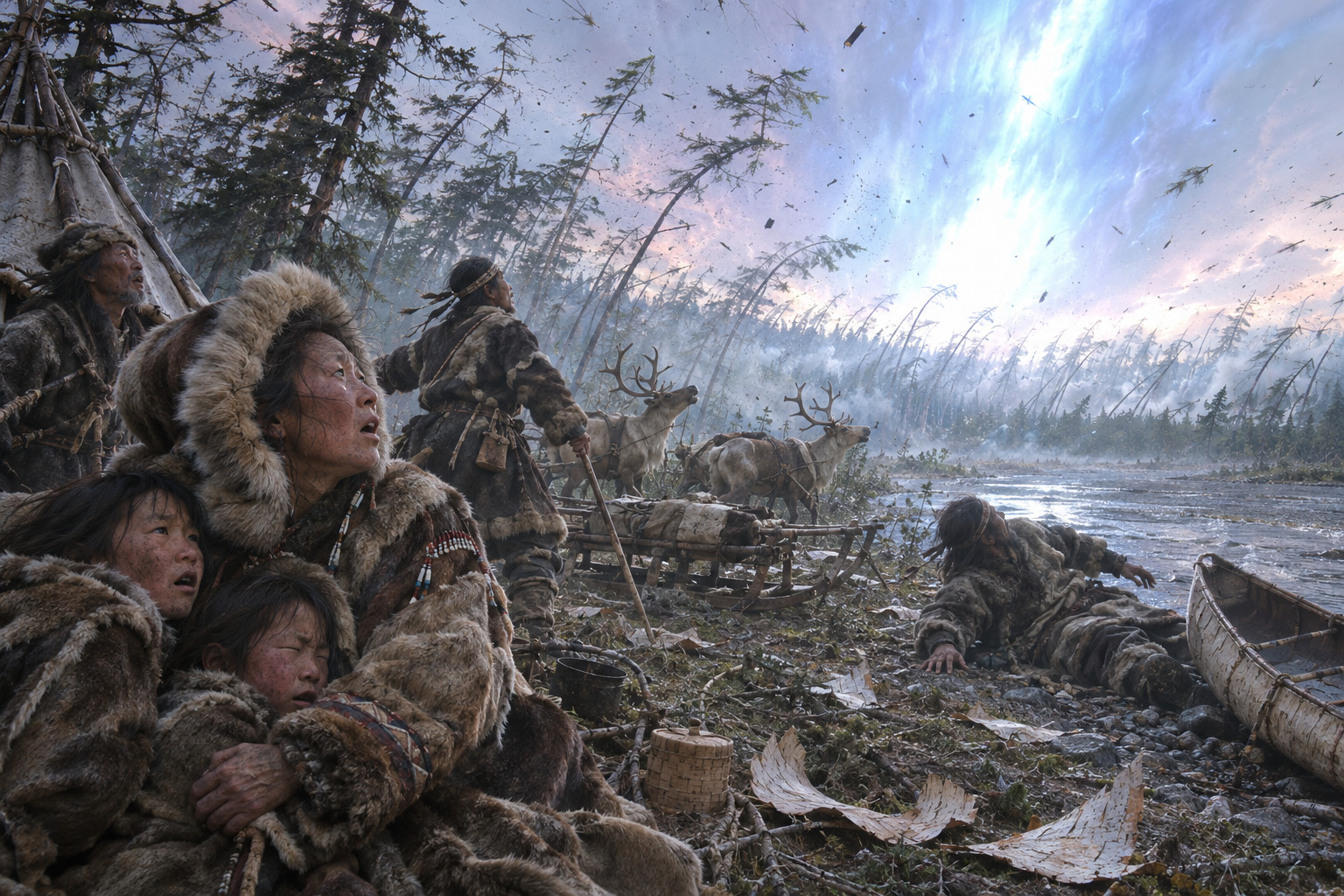
On the morning of June 30, 1908, something utterly unfamiliar tore the quiet above a stretch of Siberian forest near the Stony Tunguska River. Locals later described a column of bluish light, a thunderous roar and a shock that knocked people off their feet many miles away. When scientists finally reached the site decades later, they found a startling pattern: roughly 2,000 square kilometers of trees flattened in a radial sweep, trunks all pointing away from a central zone — yet there was no crater to explain it.
Clues, expeditions, and a stubborn puzzle
The first serious scientific attention came from Russian geologist Leonid Kulik, who led an expedition in 1927. He photographed the fallen forest, collected charcoal and recorded local testimonies. Instruments around the world had already registered something unusual on that date: seismic waves and air-pressure disturbances were detected by European barographs, and unusual twilight glows were reported as far away as Western Europe. Together those signs suggested a massive atmospheric explosion — a huge release of energy at altitude rather than a ground impact.
That hypothesis helps explain the lack of an obvious crater. Estimates of the blast’s energy have varied, but most modern calculations place it in the range of several megatons of TNT — far more powerful than any conventional explosive of the era and comparable to a small thermonuclear explosion. The favored scientific story today is that a stony meteor or a fragment of cometary ice blew apart in the atmosphere, producing an airburst that showered the taiga with heat, pressure and falling debris.
Why Tunguska still fascinates
The Tunguska event sits at the intersection of human drama and planetary risk. For decades it attracted exotic theories — from vaporized alien craft to natural gas explosions — but as observations of near-Earth objects have improved, Tunguska has become a cautionary example. The 2013 Chelyabinsk meteor over Russia gave a modern echo: a smaller airburst injured hundreds and damaged thousands of buildings, showing that explosive atmospheric strikes do happen and can affect populated areas.
Tunguska also reminds us how many of Earth’s dramatic episodes leave only fleeting traces. The remnant pattern in the trees, the scattered bits of glassy spherules later reported by some researchers, and the human stories preserved by Evenki witnesses are what we have to reconstruct an event that no camera captured. Scientists still refine energy estimates and models of the fragment’s composition, but the core fact remains: an enormous detonation happened high over a remote corner of Siberia, and its mark on the forest endures as one of the twentieth century’s strangest natural mysteries.
Conclusion
Tunguska resists tidy explanations but teaches a simple lesson. The sky can produce sudden, surprising violence without warning — and even a remote blast can leave echoes across continents and decades. For historians and scientists alike, the Siberian taiga keeps its quiet, radial scars as a mute, persistent clue to what passed through the heavens that June morning in 1908.