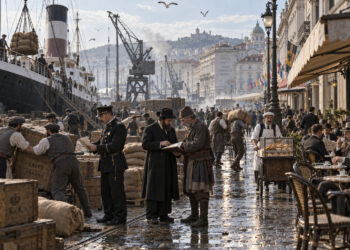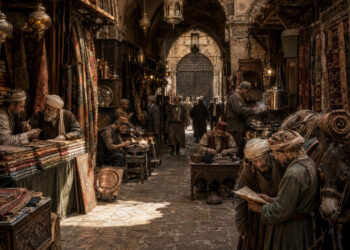


Regions develop where people, goods, and ideas move through shared spaces.
Markets, roads, and meeting places concentrate practices and create repeated interactions.
Over time those interactions become routines, memories, and institutions that mark a place.
Studying these crossroads reveals how distinct regional identities emerge without a single origin.
Markets and Movement
Markets are more than trade nodes; they are engines of social negotiation and information exchange. Regular gatherings enable vernacular norms to spread, stabilize prices, and shape local calendars. Merchants, craftspersons, and consumers form networks that link towns and countryside in layered relationships. Archaeological and archival traces of goods and stall locations let historians trace the footprint of commerce.
Paying attention to the rhythms of exchange helps explain why some practices persist and others fade. Market studies thus connect material culture to long-term regional cohesion.
Rituals and Social Bonds
Rituals and festivals anchor communities by rehearsing shared meanings in public space. These events often incorporate trade, foodways, and performance, reinforcing bonds across social lines. Even small, recurring observances create temporal structure that people use to orient labor and leisure. Ethnographic records combined with local records illuminate how ritual calendars migrate and adapt.
- Seasonal fairs that attract regional traders.
- Religious feasts tied to agricultural cycles.
Because rituals mix the sacred and the practical, they shape everyday expectations. They also transmit reputations and reputational economies that matter for longer-term regional identity.
Infrastructure and Everyday Practice
Infrastructure — roads, bridges, paths — channels movement and can privilege particular routes and actors. Investment in transportation or its neglect produces enduring patterns of connectivity and marginalization. Ordinary household sites, workshops, and crossroads accumulate meanings through repeated use and maintenance. Mapping these material traces uncovers layered histories of access, control, and community collaboration.
Combining spatial analysis with oral histories brings these patterns into clearer focus. Such methods help reconstruct how regions were lived rather than merely defined on a map.
Memory and Material Culture
Material culture — objects, built forms, and everyday tools — carries memory across generations. Houses, workshops, and relics record adaptations to environment and economic change in visible form. Small mementos and reused materials reveal practices of reuse, thrift, and symbolic continuity. Museums and local collections offer curated narratives but ordinary assemblages often tell more diverse stories. Integrating material analysis with oral testimony highlights how people remember migration, trade, and cooperation.
This combination helps historians avoid overly neat narratives of regional origin. It foregrounds contingency, improvisation, and the role of less powerful actors in shaping place. Research that centers everyday objects thus expands our sense of regional creativity and resilience.
Conclusion
Crossroads of trade and tradition show that regions are made through ongoing practices.
Attention to markets, rituals, and infrastructure reveals durable connections between places.
Scholars and local communities can use these insights to recover complex regional pasts.