Uncover History’s Secrets with Daily Updates!
Daily News Entertainment
  • Home
  • History
  • Biographies
  • Eras
  • Regions
  • Timeline
No Result
View All Result
History Ours
  • Home
  • History
  • Biographies
  • Eras
  • Regions
  • Timeline
No Result
View All Result
History Ours
No Result
View All Result
Home Regions

Orkney: Where Norse Law and Scottish Life Intertwined

in Regions
Orkney: Where Norse Law and Scottish Life Intertwined

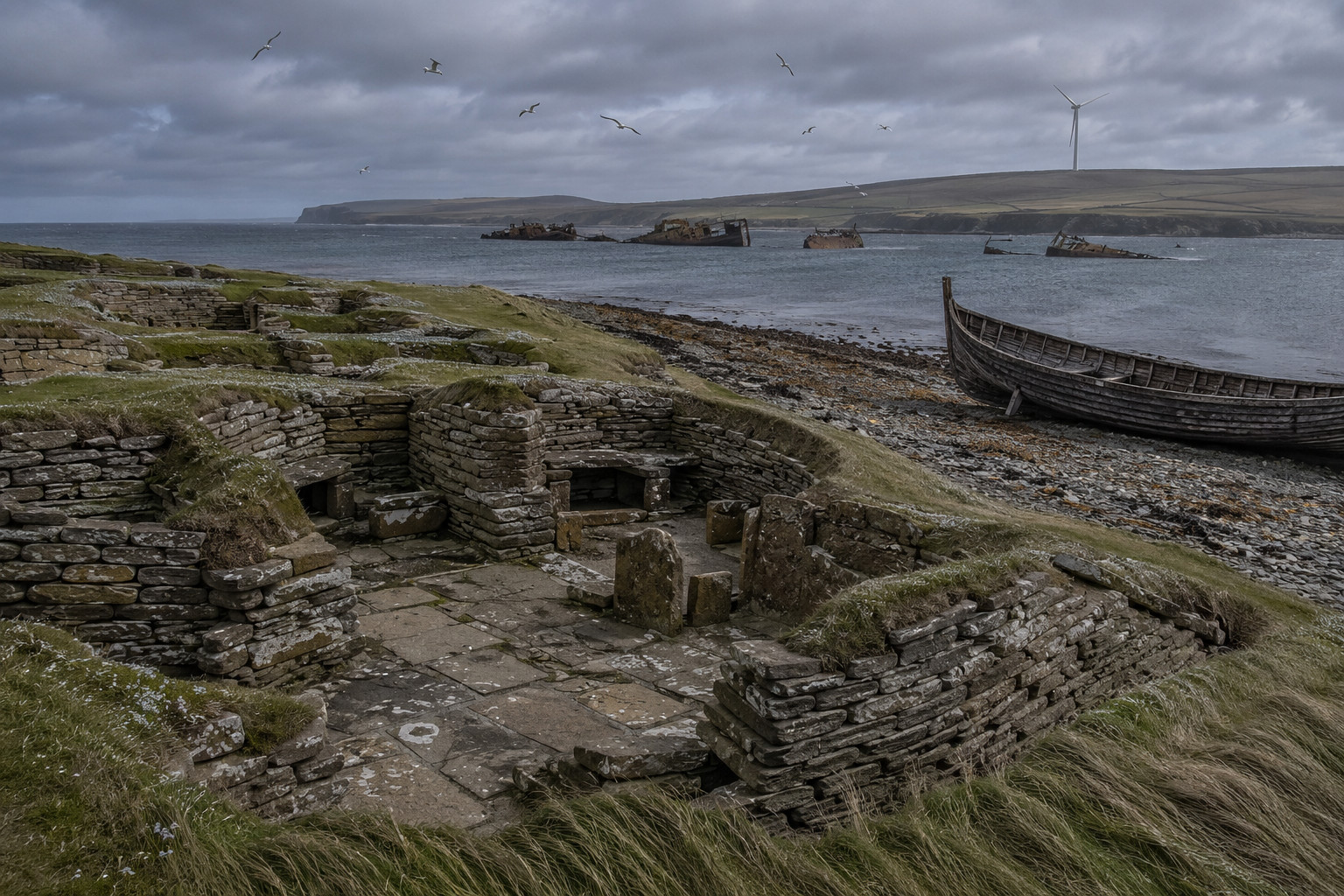
Clustered off Scotland’s northeastern coast, the Orkney Islands are small in area but large in historical texture. Wind-swept shores meet fields ringed by Neolithic walls; on the sand at Bay of Skaill lies Skara Brae, a perfectly preserved stone village older than Stonehenge. Those ancient sites make clear that Orkney was never an outpost but a place with long, continuous human work: peat cutting and barley growing, boatbuilding and fishing, all adjusted to an exposed, maritime landscape.

Norse roots and lingering law

From the late eighth and ninth centuries, Norse-speaking settlers poured into the islands, leaving a map of names—Stromness, Kirkwall, Hoy—that still reads like a Viking atlas. Norse earls ruled Orkney for centuries; their deeds survive in the medieval saga literature and, more decisively, in the islands’ institutions. Orkney retained a form of property law derived from Scandinavian custom, known as udal law, which governs foreshore rights and land tenure in ways different from mainland Scotland. Even place-names and dialect words are stubborn reminders: words for boats, weather, and family ties that came with the Norse settlers long ago.

The political turn that tied Orkney to Scotland came in the fifteenth century. When a Norwegian king failed to pay a marriage dowry, Orkney (and Shetland) were handed over as security and never returned. Norse overlords faded, but the islands did not simply become little Scotland. They kept their legal quirks, their maritime outlook, and a hybrid identity shaped by centuries of contact across the North Sea.

A naval crossroads and modern memory

Orkney’s geography has repeatedly lifted it into broader geopolitics. In both world wars the deep, sheltered waters of Scapa Flow served as a base for the British fleet. In 1919 German sailors scuttled much of their High Seas Fleet there rather than surrender it—an act that left rusting hulks and dramatic diving sites, and a reminder that these islands have been a stage for events with global consequence.

Economically, Orkney has swung with the tides: kelp and herring once brought wealth, later supplanted by crofting and mixed farming, and in recent decades by renewable energy experiments and a small but booming cultural tourism centered on the islands’ archaeology and seascapes. Visitors arrive to see stones and seabirds, but they also find a place where law, language, and livelihood carry overlapping memories of Norway, Scotland, and the North Sea.

Conclusion

Orkney’s story is not one of neat replacement—Norse then Scottish—but of layers. Stone-age homes, Viking names, medieval earls, naval anchorages and contemporary wind turbines all sit within a narrow sweep of islands. That palimpsest is the point: Orkney’s distinctiveness comes from how different eras and neighbors have left marks that are still visible in the ground, the law books, and the language people use when they talk about the weather.
Previous Post

Inside the Covered Streets: The Grand Bazaar and Istanbul’s Life

Next Post

1815–1818: The Tambora Eruption and the Year Without a Summer

Related Posts

Trieste: A Port at the Edge of Empires
Regions

Trieste: A Port at the Edge of Empires

September 15, 2026
Svalbard: How a Frozen Archipelago Became an International Outpost
Regions

Svalbard: How a Frozen Archipelago Became an International Outpost

September 15, 2026
Inside the Covered Streets: The Grand Bazaar and Istanbul’s Life
Regions

Inside the Covered Streets: The Grand Bazaar and Istanbul’s Life

September 15, 2026
The Marsh Arabs: How Iraq’s Wetlands Shaped a People
Regions

The Marsh Arabs: How Iraq’s Wetlands Shaped a People

September 2, 2026
Next Post
1815–1818: The Tambora Eruption and the Year Without a Summer

1815–1818: The Tambora Eruption and the Year Without a Summer

Search..

No Result
View All Result

Recent Articles

The Disguise That Broke Chains: Ellen and William Craft

The Disguise That Broke Chains: Ellen and William Craft

September 15, 2026
Bass Reeves: The Marshal Who Hunted Outlaws in Indian Territory

Bass Reeves: The Marshal Who Hunted Outlaws in Indian Territory

September 15, 2026
How the Crystal Palace Turned Glass and Iron into a Modern Stage

How the Crystal Palace Turned Glass and Iron into a Modern Stage

September 15, 2026
Anne Bonny: The Pirate Who Broke Rules and Expectations

Anne Bonny: The Pirate Who Broke Rules and Expectations

September 15, 2026
How Haiti Broke Its Chains: A 1791–1804 Timeline

How Haiti Broke Its Chains: A 1791–1804 Timeline

September 15, 2026

Subscribe Us

By clicking submit, I authorize History Ours and its affiliated companies to: (1) use, sell, and share my information for marketing purposes, including cross-context behavioral advertising, as described in our Terms of Service and Privacy Policy, (2) supplement the information that I provide with additional information lawfully obtained from other sources, like demographic data from public sources, interests inferred from web page views, or other data relevant to what might interest me, like past purchase or location data, (3) contact me or enable others to contact me by email with offers for goods and services from any category at the email address provided, and (4) retain my information while I am engaging with marketing messages that I receive and for a reasonable amount of time thereafter. I understand I can opt out at any time through an email that I receive, or by clicking here

Subscribe To Our Newsletter

By clicking submit, I authorize History Ours and its affiliated companies to: (1) use, sell, and share my information for marketing purposes, including cross-context behavioral advertising, as described in our Terms of Service and Privacy Policy, (2) supplement the information that I provide with additional information lawfully obtained from other sources, like demographic data from public sources, interests inferred from web page views, or other data relevant to what might interest me, like past purchase or location data, (3) contact me or enable others to contact me by email with offers for goods and services from any category at the email address provided, and (4) retain my information while I am engaging with marketing messages that I receive and for a reasonable amount of time thereafter. I understand I can opt out at any time through an email that I receive, or by clicking here.

© 2026 History Ours | All Rights Reserved

  • Contact Us
  • Privacy Policy
  • Terms of Service
  • Unsubscribe
  • Privacy Choices
  • Contact Us
  • Privacy Policy
  • Terms of Service
  • Unsubscribe
  • Privacy Choices

© 2026 History Ours | All Rights Reserved

No Result
View All Result
  • Home
  • History
  • Biographies
  • Eras
  • Regions
  • Timeline

© 2026 History Ours | All Rights Reserved

Skip to content
Open toolbar Accessibility Tools

Accessibility Tools

  • Increase TextIncrease Text
  • Decrease TextDecrease Text
  • GrayscaleGrayscale
  • High ContrastHigh Contrast
  • Negative ContrastNegative Contrast
  • Light BackgroundLight Background
  • Links UnderlineLinks Underline
  • Readable FontReadable Font
  • Reset Reset