

Uncover History’s Secrets with Daily Updates!
Daily News Entertainment
  • Home
  • History
  • Biographies
  • Eras
  • Regions
  • Timeline
No Result
View All Result
History Ours
  • Home
  • History
  • Biographies
  • Eras
  • Regions
  • Timeline
No Result
View All Result
History Ours
No Result
View All Result

Bahis vergilendirmesi Türkiye’de devlet kontrolündedir, ancak yeni açılan casino siteleri gibi uluslararası sitelerde oyuncular kendi kazançlarını yönetir.

Home Timeline

Balancing Detail and Clarity in Historical Timeline Design

in Timeline
Balancing Detail and Clarity in Historical Timeline Design

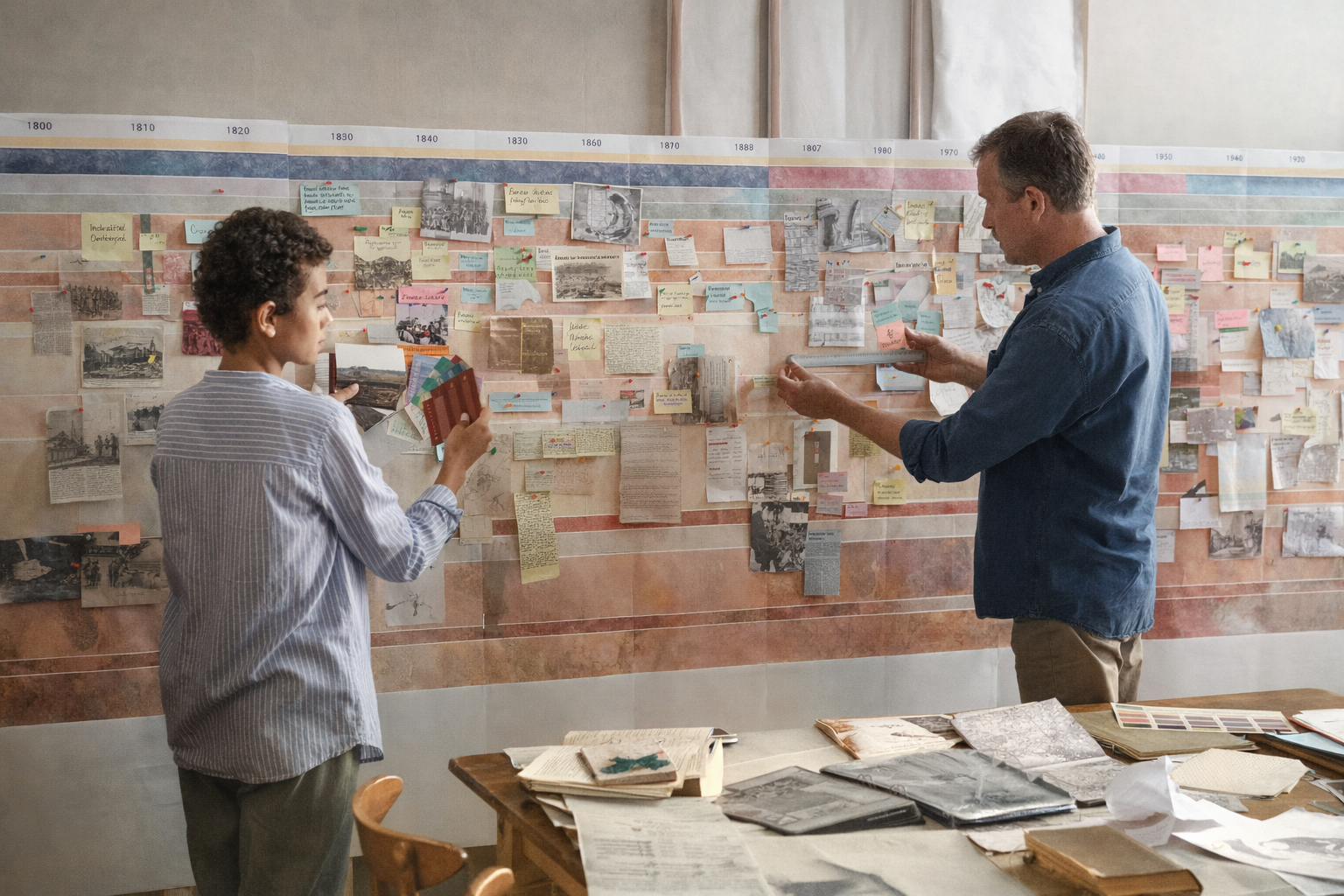
Timelines are powerful tools for summarizing historical change, connecting events across time, and highlighting long-term trends that might otherwise remain hidden. They must balance event density with readability so that viewers can follow sequences, retain a sense of causality, and avoid becoming overwhelmed by minutiae. Effective timelines establish clear priorities, using scale, layout, and typographic choices to guide attention toward significant patterns and reveal recurring themes. Choosing an appropriate scope and level of detail helps preserve narrative coherence while supporting different user goals and permitting meaningful nuance.

Define scope and audience

Start by defining the timeline’s purpose: educational overview, research reference, or public exhibition with interactive features to explore complexity. Identify the target audience and tailor terminology, granularity, and visual complexity accordingly, taking into account prior knowledge and likely questions from users. Decide on temporal boundaries and whether the timeline emphasizes individual dates, durations, thematic arcs, or comparative timelines that run in parallel. A clear scope prevents clutter, supports prioritized storytelling, and makes subsequent design decisions easier to justify to collaborators.

Prototype different scopes with short annotated examples to see how patterns appear at varying scales. Early testing with representative readers reveals whether the chosen level of detail supports comprehension and fulfills the project’s goals.

Establish visual hierarchy and scale

Visual hierarchy lets viewers scan quickly and then dive deeper into relevant segments; use size, weight, color, and placement to differentiate primary events from supporting items and reserve stronger contrast for focal points. Select a temporal scale that matches the narrative: too compressed a scale flattens causality, while too expanded a scale creates spurious gaps and reduces comparative clarity. Group related items into lanes or bands to separate chronological flow from thematic threads, and apply consistent spacing and typographic rhythm to maintain legibility across dense sequences. Consider interactive affordances that allow secondary layers to appear on demand, preserving initial clarity while offering depth for curious users.

Use legends, consistent markers, and typographic conventions to encode significance without overwhelming the main line. Thoughtful default views that reveal a clear pattern help audiences orient before they explore additional details.

Context, sources, and interpretive notes

Context transforms lists into narratives: brief captions, maps, and explanatory notes help viewers understand significance, relationships, and long-term consequences rather than just chronology. Cite sources clearly and indicate uncertainty where dates or attributions are contested to build trust and encourage further inquiry, particularly for timelines used in educational or research settings. Provide links or references to archival materials, digitized documents, or bibliographic entries so motivated users can investigate primary evidence and differing interpretations. Balancing narrative voice with evidentiary transparency strengthens both accuracy and engagement.

Include a concise source panel or methodology note that explains selection criteria without interrupting the main flow. Clear documentation supports reuse and invites community feedback for ongoing improvement.

Conclusion

Designing an effective historical timeline requires deliberate choices about scope, visual hierarchy, and transparent sourcing to balance depth with clarity. Iterative testing with representative users and gradual refinement ensure the timeline communicates major patterns while allowing access to richer detail. When well designed, timelines reveal connections, support interpretation, and invite ongoing exploration by diverse audiences.


Previous Post

Design Principles for Readable and Engaging Historical Timelines

Next Post

Neighborhood Routines and Material Culture in Market Towns

Related Posts

Design Principles for Readable and Engaging Historical Timelines
Timeline

Design Principles for Readable and Engaging Historical Timelines

March 7, 2026
Designing Effective Chronologies for Online History Projects
Timeline

Designing Effective Chronologies for Online History Projects

March 2, 2026
Constructing Accurate Historical Timelines for Clear Understanding
Timeline

Constructing Accurate Historical Timelines for Clear Understanding

March 2, 2026
The Changing Paths of Human Communication Over Centuries
Timeline

The Changing Paths of Human Communication Over Centuries

February 25, 2026
Next Post
Neighborhood Routines and Material Culture in Market Towns

Neighborhood Routines and Material Culture in Market Towns

Search..

No Result
View All Result

Recent Articles

Crafting Thoughtful, Balanced Biographical Narratives That Respect Sources

Crafting Thoughtful, Balanced Biographical Narratives That Respect Sources

March 9, 2026
Tracing Lives Through Sources: A Practical Biographical Guide

Tracing Lives Through Sources: A Practical Biographical Guide

March 9, 2026
Markets, Memory, and Mobility in Small Historic Towns

Markets, Memory, and Mobility in Small Historic Towns

March 8, 2026
Neighborhood Routines and Material Culture in Market Towns

Neighborhood Routines and Material Culture in Market Towns

March 8, 2026
Balancing Detail and Clarity in Historical Timeline Design

Balancing Detail and Clarity in Historical Timeline Design

March 7, 2026

Subscribe Us

By clicking submit, I authorize History Ours and its affiliated companies to: (1) use, sell, and share my information for marketing purposes, including cross-context behavioral advertising, as described in our Terms of Service and Privacy Policy, (2) supplement the information that I provide with additional information lawfully obtained from other sources, like demographic data from public sources, interests inferred from web page views, or other data relevant to what might interest me, like past purchase or location data, (3) contact me or enable others to contact me by email with offers for goods and services from any category at the email address provided, and (4) retain my information while I am engaging with marketing messages that I receive and for a reasonable amount of time thereafter. I understand I can opt out at any time through an email that I receive, or by clicking here

Subscribe To Our Newsletter

By clicking submit, I authorize History Ours and its affiliated companies to: (1) use, sell, and share my information for marketing purposes, including cross-context behavioral advertising, as described in our Terms of Service and Privacy Policy, (2) supplement the information that I provide with additional information lawfully obtained from other sources, like demographic data from public sources, interests inferred from web page views, or other data relevant to what might interest me, like past purchase or location data, (3) contact me or enable others to contact me by email with offers for goods and services from any category at the email address provided, and (4) retain my information while I am engaging with marketing messages that I receive and for a reasonable amount of time thereafter. I understand I can opt out at any time through an email that I receive, or by clicking here.

© 2026 History Ours | All Rights Reserved

  • Contact Us
  • Privacy Policy
  • Terms of Service
  • Unsubscribe
  • Privacy Choices
  • Contact Us
  • Privacy Policy
  • Terms of Service
  • Unsubscribe
  • Privacy Choices

© 2026 History Ours | All Rights Reserved

No Result
View All Result
  • Home
  • History
  • Biographies
  • Eras
  • Regions
  • Timeline

© 2026 History Ours | All Rights Reserved

Skip to content
Open toolbar Accessibility Tools

Accessibility Tools

  • Increase TextIncrease Text
  • Decrease TextDecrease Text
  • GrayscaleGrayscale
  • High ContrastHigh Contrast
  • Negative ContrastNegative Contrast
  • Light BackgroundLight Background
  • Links UnderlineLinks Underline
  • Readable FontReadable Font
  • Reset Reset