Uncover History’s Secrets with Daily Updates!
Daily News Entertainment
  • Home
  • History
  • Biographies
  • Eras
  • Regions
  • Timeline
No Result
View All Result
History Ours
  • Home
  • History
  • Biographies
  • Eras
  • Regions
  • Timeline
No Result
View All Result
History Ours
No Result
View All Result
Home Timeline

Curating Time: Selecting Threads and Scales for Exhibits

in Timeline
Curating Time: Selecting Threads and Scales for Exhibits

Choosing how to represent time is one of the most consequential decisions when building a public history timeline. A clear curatorial thread and a deliberate choice of scale help visitors move from isolated facts to a coherent narrative. Balancing thematic focus with representative detail allows timelines to both inform and invite inquiry. This piece lays out practical approaches to selecting threads and scales that serve diverse audiences.

Clarify the central thread

Begin by naming the single narrative or question the timeline will foreground, whether cultural change, technological adoption, or institutional development. A focused thread provides direction for selecting events and avoids overwhelming visitors with undifferentiated dates. Choose a thread that can be supported by accessible documents, objects, or testimonies so claims on the timeline remain verifiable. Keep that thread visible in labels and introductory copy so readers consistently recognize the connecting idea.

Keeping a clear thread also helps collaborators decide what to include. It guides research priorities and ensures interpretive coherence across the timeline.

Choose scale to match your story

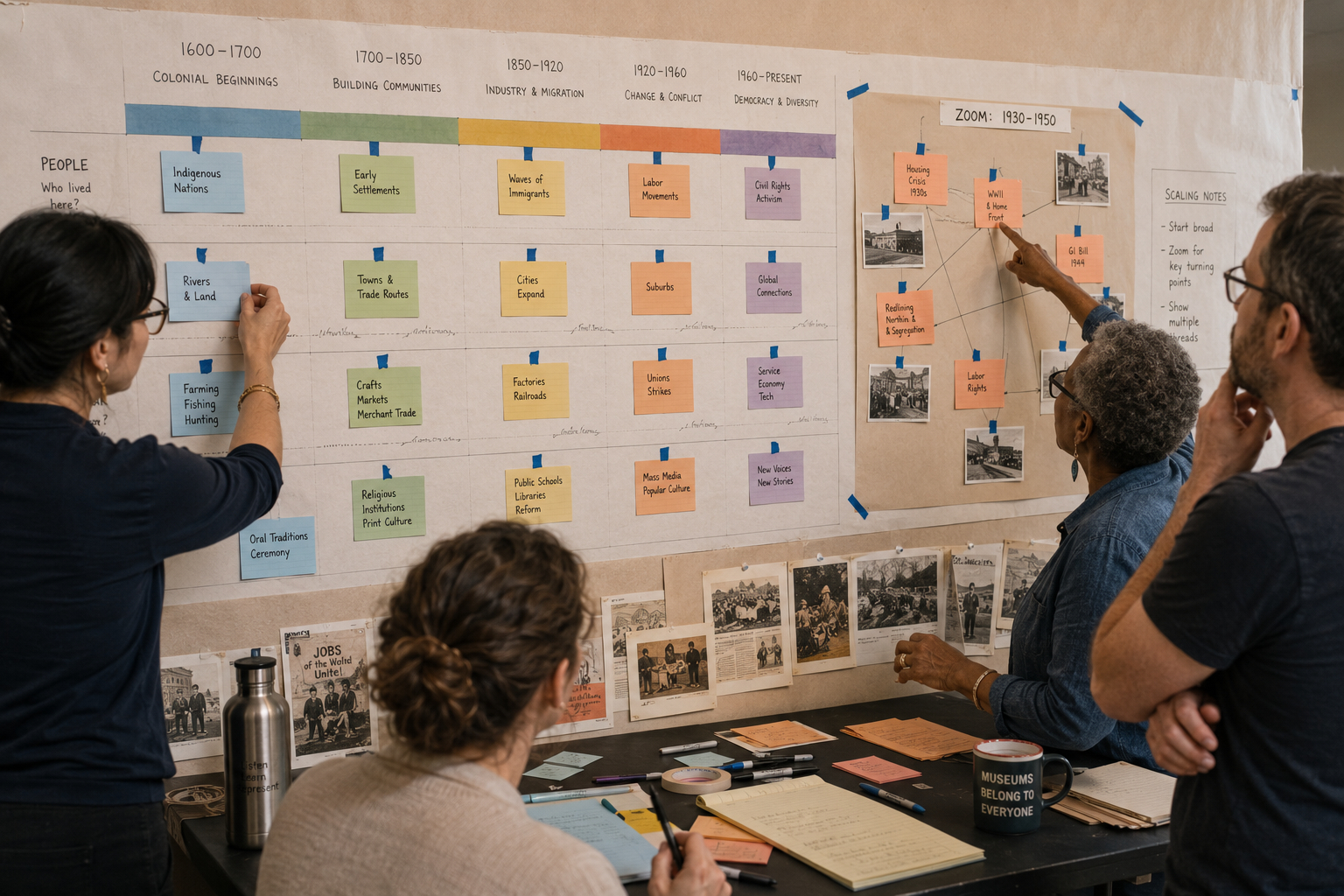
Scale determines the rhythm of a timeline: decade-by-decade presentations suit long-term trends, while year-by-year layouts work for rapid developments. Think about temporal scope alongside spatial or social scale; a local political reform might need narrow dates but deeper contextual entries. Consider layering scales—overview bands for long arcs with zoomed panels for pivotal moments. This layered approach preserves both macro patterns and microdetails without crowding the main display.

Selecting scale deliberately also sets visitor expectations about pacing and depth. Use captions to signal shifts between broad patterns and focused episodes.

Prioritize representative events, not exhaustive lists

Resist the urge to add every documented date; select events that illustrate your thread and reflect diverse perspectives. Include counterpoints and moments of contestation to avoid a one-sided narrative, and annotate entries with sources or brief context. Where appropriate, use visual hierarchy—size, color, or placement—to distinguish turning points from supporting details. This keeps the timeline readable while honoring complexity.

Prioritization makes timelines more useful for orientation and further study. It also creates space for visitors to notice patterns rather than skim a list.

Prototype, test, and iterate with audiences

Build low-fidelity mockups and test them with representative users, including people unfamiliar with the topic. Observe what visitors notice first, where they hesitate, and which entries spark questions. Use those observations to adjust pacing, labeling, and the balance between text and visual elements. Iteration often reveals that small edits improve comprehension more than additional content does.

Testing ensures the timeline communicates as intended and reveals opportunities to add clarifying material. Revisions based on feedback strengthen both accuracy and accessibility.

Conclusion

Curating time requires firm choices about narrative thread and temporal scale. Intentional selection and user testing help timelines convey meaning without overwhelming readers. Thoughtful design invites sustained engagement and encourages further exploration.


Previous Post

Anchoring Regions: Everyday Places and Collective Memory

Next Post

Strategic Timeline Design for Connected Historical Narratives

Related Posts

How the Black Death Spread Across Europe, 1347–1351
Timeline

How the Black Death Spread Across Europe, 1347–1351

October 28, 2026
The Great Stink of 1858: How London Smell Rebuilt Itself
Timeline

The Great Stink of 1858: How London Smell Rebuilt Itself

October 28, 2026
A Timeline of the Dutch Golden Age and the VOC
Timeline

A Timeline of the Dutch Golden Age and the VOC

October 23, 2026
The Printing Press: A Timeline from Gutenberg to Mass Media
Timeline

The Printing Press: A Timeline from Gutenberg to Mass Media

October 23, 2026
Next Post
Strategic Timeline Design for Connected Historical Narratives

Strategic Timeline Design for Connected Historical Narratives

Search..

No Result
View All Result

Recent Articles

The Salon Era: How Conversation Shaped the Enlightenment

The Salon Era: How Conversation Shaped the Enlightenment

October 31, 2026
Tenement New York: Life in Vertical Slums, 1870–1910

Tenement New York: Life in Vertical Slums, 1870–1910

October 31, 2026
Mary Seacole: The Jamaican Nurse Who Went to War

Mary Seacole: The Jamaican Nurse Who Went to War

October 30, 2026
Ada Lovelace: The Poet Who Helped Imagine Modern Computers

Ada Lovelace: The Poet Who Helped Imagine Modern Computers

October 30, 2026
John Snow, the Broad Street Pump, and Cholera’s Fall

John Snow, the Broad Street Pump, and Cholera’s Fall

October 29, 2026

Subscribe Us

By clicking submit, I authorize History Ours and its affiliated companies to: (1) use, sell, and share my information for marketing purposes, including cross-context behavioral advertising, as described in our Terms of Service and Privacy Policy, (2) supplement the information that I provide with additional information lawfully obtained from other sources, like demographic data from public sources, interests inferred from web page views, or other data relevant to what might interest me, like past purchase or location data, (3) contact me or enable others to contact me by email with offers for goods and services from any category at the email address provided, and (4) retain my information while I am engaging with marketing messages that I receive and for a reasonable amount of time thereafter. I understand I can opt out at any time through an email that I receive, or by clicking here

Subscribe To Our Newsletter

By clicking submit, I authorize History Ours and its affiliated companies to: (1) use, sell, and share my information for marketing purposes, including cross-context behavioral advertising, as described in our Terms of Service and Privacy Policy, (2) supplement the information that I provide with additional information lawfully obtained from other sources, like demographic data from public sources, interests inferred from web page views, or other data relevant to what might interest me, like past purchase or location data, (3) contact me or enable others to contact me by email with offers for goods and services from any category at the email address provided, and (4) retain my information while I am engaging with marketing messages that I receive and for a reasonable amount of time thereafter. I understand I can opt out at any time through an email that I receive, or by clicking here.

© 2026 History Ours | All Rights Reserved

  • Contact Us
  • Privacy Policy
  • Terms of Service
  • Unsubscribe
  • Privacy Choices
  • Contact Us
  • Privacy Policy
  • Terms of Service
  • Unsubscribe
  • Privacy Choices

© 2026 History Ours | All Rights Reserved

No Result
View All Result
  • Home
  • History
  • Biographies
  • Eras
  • Regions
  • Timeline

© 2026 History Ours | All Rights Reserved

Skip to content
Open toolbar Accessibility Tools

Accessibility Tools

  • Increase TextIncrease Text
  • Decrease TextDecrease Text
  • GrayscaleGrayscale
  • High ContrastHigh Contrast
  • Negative ContrastNegative Contrast
  • Light BackgroundLight Background
  • Links UnderlineLinks Underline
  • Readable FontReadable Font
  • Reset Reset