Uncover History’s Secrets with Daily Updates!
Daily News Entertainment
  • Home
  • History
  • Biographies
  • Eras
  • Regions
  • Timeline
No Result
View All Result
History Ours
  • Home
  • History
  • Biographies
  • Eras
  • Regions
  • Timeline
No Result
View All Result
History Ours
No Result
View All Result
Home Timeline

The Erie Canal: A Waterway That Built New York

in Timeline
The Erie Canal: A Waterway That Built New York

In the early 19th century, moving goods from the American interior to the Atlantic was slow, expensive, and brutal on roads. New York’s solution was audacious: stretch a man-made river across the state to link the Hudson River with Lake Erie. The idea was championed by Governor DeWitt Clinton, mocked at first as “Clinton’s Folly,” but it answered a concrete political and economic question — how to make New York City the trade hub for the growing trans-Appalachian West.

Digging, dikes, and the “Wedding of the Waters”

Construction began in 1817. Engineers and laborers—recent immigrants, local farmers, and hired hands—cut through swamps and rock by hand, using horse-drawn scrapers and black-powder blasting. The original Erie Canal stretched about 363 miles from Albany to Buffalo, was roughly 4 feet deep and 40 feet wide at the top (narrower at the bottom), and required 83 locks to climb and descend the state’s changing elevations.

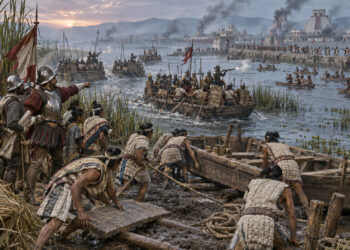
The project cost New York state around $7 million and was financed by public bonds. When the canal formally opened on October 26, 1825, DeWitt Clinton took part in a symbolic “Wedding of the Waters,” ceremonially mixing a cask of Atlantic water with Lake Erie to mark the new connection between ocean and inland lake.

From small boats to booming cities

The canal did what it promised. By providing a cheaper, steadier route, it transformed the economics of transport: by some accounts the cost to ship a ton of freight from Buffalo to New York City fell from roughly $100 to about $10. That collapse in costs made western grain and raw materials competitive on world markets and sent settlers, mills, and merchants following the canal’s path.

Communities along the waterway shot up into cities. Rochester grew as a milling center, Syracuse as a salt and manufacturing hub, and Buffalo became a major transshipment point on the lake. New York City surged ahead of Philadelphia and Baltimore to become the nation’s leading port—its rise directly tied to the canal’s flow of goods.

The Erie also provoked a canal-building craze across the young United States and spurred improvements in civil engineering: aqueducts, lock designs, and coordinated state financing all matured faster because of the project.

Conclusion

The Erie Canal was both simple and revolutionary: a narrow ribbon of fresh water that rewrote trade routes, built cities, and reshaped a region. It arrived before railroads dominated and remained a backbone for decades, enlarged and maintained as the state’s needs changed. Today, traces of that original 1817–1825 work survive in parks, preserved locks, and place names—reminders that sometimes the most consequential infrastructure begins as a stubborn, improbable ditch in the ground.
Previous Post

The Trent Affair: How a Diplomatic Snag Nearly Brought Britain In

Next Post

Isabella Stewart Gardner: Boston’s Provocative Collector and Her Museum

Related Posts

Tenochtitlan’s Fall: A Timeline of 1519–1521 Siege
Timeline

Tenochtitlan’s Fall: A Timeline of 1519–1521 Siege

November 17, 2026
Solving Longitude: The Clock, the Prize, and the Sea
Timeline

Solving Longitude: The Clock, the Prize, and the Sea

November 17, 2026
When London Went Dark: The Great Smog Timeline
Timeline

When London Went Dark: The Great Smog Timeline

November 12, 2026
How London Burned: A Four-Day Timeline of 1666
Timeline

How London Burned: A Four-Day Timeline of 1666

November 12, 2026
Next Post
Isabella Stewart Gardner: Boston’s Provocative Collector and Her Museum

Isabella Stewart Gardner: Boston’s Provocative Collector and Her Museum

Search..

No Result
View All Result

Recent Articles

Isabella Stewart Gardner: Boston’s Provocative Collector and Her Museum

Isabella Stewart Gardner: Boston’s Provocative Collector and Her Museum

November 22, 2026
The Erie Canal: A Waterway That Built New York

The Erie Canal: A Waterway That Built New York

November 22, 2026
The Trent Affair: How a Diplomatic Snag Nearly Brought Britain In

The Trent Affair: How a Diplomatic Snag Nearly Brought Britain In

November 21, 2026
After the Quake: How 1755 Lisbon Reshaped an Empire

After the Quake: How 1755 Lisbon Reshaped an Empire

November 21, 2026
The Jazz Age: Sound, Speakeasies, and Urban Style

The Jazz Age: Sound, Speakeasies, and Urban Style

November 20, 2026

Subscribe Us

By clicking submit, I authorize History Ours and its affiliated companies to: (1) use, sell, and share my information for marketing purposes, including cross-context behavioral advertising, as described in our Terms of Service and Privacy Policy, (2) supplement the information that I provide with additional information lawfully obtained from other sources, like demographic data from public sources, interests inferred from web page views, or other data relevant to what might interest me, like past purchase or location data, (3) contact me or enable others to contact me by email with offers for goods and services from any category at the email address provided, and (4) retain my information while I am engaging with marketing messages that I receive and for a reasonable amount of time thereafter. I understand I can opt out at any time through an email that I receive, or by clicking here

Subscribe To Our Newsletter

By clicking submit, I authorize History Ours and its affiliated companies to: (1) use, sell, and share my information for marketing purposes, including cross-context behavioral advertising, as described in our Terms of Service and Privacy Policy, (2) supplement the information that I provide with additional information lawfully obtained from other sources, like demographic data from public sources, interests inferred from web page views, or other data relevant to what might interest me, like past purchase or location data, (3) contact me or enable others to contact me by email with offers for goods and services from any category at the email address provided, and (4) retain my information while I am engaging with marketing messages that I receive and for a reasonable amount of time thereafter. I understand I can opt out at any time through an email that I receive, or by clicking here.

© 2026 History Ours | All Rights Reserved

  • Contact Us
  • Privacy Policy
  • Terms of Service
  • Unsubscribe
  • Privacy Choices
  • Contact Us
  • Privacy Policy
  • Terms of Service
  • Unsubscribe
  • Privacy Choices

© 2026 History Ours | All Rights Reserved

No Result
View All Result
  • Home
  • History
  • Biographies
  • Eras
  • Regions
  • Timeline

© 2026 History Ours | All Rights Reserved

Skip to content
Open toolbar Accessibility Tools

Accessibility Tools

  • Increase TextIncrease Text
  • Decrease TextDecrease Text
  • GrayscaleGrayscale
  • High ContrastHigh Contrast
  • Negative ContrastNegative Contrast
  • Light BackgroundLight Background
  • Links UnderlineLinks Underline
  • Readable FontReadable Font
  • Reset Reset