
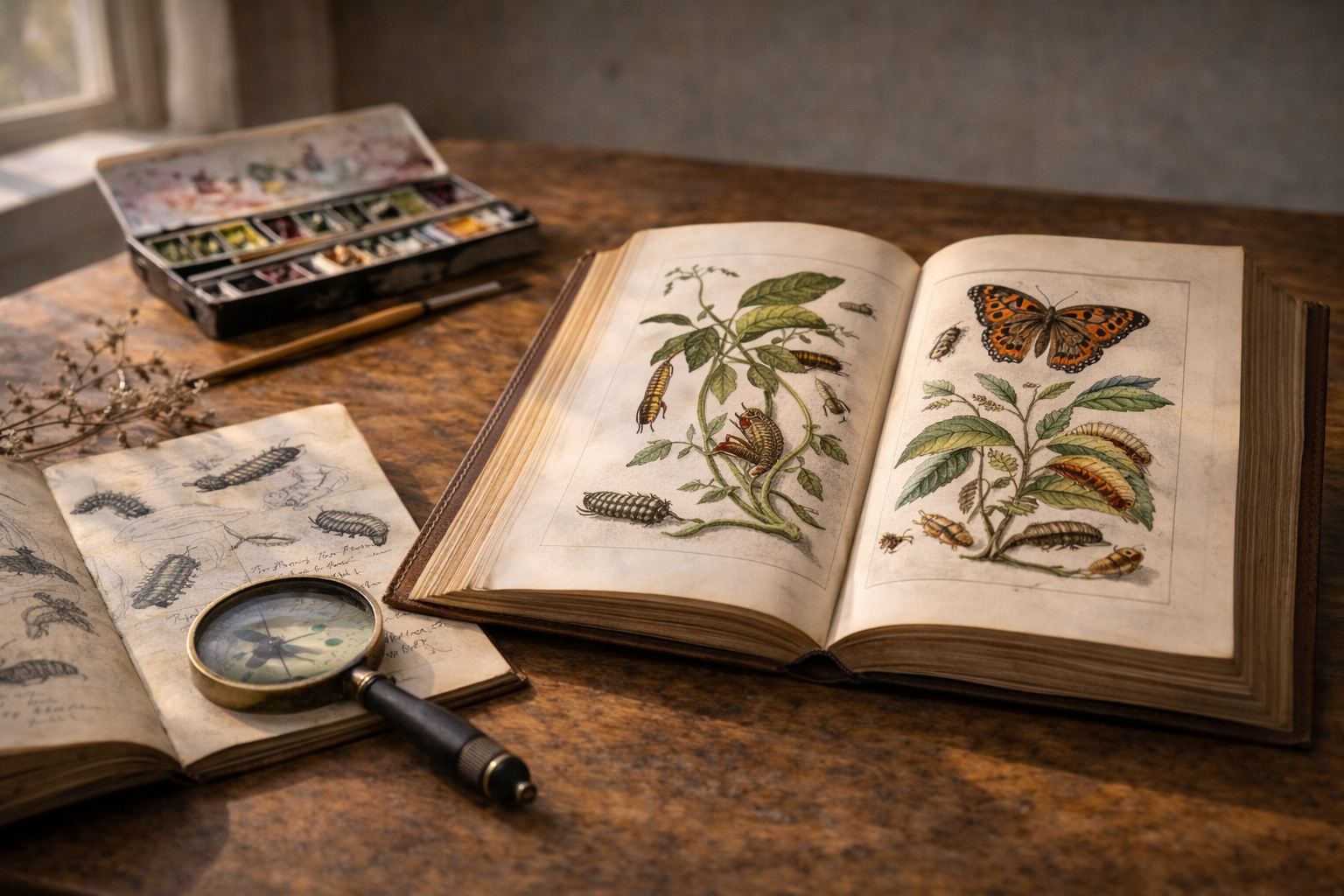
Maria Sibylla Merian combined careful observation with skilled illustration to change how people saw insects.
Trained in a family of painters, she turned an artisanal talent into systematic study of life cycles and metamorphosis.
Her books of engraved plates showed insects alongside their host plants, emphasizing relationships and development rather than isolated specimens.
This article examines her formative years, field practice, techniques, and the influence her work exerted on natural history.
Early life and curiosity
Merian grew up surrounded by painters and engravers, learning workshop techniques while cultivating a special interest in caterpillars and butterflies. Her curiosity was practical: she raised insects from egg to adult to document their stages rather than simply classify them by appearance. This hands-on approach set her apart from many contemporaries who relied on dead specimens and secondhand reports. She developed an observational discipline that combined art and inquiry, making observation itself a method.
Field journeys and observation
In adulthood she undertook extended fieldwork, spending months in tropical habitats to observe species in situ and record host plant associations. Rather than collecting only rare specimens, she focused on life histories, noting behavior, food sources, and seasonal timing. Her notebooks contained sketches, color notes, and ecological remarks that informed later engraved publications. These journeys reinforced her conviction that accurate representation required observing organisms in their context.
Artistic methods and publication
Merian translated field observations into engraved plates and hand-colored prints, insisting on accuracy while preserving aesthetic clarity. Her compositions typically pair an insect at several life stages with the plant it eats, labeled carefully to guide readers toward ecological insight.
– She used direct sketches from living subjects, avoiding fantastical embellishments common in some earlier prints.
– Her engravings balanced scientific detail with compositional harmony to appeal to both collectors and scholars.
After publication, these images circulated widely and were praised for their clarity and pedagogical value. Her methods helped bridge artistic practice and empirical science in printed form.
Scientific legacy and influence
Though not trained in formal scientific networks of her time, Merian influenced both artists and naturalists by modeling rigorous field observation and documentation. Her plates provided reliable evidence for metamorphosis and plant-insect relationships, contributing to later ecological and entomological studies. Collectors and scholars prized her work for its combination of beauty and empirical content, and modern historians view her as a pioneer of ecological illustration. Her example encouraged others to prioritize observation over received wisdom.
Conclusion
Merian stands as an important figure in the history of natural history because she united artistic skill with empirical observation.
Her work shifted attention toward life cycles and ecological connections and broadened how nature could be studied and represented.
By presenting organisms in context, she left a legacy that continues to inform both art and science.