
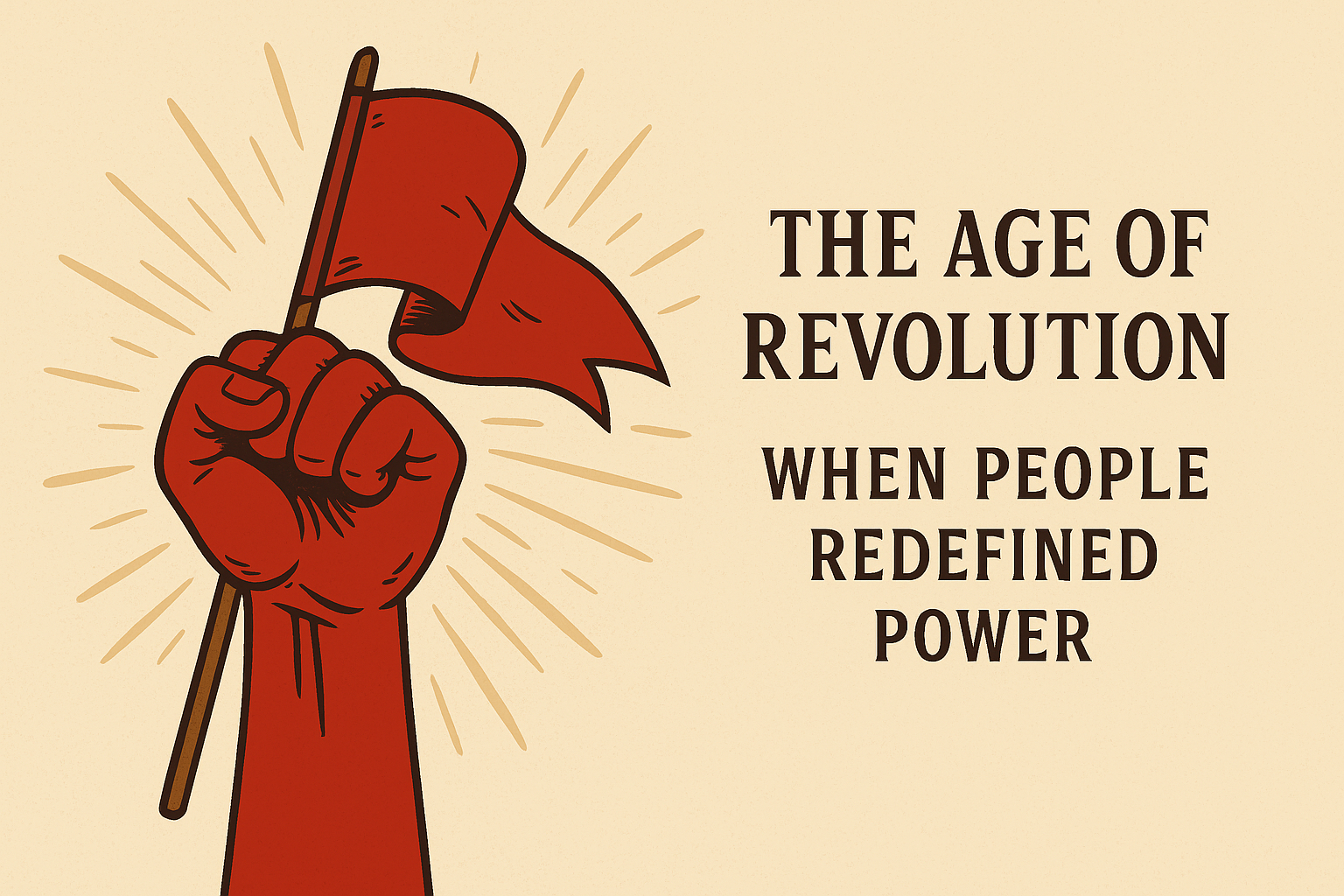
The Age of Revolution marked a turning point in human history—a time when ordinary people challenged monarchs, empires, and centuries of inequality. Spanning from the late 18th to the 19th century, this era reshaped nations, economies, and ideas about freedom and governance, laying the foundation for the modern world.
The Spark of Change
The Enlightenment planted the seeds of revolution. Thinkers like John Locke and Jean-Jacques Rousseau introduced radical ideas about liberty, equality, and the rights of individuals. These philosophies inspired citizens to question absolute rule and demand governments that represented their voices. The American Revolution (1775–1783) and the French Revolution (1789–1799) became powerful examples of how ideas could ignite transformation.
Global Waves of Rebellion
Revolutionary spirit spread far beyond Europe and the Americas. In Haiti, enslaved people rose up against colonial rule, forming the first independent Black republic. Across Latin America, leaders like Simón Bolívar and José de San Martín led independence movements that broke centuries of European domination. The Industrial Revolution, too, became part of this age of upheaval—revolutionizing labor, technology, and the structure of society itself.
The Redefinition of Power
What truly defined this era was the shift in where power came from. Instead of divine right or hereditary privilege, power began to derive from the people. Constitutions, representative governments, and declarations of rights replaced monarchs’ decrees. This new worldview forever altered how humanity viewed justice, authority, and participation in governance.
Legacy of the Revolution
Though the Age of Revolution brought turmoil, its legacy is one of progress. It paved the way for democracy, human rights, and the idea that every individual could shape the future. The echoes of that revolutionary spirit continue to inspire movements for equality and justice across the globe today.
Conclusion
The Age of Revolution was not just a series of uprisings—it was a redefinition of humanity’s relationship with power. From royal palaces to crowded city streets, people stood up for the idea that freedom and equality belong to all. In doing so, they forever changed the world’s political and moral landscape.