

Uncover History’s Secrets with Daily Updates!
Daily News Entertainment
  • Home
  • History
  • Biographies
  • Eras
  • Regions
  • Timeline
No Result
View All Result
History Ours
  • Home
  • History
  • Biographies
  • Eras
  • Regions
  • Timeline
No Result
View All Result
History Ours
No Result
View All Result
Home History

Daily Routes and Hidden Economies of Market Town Streets

in History
Daily Routes and Hidden Economies of Market Town Streets

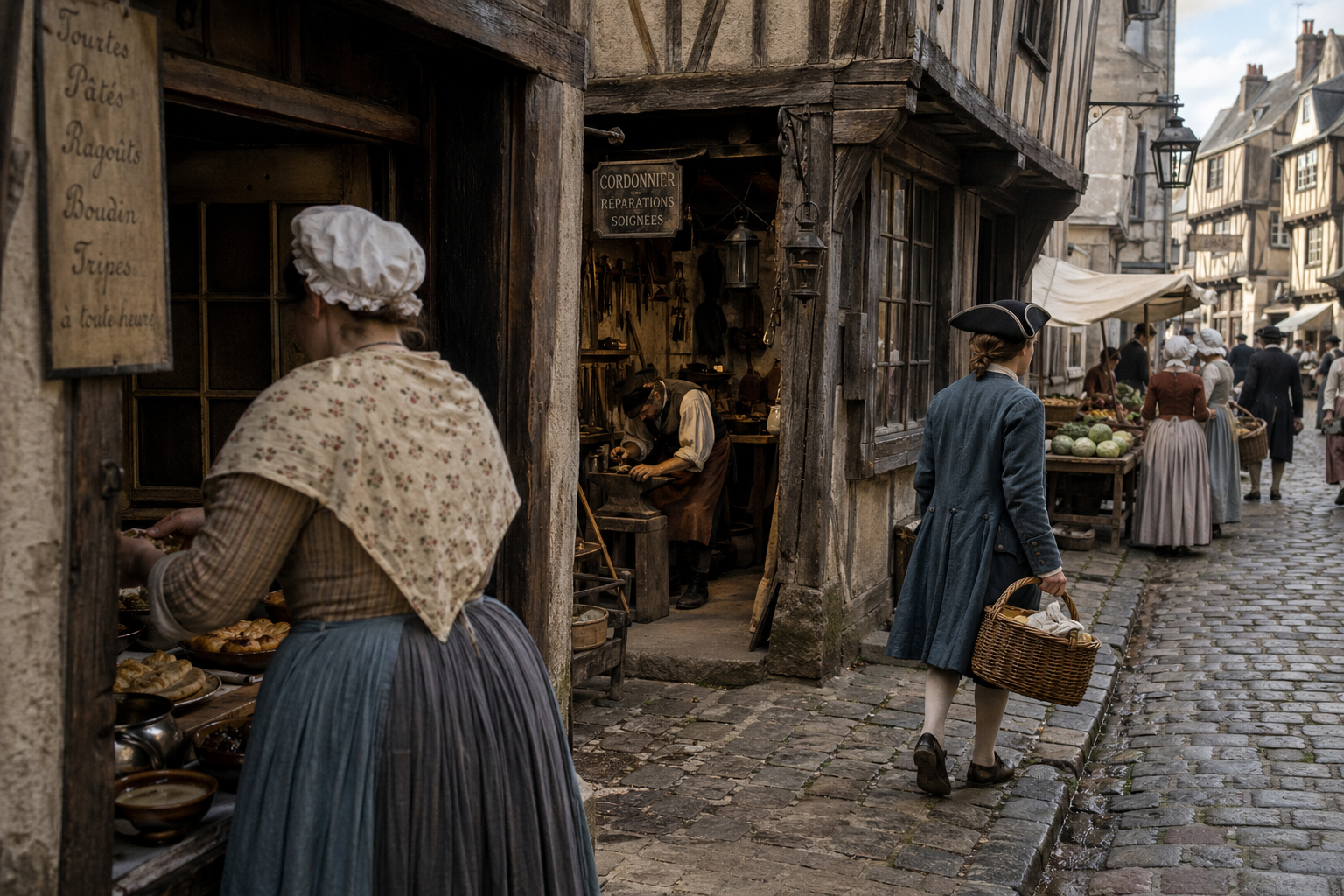
Market town streets were arteries of everyday life where people, goods and information flowed in patterned routes. Merchants, shoppers and service providers moved along the same lanes, creating predictable rhythms that structured work and leisure. These routes concealed informal trades, short-term exchanges and social obligations that rarely appear in official records. Reading streets as layered economic spaces reveals how ordinary mobility sustained broader urban systems.

Street Movement and Social Exchange

Daily routes linked homes to workshops, stalls and communal spaces, shaping who encountered whom and how often. Regular interactions at crossroads, alleyways and stall-fronts built reputations, facilitated credit and transmitted news. Movement patterns also reinforced class and gendered divisions of labor, as some lanes became known for particular trades while others hosted domestic errands. Attention to these flows helps explain how trust and obligation circulated beyond formal institutions.

Understanding movement requires tracing recurring journeys and the social ties they produced. Markets and thoroughfares functioned as meeting points where economic and social exchange blurred. Over time, these repeated contacts created durable networks that supported both survival and opportunity.

Everyday Commerce Beyond the Market

Not all exchange occurred at the official market square; much commerce took place in thresholds, backyards and doorways. Informal sales, barter arrangements and service work often operated in the shadows of regulated trade, relying on local knowledge and steady clientele. These hidden economies provided flexibility for households to manage risk and to supplement incomes during lean seasons. They also allowed new entrants to test products and build a customer base without heavy capital investment.

  • Household cooks selling prepared food at doorsteps.
  • Artisans offering bespoke repairs in alleyway workshops.
  • Small-scale lenders and credit networks operating through trusted neighbors.

These activities adapted to spatial constraints and legal frameworks, persisting in places where official oversight was limited. They reveal the ingenuity of residents in sustaining livelihoods within confined urban geographies.

Workplaces, Homes, and Overlapping Zones

In many towns, the line between workplace and home was porous, and daily routes stitched these zones together. Shopkeepers lived above their stalls, apprentices lodged with masters, and yards served as production sites, making streets the stage for continuous economic activity. This overlap generated micro-institutions—rules, customs and routines—that governed transactions and mediated disputes. It also meant that changes to street design or regulation could have outsized effects on household economies.

Examining these overlapping spaces highlights the embeddedness of economic life within social and spatial patterns. Policy or planning historians should account for these interdependencies when interpreting urban change.

Conclusion

Market town streets embodied layered economies where movement produced meaning and value.
Hidden exchanges and everyday routes sustained livelihoods and social ties across neighborhoods.
Recognizing these patterns enriches our understanding of historical urban life and resilience.


Previous Post

Planning Timeline Narratives to Illuminate Historical Change

Next Post

Boundaries of Belonging in Historic Market Communities

Related Posts

Anne Bonny: The Pirate Who Broke Rules and Expectations
History

Anne Bonny: The Pirate Who Broke Rules and Expectations

September 15, 2026
How the Crystal Palace Turned Glass and Iron into a Modern Stage
History

How the Crystal Palace Turned Glass and Iron into a Modern Stage

September 15, 2026
Mary Anning and the Coast That Revealed Lost Worlds
History

Mary Anning and the Coast That Revealed Lost Worlds

September 15, 2026
When Mount Pelée Erased Saint-Pierre, 1902
History

When Mount Pelée Erased Saint-Pierre, 1902

September 15, 2026
Next Post
Boundaries of Belonging in Historic Market Communities

Boundaries of Belonging in Historic Market Communities

Search..

No Result
View All Result

Recent Articles

How the Ruhr Became Germany’s Engine and Then Its Archive

How the Ruhr Became Germany’s Engine and Then Its Archive

September 17, 2026
Salt, Walls, and Ships: How Dalmatia Became a Maritime Frontier

Salt, Walls, and Ships: How Dalmatia Became a Maritime Frontier

September 17, 2026
Edo: Japan’s Urban Revolution of Lanterns and Printshops

Edo: Japan’s Urban Revolution of Lanterns and Printshops

September 16, 2026
How the Little Ice Age Changed Everyday Life in Europe

How the Little Ice Age Changed Everyday Life in Europe

September 16, 2026
The Disguise That Broke Chains: Ellen and William Craft

The Disguise That Broke Chains: Ellen and William Craft

September 15, 2026

Subscribe Us

By clicking submit, I authorize History Ours and its affiliated companies to: (1) use, sell, and share my information for marketing purposes, including cross-context behavioral advertising, as described in our Terms of Service and Privacy Policy, (2) supplement the information that I provide with additional information lawfully obtained from other sources, like demographic data from public sources, interests inferred from web page views, or other data relevant to what might interest me, like past purchase or location data, (3) contact me or enable others to contact me by email with offers for goods and services from any category at the email address provided, and (4) retain my information while I am engaging with marketing messages that I receive and for a reasonable amount of time thereafter. I understand I can opt out at any time through an email that I receive, or by clicking here

Subscribe To Our Newsletter

By clicking submit, I authorize History Ours and its affiliated companies to: (1) use, sell, and share my information for marketing purposes, including cross-context behavioral advertising, as described in our Terms of Service and Privacy Policy, (2) supplement the information that I provide with additional information lawfully obtained from other sources, like demographic data from public sources, interests inferred from web page views, or other data relevant to what might interest me, like past purchase or location data, (3) contact me or enable others to contact me by email with offers for goods and services from any category at the email address provided, and (4) retain my information while I am engaging with marketing messages that I receive and for a reasonable amount of time thereafter. I understand I can opt out at any time through an email that I receive, or by clicking here.

© 2026 History Ours | All Rights Reserved

  • Contact Us
  • Privacy Policy
  • Terms of Service
  • Unsubscribe
  • Privacy Choices
  • Contact Us
  • Privacy Policy
  • Terms of Service
  • Unsubscribe
  • Privacy Choices

© 2026 History Ours | All Rights Reserved

No Result
View All Result
  • Home
  • History
  • Biographies
  • Eras
  • Regions
  • Timeline

© 2026 History Ours | All Rights Reserved

Skip to content
Open toolbar Accessibility Tools

Accessibility Tools

  • Increase TextIncrease Text
  • Decrease TextDecrease Text
  • GrayscaleGrayscale
  • High ContrastHigh Contrast
  • Negative ContrastNegative Contrast
  • Light BackgroundLight Background
  • Links UnderlineLinks Underline
  • Readable FontReadable Font
  • Reset Reset