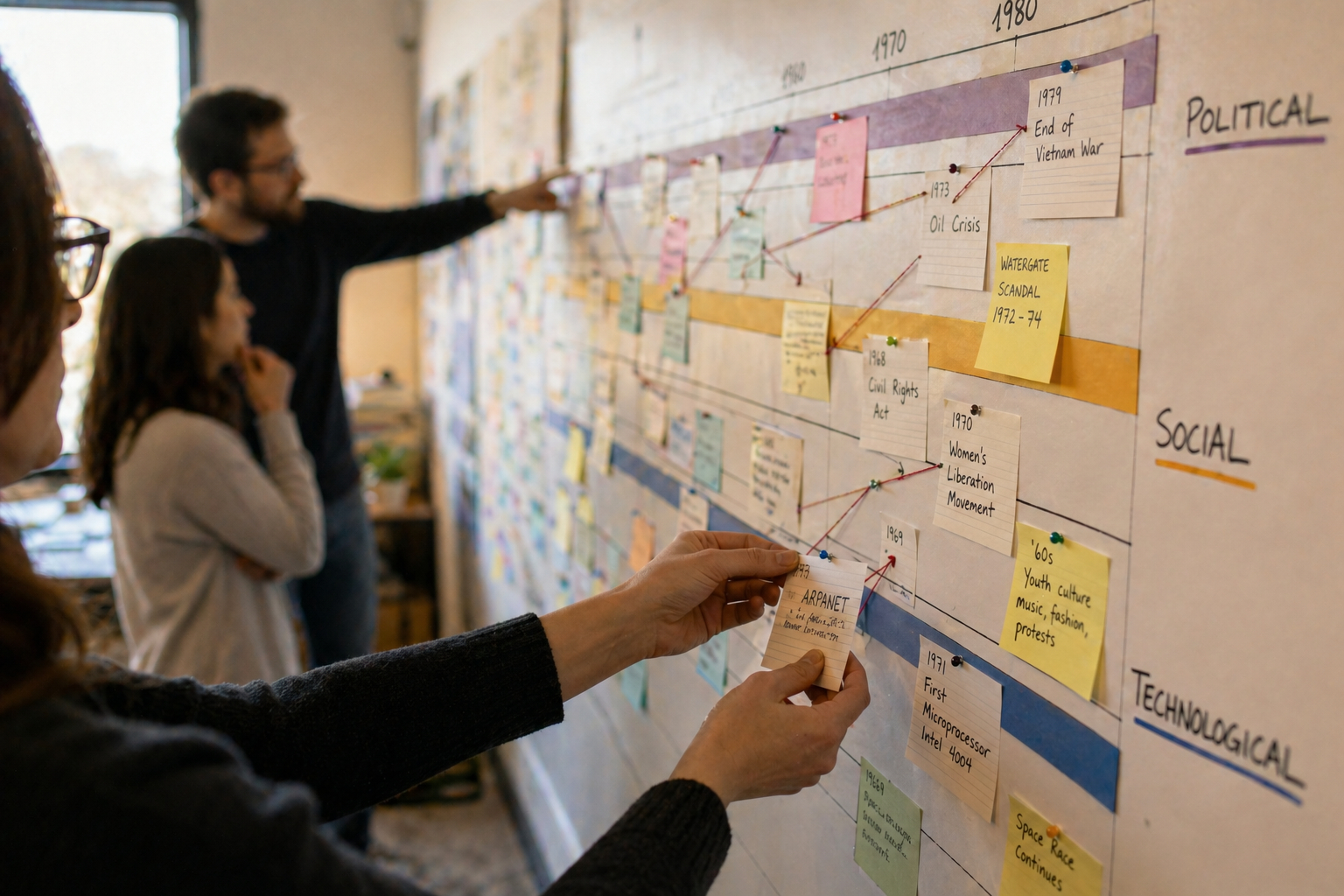
Timelines are tools for compressing years into readable sequences.
They guide audiences through causation, continuity, and turning points.
Good timeline narratives balance chronology with selective emphasis.
This piece outlines practical steps for planning layered public timelines.
Define scope and focal questions
Begin by clarifying the temporal span and the questions your timeline will answer. Identify the core themes—political change, social movements, technological shifts—and decide which events illuminate those threads. Limiting scope prevents overload and helps visitors grasp the narrative arc. Use research priorities to justify inclusion and exclusion of events.
Drafting focal questions also shapes labeling and interpretation choices. Be explicit about what the timeline intends to show so users can read it with the right expectations.
Establish visual hierarchy and scale
Visual design determines how audiences prioritize information on a timeline. Use scale to distinguish eras, larger markers for turning points, and color or weight to signal thematic categories. Typography and spacing guide scanning behavior and reduce cognitive load for complex sequences. A clear legend and consistent visual rules will keep the layout legible across sizes and platforms.
Test hierarchy with mockups and user feedback to ensure key events stand out without obscuring broader patterns. Adjust proportions to maintain readability at different viewing distances.
Layer context and thematic threads
Rather than a single linear row of dates, layer contextual information to reveal connections across time. Parallel tracks for political, economic, cultural, and local developments let readers compare trajectories. Brief contextual blurbs and links to deeper resources provide depth without crowding the main line. Grouping related items thematically makes cause-and-effect relationships more apparent.
Consider interactive or print-friendly variations that allow users to toggle layers. That flexibility helps diverse audiences explore the timeline at their preferred level of detail.
Maintain accuracy and interpretive transparency
Rigorous sourcing and clear attribution are essential for trustworthy timelines. Cite primary sources where possible and note contested dates or interpretations with concise annotations. Where uncertainty exists, use qualifiers and offer access to the supporting evidence. This approach protects credibility and invites critical engagement from informed viewers.
Regular review cycles and community consultation can surface gaps or biases. Treat the timeline as a living project that evolves as new research emerges.
Conclusion
Well-planned timelines combine selective scope, strong visual hierarchy, and layered context.
They make historical change intelligible without oversimplifying complexity.
Thoughtful sourcing and iterative testing keep them accurate and useful for public audiences.