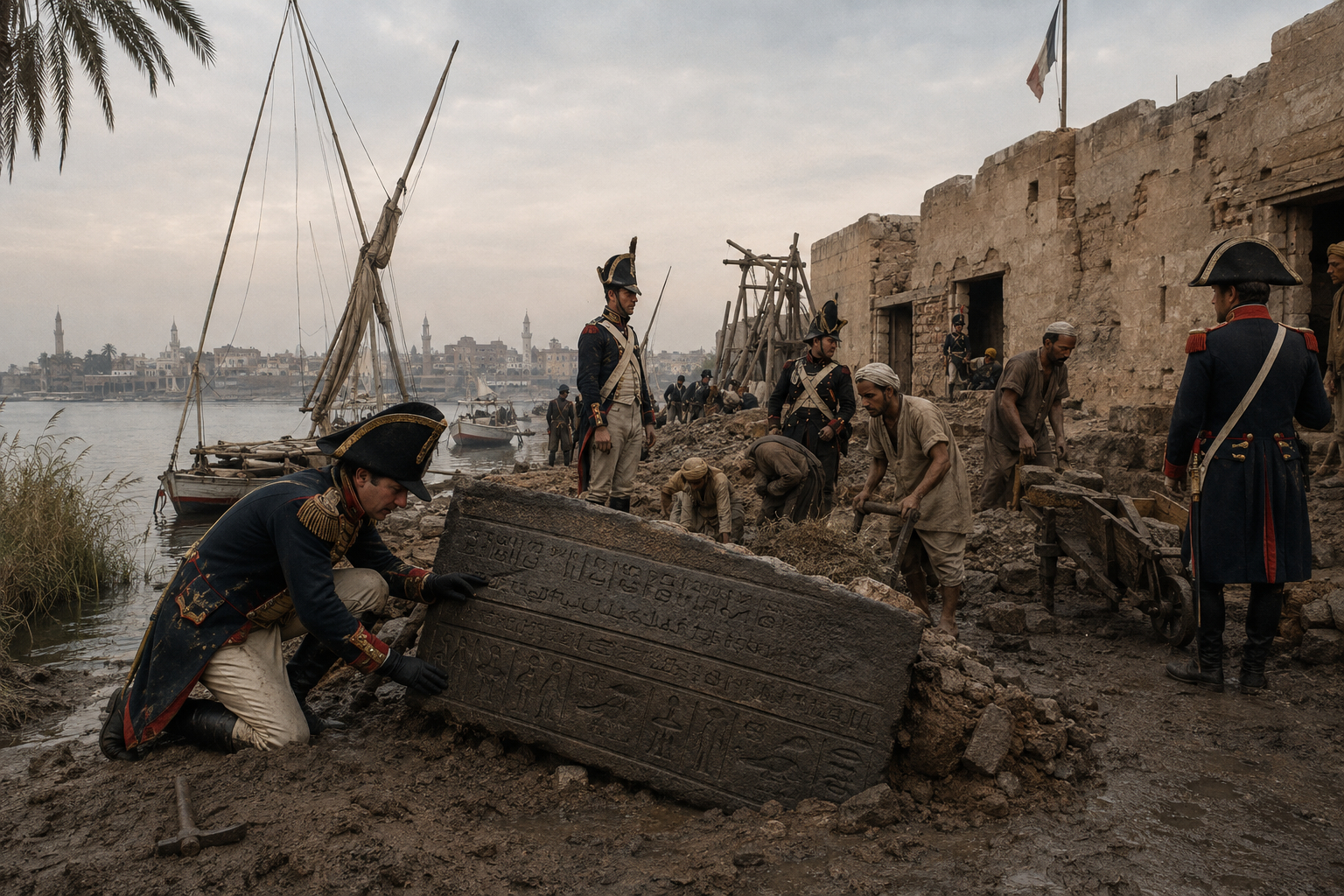
In 1799 a battered block of dark stone turned up not in a museum but on a muddy Nile bank, dug from the foundations of Fort Julien near the town of Rosetta (modern Rashid). The man who noticed it was Pierre-François Bouchard, a French army engineer serving with Napoleon’s Egyptian expedition. Carved across the stone were three scripts stacked one above another: classical Greek, a cursive Egyptian script later called demotic, and the pictorial signs we now call hieroglyphs.
At once the find felt like a key. Greek could be read, and that promised a bridge to the two Egyptian scripts no living person understood. The object’s practical origins—a reused slab in a fortification—belied the outsized role it would play in unlocking a five-thousand-year-old writing system.
Between empires: study and seizure (1801–1802)
Scholars among the French occupying force began copying the Greek text and studying the demotic. But the stone’s fate was determined by geopolitics. When French troops surrendered to British forces in Egypt in 1801, a clause in the terms of capitulation handed a trove of antiquities to the victors. The Rosetta Stone left Alexandria for London and went on display at the British Museum in 1802, where crowds and curiosity soon followed.
Its arrival in Britain changed the scale of the puzzle. Now multiple scholars, with access to the Greek inscription, could test hypotheses about how demotic and hieroglyphs worked. The stone itself would remain central to those attempts, even as researchers recognized its limitations: it was a single copy of one decree, not a grammar or bilingual textbook.
From educated guesses to a breakthrough (1814–1822)
Work on the Rosetta Stone unfolded in stages. In 1814 the English polymath Thomas Young showed that some hieroglyphs could represent sounds, not just ideas—a critical insight that began to erode the long-held view that hieroglyphs were purely symbolic. But it took a concerted leap by a French linguist, Jean-François Champollion, to assemble the evidence into a working system.
Champollion’s 1822 announcement did not arrive from a single stroke of genius but from years of painstaking comparison: cartouches names of rulers in hieroglyphic text with their Greek equivalents, analysis of demotic signs, and study of Coptic, the late descendant of ancient Egyptian. His work demonstrated that hieroglyphs combined phonetic and semantic elements—an approach that opened the language of temples and tombs to modern readers.
Conclusion
The Rosetta Stone’s story is both accidental and immense: a reused building block unearthed in a military campaign, transported by the politics of empire, then made world-changing by patient scholarship. It did not single-handedly decode an ancient civilization, but it gave scholars the foothold they needed to read Egypt’s own voice again. Standing in the British Museum today, the stone remains a compact, physical reminder that sometimes the past yields its secrets in the most unlikely places.