Uncover History’s Secrets with Daily Updates!
Daily News Entertainment
  • Home
  • History
  • Biographies
  • Eras
  • Regions
  • Timeline
No Result
View All Result
History Ours
  • Home
  • History
  • Biographies
  • Eras
  • Regions
  • Timeline
No Result
View All Result
History Ours
No Result
View All Result
Home History

Windows, Wells, and Walkways: Material Life in Market Towns

in History
Windows, Wells, and Walkways: Material Life in Market Towns

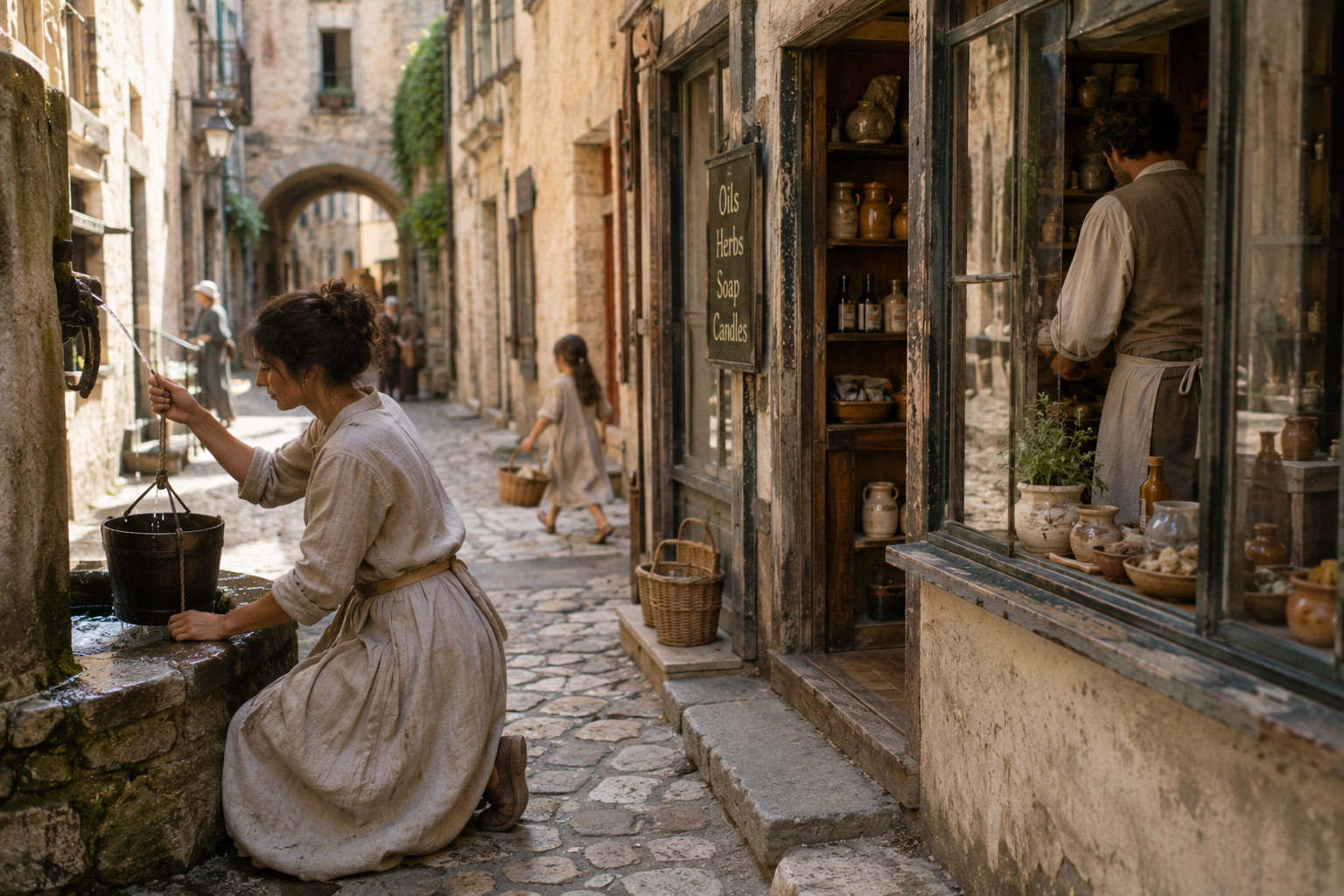
Everyday life in historic market towns was shaped as much by material features as by institutions.
Simple elements like windows, wells, and narrow walkways structured movement, attention, and social exchange.
These physical markers guided where people met, how goods circulated, and how residents claimed space.
Reading the built environment reveals patterns of work, neighborliness, and public order across ordinary days.

Material Markers of Daily Life

Windows and doorways were more than openings; they framed social interaction and regulated privacy.
Shopfront windows displayed goods and signaled availability, while domestic windows allowed glimpses into household routines.
Thresholds became stages for selling, chatting, and passing messages, so their location mattered to both trade and trust.
Architectural details also conveyed status, signaling which families or businesses held influence on a street.

Such material markers were durable traces that historians can read to understand routine behavior.
They shaped who stopped, shopped, or lingered in particular parts of town.

Movement and Social Interaction

Narrow passageways, alleys, and main streets channeled foot traffic in predictable flows that structured encounters.
Markets and crosses concentrated movement and created recurring meeting points for news, negotiation, and recreation.
These pathways also mediated social boundaries, making some interactions public and others more concealed.
Regular routes—commuter paths between home and workplace—produced habitual contact networks over time.

Understanding these routes helps explain how information, goods, and social obligations spread in town life.
Mobility patterns thus underpinned both economic resilience and community cohesion.

Domestic and Commercial Overlaps

Many buildings combined household and business functions, so domestic spaces doubled as sites of production and exchange.
Backrooms, courtyards, and wells supported household industries like brewing, tanning, or textile work.
Shared resources such as pumps and communal ovens required cooperative management and produced everyday interdependence.
This overlap blurred the line between private life and public commerce in practical, material ways.

Consequently, social relationships were often negotiated through daily tasks and shared obligations.
Material arrangements made community networks visible and manageable across ordinary routines.

Conclusion

Material elements—windows, wells, walkways—served as the persistent architecture of daily life.
They directed movement, framed exchanges, and created the textures of neighborhood interaction.
Reading these features offers a grounded way to reconstruct how historic towns functioned in practice.

Previous Post

Practical Principles for Crafting Public History Timelines

Next Post

Thresholds and Transitions: Home-Work Boundaries in Market Towns

Related Posts

Anne Bonny: The Pirate Who Broke Rules and Expectations
History

Anne Bonny: The Pirate Who Broke Rules and Expectations

September 15, 2026
How the Crystal Palace Turned Glass and Iron into a Modern Stage
History

How the Crystal Palace Turned Glass and Iron into a Modern Stage

September 15, 2026
Mary Anning and the Coast That Revealed Lost Worlds
History

Mary Anning and the Coast That Revealed Lost Worlds

September 15, 2026
When Mount Pelée Erased Saint-Pierre, 1902
History

When Mount Pelée Erased Saint-Pierre, 1902

September 15, 2026
Next Post
Thresholds and Transitions: Home-Work Boundaries in Market Towns

Thresholds and Transitions: Home-Work Boundaries in Market Towns

Search..

No Result
View All Result

Recent Articles

The Disguise That Broke Chains: Ellen and William Craft

The Disguise That Broke Chains: Ellen and William Craft

September 15, 2026
Bass Reeves: The Marshal Who Hunted Outlaws in Indian Territory

Bass Reeves: The Marshal Who Hunted Outlaws in Indian Territory

September 15, 2026
How the Crystal Palace Turned Glass and Iron into a Modern Stage

How the Crystal Palace Turned Glass and Iron into a Modern Stage

September 15, 2026
Anne Bonny: The Pirate Who Broke Rules and Expectations

Anne Bonny: The Pirate Who Broke Rules and Expectations

September 15, 2026
How Haiti Broke Its Chains: A 1791–1804 Timeline

How Haiti Broke Its Chains: A 1791–1804 Timeline

September 15, 2026

Subscribe Us

By clicking submit, I authorize History Ours and its affiliated companies to: (1) use, sell, and share my information for marketing purposes, including cross-context behavioral advertising, as described in our Terms of Service and Privacy Policy, (2) supplement the information that I provide with additional information lawfully obtained from other sources, like demographic data from public sources, interests inferred from web page views, or other data relevant to what might interest me, like past purchase or location data, (3) contact me or enable others to contact me by email with offers for goods and services from any category at the email address provided, and (4) retain my information while I am engaging with marketing messages that I receive and for a reasonable amount of time thereafter. I understand I can opt out at any time through an email that I receive, or by clicking here

Subscribe To Our Newsletter

By clicking submit, I authorize History Ours and its affiliated companies to: (1) use, sell, and share my information for marketing purposes, including cross-context behavioral advertising, as described in our Terms of Service and Privacy Policy, (2) supplement the information that I provide with additional information lawfully obtained from other sources, like demographic data from public sources, interests inferred from web page views, or other data relevant to what might interest me, like past purchase or location data, (3) contact me or enable others to contact me by email with offers for goods and services from any category at the email address provided, and (4) retain my information while I am engaging with marketing messages that I receive and for a reasonable amount of time thereafter. I understand I can opt out at any time through an email that I receive, or by clicking here.

© 2026 History Ours | All Rights Reserved

  • Contact Us
  • Privacy Policy
  • Terms of Service
  • Unsubscribe
  • Privacy Choices
  • Contact Us
  • Privacy Policy
  • Terms of Service
  • Unsubscribe
  • Privacy Choices

© 2026 History Ours | All Rights Reserved

No Result
View All Result
  • Home
  • History
  • Biographies
  • Eras
  • Regions
  • Timeline

© 2026 History Ours | All Rights Reserved

Skip to content
Open toolbar Accessibility Tools

Accessibility Tools

  • Increase TextIncrease Text
  • Decrease TextDecrease Text
  • GrayscaleGrayscale
  • High ContrastHigh Contrast
  • Negative ContrastNegative Contrast
  • Light BackgroundLight Background
  • Links UnderlineLinks Underline
  • Readable FontReadable Font
  • Reset Reset