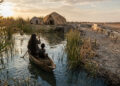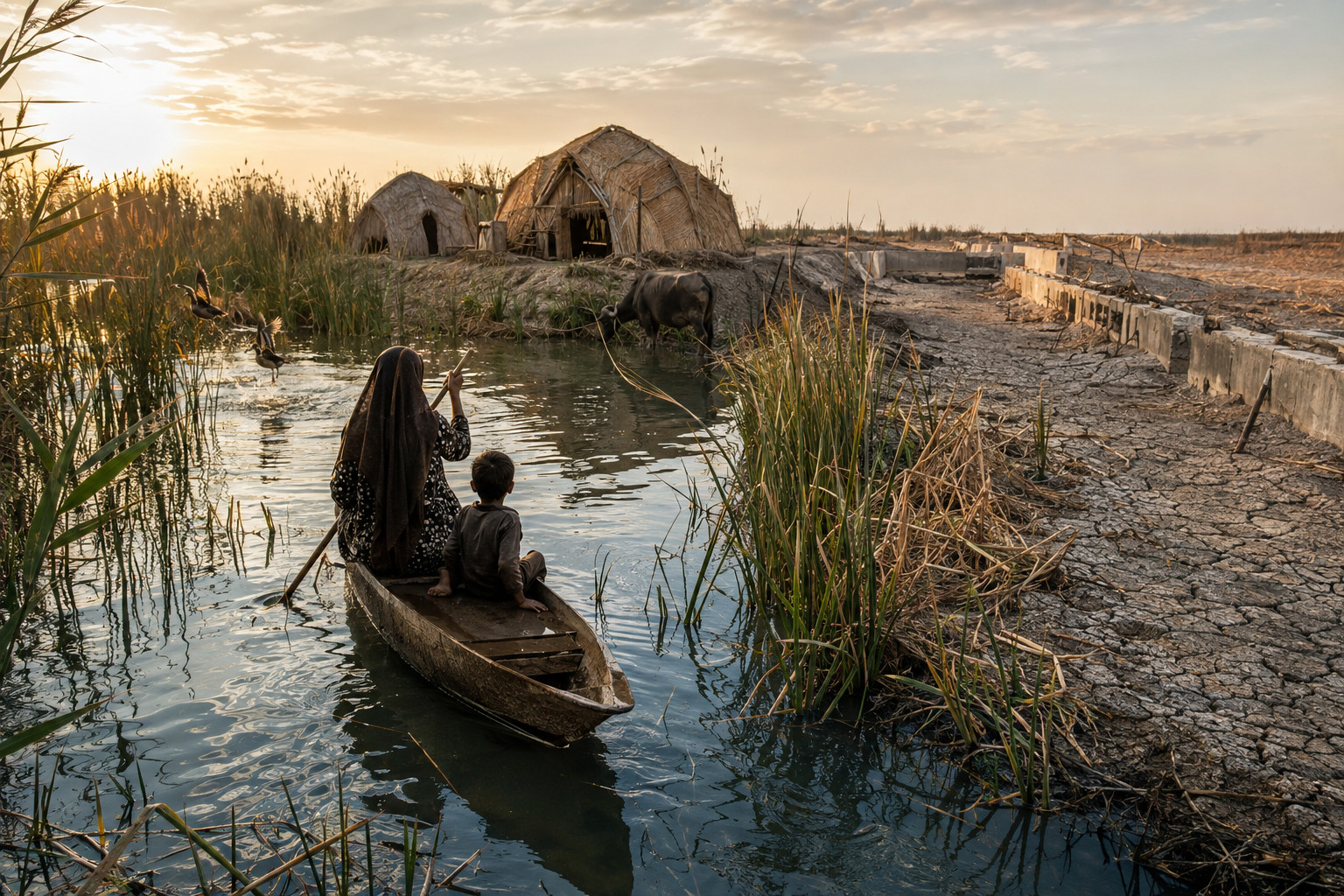
South of the Tigris and Euphrates, a lacework of canals, reedbeds and shallow lakes once made a landscape unlike any other in the Middle East. People known broadly as the Marsh Arabs — the Ma’dan — lived there for centuries, not beside the water but in it. Villages consisted of reed houses on raised mounds, narrow waterways threaded between dwellings, and long, slender boats called mashoof that served as the primary highway for trading, schooling and visiting family.
The marshes dictated the rhythm of life: seasonal floods brought fish and fresh pastures for water buffalo, reeds provided building material and fuel, and whole communities organized around fishing, flocks, and the making of reed mats and baskets for market. Their domestic architecture — curved reed walls, thatched roofs, woven partitions — was at once crude and ingenious, adapted to a world where solid ground was a seasonal luxury.
When engineers chased the water away
In the late twentieth century the marshes changed faster than the people could. A drive to expand agriculture and to control dissident populations produced a network of canals, embankments and pumping schemes that diverted the floods and drained large tracts of wetland. Villages that had floated on a rhythm of water found themselves marooned on sunbaked clay; reedbeds withered, fisheries collapsed, and salt moved in where fresh water once lay.
The social consequences were immediate. Families dispersed to towns or refugee camps, traditional economies unraveled, and migratory birds and marsh wildlife declined. The marshes stopped being a place that sustained a distinctive way of life and instead became a visible record of political decisions — furrows, dried lagoons, and the slow cracking of formerly fertile ground.
Reflooding, resilience, and limits
After the political order that had ordered the drainage collapsed, breaches in canals and a deliberate effort by returning residents let water back into some basins. Reed shoots reappeared along narrow channels, herders brought buffalo back, and a handful of villages reconstructed reed houses. Photographs from this period show a fragile but striking revival: people once more navigating the marshes by mashoof, children learning to read by the sound of water against the hull.
Yet recovery has been partial. Upstream dams, new irrigation regimes, salinization and pollution have reduced the volume and quality of water flowing into the marshes. Many former residents remain in towns, their skills and memories preserved but their lives transformed. Restoration has been as much cultural as environmental — an attempt to reweave practices that the landscape once made possible.
Conclusion
The story of the Mesopotamian marshes is a reminder that regions are not only lines on a map but living combinations of people, work and water. The Marsh Arabs adapted to a watery world and then adapted again when that world was taken away. What remains today is a patchwork: returning reeds and restored canals alongside salt flats and town-born generations. The marshes still hold traces of an older order, and in those traces you can read how environment and human choice together shape a region’s history.