Uncover History’s Secrets with Daily Updates!
Daily News Entertainment
  • Home
  • History
  • Biographies
  • Eras
  • Regions
  • Timeline
No Result
View All Result
History Ours
  • Home
  • History
  • Biographies
  • Eras
  • Regions
  • Timeline
No Result
View All Result
History Ours
No Result
View All Result
Home Timeline

Designing Timelines to Reveal Patterns and Perspectives

in Timeline
Designing Timelines to Reveal Patterns and Perspectives

Timelines can do more than list dates; they shape understanding and emphasis.
A thoughtful timeline helps readers see sequences, causality, and recurring motifs.
Design choices—scope, scale, and annotation—determine how accessible that story becomes.
This article outlines practical steps to build timelines that communicate patterns and varied perspectives.

Defining scope and narrative focus

Start by choosing a clear scope and narrative focus for the timeline, deciding what span of years and which populations or themes will be included. Limit is more effective than trying to show everything; narrow choices let you show connections in more depth. Define the level of granularity—decide whether to display events by day, year, or decade—and be consistent. Document sources and selection criteria so users understand why items appear and how gaps were handled. Early editorial notes help future updates and maintain transparency about interpretive choices.

Make tradeoffs explicit in a short curator note that accompanies the timeline. Explain omissions and the criteria used to prioritize events. That context supports trust and invites checking and contribution.

Sequencing events and emphasizing causality

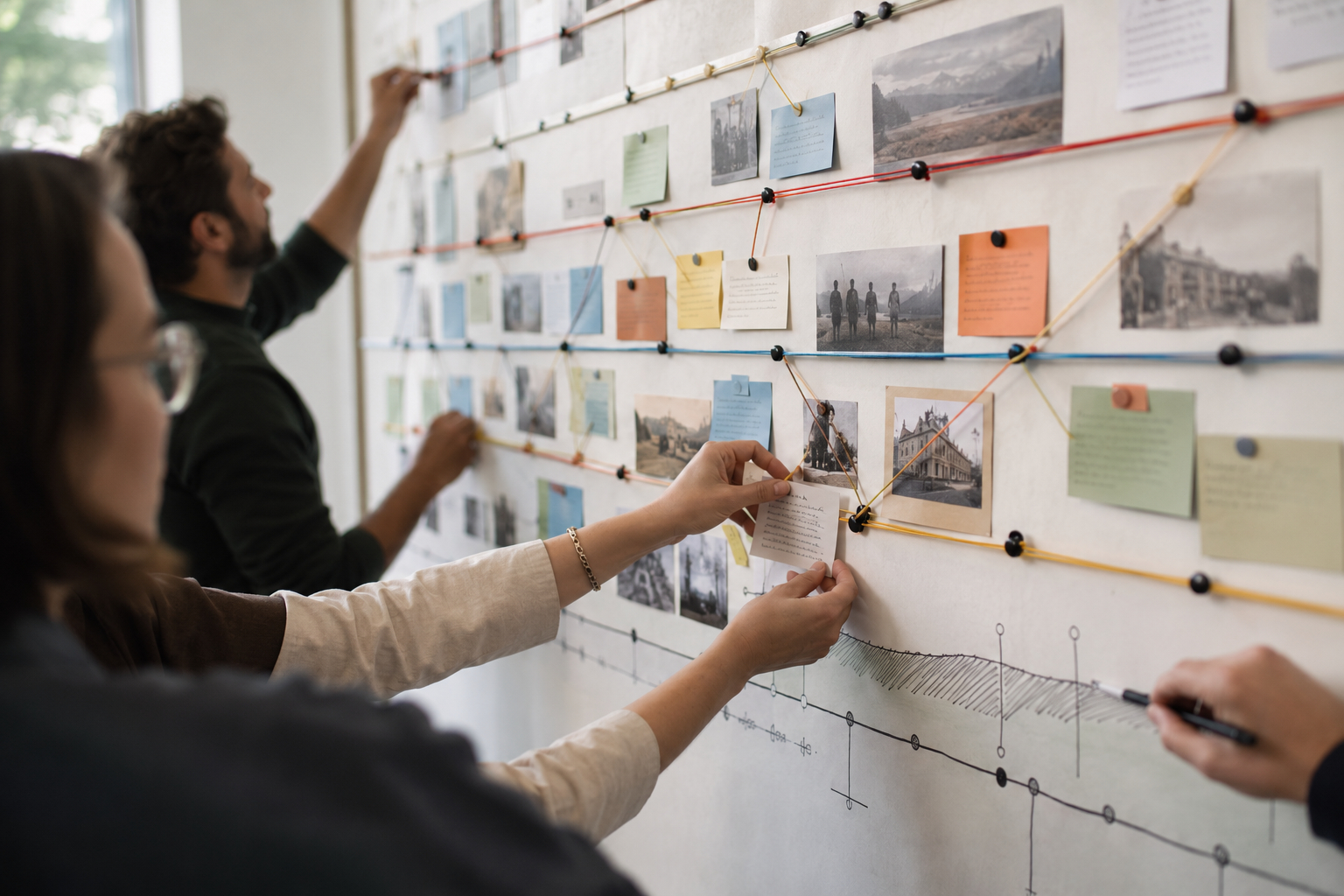
Sequence matters: pure chronology can work, but thematic lanes reveal longer-running processes that cross years. Group related events into bands or threads to help readers follow multiple streams of activity without confusion. Use visual connectors—arrows, shaded ranges, or brief cause labels—to make causal links visible where appropriate. Consider nonlinear presentations for contested histories; juxtaposing concurrent perspectives can highlight divergence and dialogue. Balance density with pace by breaking complex periods into zoomed-in intervals or expandable layers.

Add signposts such as milestone icons and short headers to anchor attention. Keep explanatory text concise and link to fuller resources for readers who want more detail. These touches preserve clarity while allowing depth for interested users.

Annotating with context and primary sources

Annotations provide essential context that turns dates into stories; short, focused labels are better than long paragraphs. Where possible, include primary source excerpts, images, or linked documents to let users see evidence directly. Attribute provenance clearly so readers can assess reliability and follow up on sources. Use concise quotes and captions to humanize events without overwhelming the layout. In online timelines, provide expandable annotations or side panels for deeper context and citations.

Limit on-card text to a sentence or two and place extended material behind links. Clear attribution and accessible scans or transcripts increase trust and usability. Think of annotations as invitations to further inquiry rather than exhaustive explanations.

Visual hierarchy, scale, and accessibility

Establish a visual hierarchy with type size, weight, and color so primary events stand out while secondary items recede. Choose a consistent scale and provide rulers or time markers to help orient readers across long spans. Ensure color contrast, legible fonts, and keyboard navigation for accessibility.

Design responsively so printed and mobile versions preserve meaning and hierarchy. Test prototypes with diverse users to catch readability and interpretive issues early.

Conclusion

Timelines are interpretive tools that guide attention and meaning.
Prioritize clarity, document selection, and create pathways to deeper research.
A disciplined design process yields timelines that invite exploration and informed reflection.


Previous Post

Small Places, Big Histories: Reading Regional Change

Next Post

Framing Time: Choosing Threads for Public History Timelines

Related Posts

How Haiti Broke Its Chains: A 1791–1804 Timeline
Timeline

How Haiti Broke Its Chains: A 1791–1804 Timeline

September 15, 2026
From Horses to Wires: How the Pony Express Met the Telegraph
Timeline

From Horses to Wires: How the Pony Express Met the Telegraph

September 15, 2026
From Swamps to Shortcut: A Timeline of the Panama Canal
Timeline

From Swamps to Shortcut: A Timeline of the Panama Canal

September 15, 2026
1815–1818: The Tambora Eruption and the Year Without a Summer
Timeline

1815–1818: The Tambora Eruption and the Year Without a Summer

September 15, 2026
Next Post
Framing Time: Choosing Threads for Public History Timelines

Framing Time: Choosing Threads for Public History Timelines

Search..

No Result
View All Result

Recent Articles

The Disguise That Broke Chains: Ellen and William Craft

The Disguise That Broke Chains: Ellen and William Craft

September 15, 2026
Bass Reeves: The Marshal Who Hunted Outlaws in Indian Territory

Bass Reeves: The Marshal Who Hunted Outlaws in Indian Territory

September 15, 2026
How the Crystal Palace Turned Glass and Iron into a Modern Stage

How the Crystal Palace Turned Glass and Iron into a Modern Stage

September 15, 2026
Anne Bonny: The Pirate Who Broke Rules and Expectations

Anne Bonny: The Pirate Who Broke Rules and Expectations

September 15, 2026
How Haiti Broke Its Chains: A 1791–1804 Timeline

How Haiti Broke Its Chains: A 1791–1804 Timeline

September 15, 2026

Subscribe Us

By clicking submit, I authorize History Ours and its affiliated companies to: (1) use, sell, and share my information for marketing purposes, including cross-context behavioral advertising, as described in our Terms of Service and Privacy Policy, (2) supplement the information that I provide with additional information lawfully obtained from other sources, like demographic data from public sources, interests inferred from web page views, or other data relevant to what might interest me, like past purchase or location data, (3) contact me or enable others to contact me by email with offers for goods and services from any category at the email address provided, and (4) retain my information while I am engaging with marketing messages that I receive and for a reasonable amount of time thereafter. I understand I can opt out at any time through an email that I receive, or by clicking here

Subscribe To Our Newsletter

By clicking submit, I authorize History Ours and its affiliated companies to: (1) use, sell, and share my information for marketing purposes, including cross-context behavioral advertising, as described in our Terms of Service and Privacy Policy, (2) supplement the information that I provide with additional information lawfully obtained from other sources, like demographic data from public sources, interests inferred from web page views, or other data relevant to what might interest me, like past purchase or location data, (3) contact me or enable others to contact me by email with offers for goods and services from any category at the email address provided, and (4) retain my information while I am engaging with marketing messages that I receive and for a reasonable amount of time thereafter. I understand I can opt out at any time through an email that I receive, or by clicking here.

© 2026 History Ours | All Rights Reserved

  • Contact Us
  • Privacy Policy
  • Terms of Service
  • Unsubscribe
  • Privacy Choices
  • Contact Us
  • Privacy Policy
  • Terms of Service
  • Unsubscribe
  • Privacy Choices

© 2026 History Ours | All Rights Reserved

No Result
View All Result
  • Home
  • History
  • Biographies
  • Eras
  • Regions
  • Timeline

© 2026 History Ours | All Rights Reserved

Skip to content
Open toolbar Accessibility Tools

Accessibility Tools

  • Increase TextIncrease Text
  • Decrease TextDecrease Text
  • GrayscaleGrayscale
  • High ContrastHigh Contrast
  • Negative ContrastNegative Contrast
  • Light BackgroundLight Background
  • Links UnderlineLinks Underline
  • Readable FontReadable Font
  • Reset Reset