

Uncover History’s Secrets with Daily Updates!
Daily News Entertainment
  • Home
  • History
  • Biographies
  • Eras
  • Regions
  • Timeline
No Result
View All Result
History Ours
  • Home
  • History
  • Biographies
  • Eras
  • Regions
  • Timeline
No Result
View All Result
History Ours
No Result
View All Result
Home Timeline

Evolution of Architecture Through the Ages

in Timeline
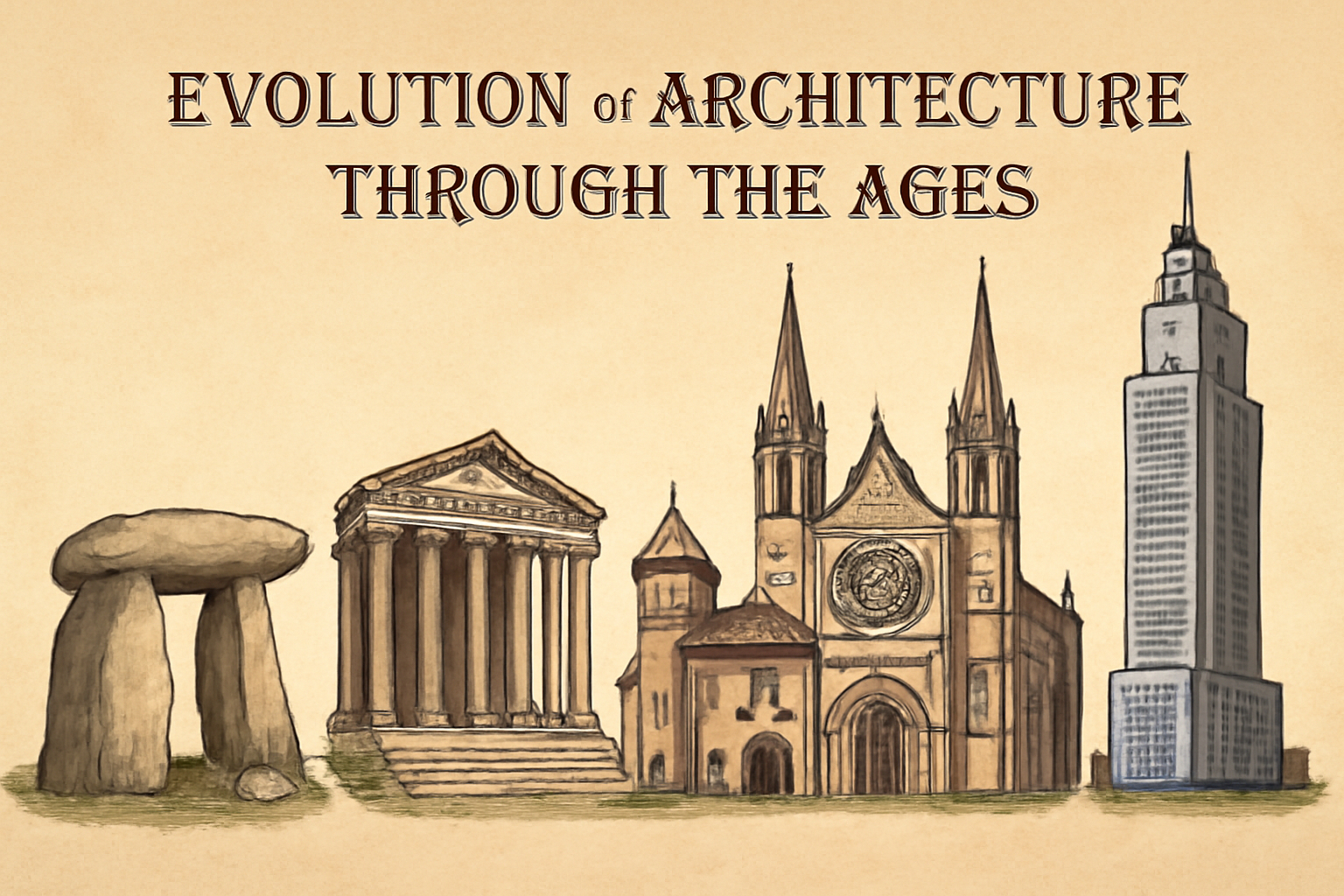
Evolution of Architecture Through the Ages

Architecture is not just the art of building; it’s the physical manifestation of culture, technological advances, and societal values. The evolution of architecture spans thousands of years, reflecting changes in human society, from primitive shelters to the awe-inspiring skyscrapers of today. Each era brought new materials, ideas, and purposes to the built environment, influencing the way we live, work, and interact. Understanding this evolution offers insights into the development of civilizations and the expression of human creativity.

Ancient Architecture: The Birth of Structure

The earliest examples of architecture can be found in the remains of ancient civilizations, where humans-built shelter out of necessity and spiritual expression. The Egyptians, for instance, created monumental structures like the pyramids, showcasing advanced understanding of geometry and the ability to mobilize vast labor forces. The Greeks and Romans followed, refining architectural principles with their own innovations — the iconic columns, arches, and domes — which would influence building practices for centuries.

Medieval Architecture: Religion and Defense

During the Middle Ages, architecture became a tool for expressing the dominance of religion and the power of feudal systems. The towering Gothic cathedrals of Europe, with their intricate stained-glass windows, pointed arches, and ribbed vaults, reflected the era’s devotion to the divine. Simultaneously, castles and fortresses symbolized the feudal structure, designed to protect and control. These buildings emphasized both function and grandeur, setting the stage for the Renaissance and beyond.

Renaissance and Baroque: Humanism and Ornamentation

The Renaissance period marked a revival of classical ideals, including symmetry, proportion, and the integration of human experience with architecture. Architects like Filippo Brunelleschi and Michelangelo brought forward innovations in perspective and the use of domes and columns. The Baroque period that followed was even more ornate, focusing on dramatic, emotional spaces with sweeping curves and extravagant decoration. This era’s buildings symbolized the power and authority of church and state.

Modern Architecture: Function and Innovation

The Industrial Revolution brought with it a wealth of new materials — steel, glass, and concrete — which radically changed the way buildings were designed and constructed. The early 20th century saw the rise of modernism, with architects like Frank Lloyd Wright and Le Corbusier pushing the boundaries of form and function. The modernist movement emphasized simplicity, clean lines, and the idea that the form of a building should follow its function. Glass skyscrapers, flat roofs, and open floor plans became hallmarks of this era.

Contemporary Architecture: Sustainable and Digital Designs

Today, architecture continues to evolve in response to global challenges such as climate change, urbanization, and the integration of digital technologies. Sustainable design practices, including energy-efficient buildings and green materials, have become central to contemporary architecture. Innovations in digital modeling, 3D printing, and robotics are allowing architects to push the boundaries of what is physically and economically possible. Cities are evolving with smart infrastructure, and the integration of nature into urban planning is becoming more prominent.

Conclusion

Architecture reflects humanity’s creativity, resilience, and the changing values of society. From the simple shelters of our ancestors to the towering skyscrapers of today, the built environment continues to evolve, adapting to new technologies, environmental challenges, and cultural shifts. Understanding the history of architecture helps us appreciate how our surroundings shape our lives and how the buildings of the future may reflect our ongoing progress and challenges.


Previous Post

The History of Migration and Cultural Exchange

Next Post

The Forgotten Architects of Civilization

Related Posts

How Haiti Broke Its Chains: A 1791–1804 Timeline
Timeline

How Haiti Broke Its Chains: A 1791–1804 Timeline

September 15, 2026
From Horses to Wires: How the Pony Express Met the Telegraph
Timeline

From Horses to Wires: How the Pony Express Met the Telegraph

September 15, 2026
From Swamps to Shortcut: A Timeline of the Panama Canal
Timeline

From Swamps to Shortcut: A Timeline of the Panama Canal

September 15, 2026
1815–1818: The Tambora Eruption and the Year Without a Summer
Timeline

1815–1818: The Tambora Eruption and the Year Without a Summer

September 15, 2026
Next Post
The Forgotten Architects of Civilization

The Forgotten Architects of Civilization

Search..

No Result
View All Result

Recent Articles

The Disguise That Broke Chains: Ellen and William Craft

The Disguise That Broke Chains: Ellen and William Craft

September 15, 2026
Bass Reeves: The Marshal Who Hunted Outlaws in Indian Territory

Bass Reeves: The Marshal Who Hunted Outlaws in Indian Territory

September 15, 2026
How the Crystal Palace Turned Glass and Iron into a Modern Stage

How the Crystal Palace Turned Glass and Iron into a Modern Stage

September 15, 2026
Anne Bonny: The Pirate Who Broke Rules and Expectations

Anne Bonny: The Pirate Who Broke Rules and Expectations

September 15, 2026
How Haiti Broke Its Chains: A 1791–1804 Timeline

How Haiti Broke Its Chains: A 1791–1804 Timeline

September 15, 2026

Subscribe Us

By clicking submit, I authorize History Ours and its affiliated companies to: (1) use, sell, and share my information for marketing purposes, including cross-context behavioral advertising, as described in our Terms of Service and Privacy Policy, (2) supplement the information that I provide with additional information lawfully obtained from other sources, like demographic data from public sources, interests inferred from web page views, or other data relevant to what might interest me, like past purchase or location data, (3) contact me or enable others to contact me by email with offers for goods and services from any category at the email address provided, and (4) retain my information while I am engaging with marketing messages that I receive and for a reasonable amount of time thereafter. I understand I can opt out at any time through an email that I receive, or by clicking here

Subscribe To Our Newsletter

By clicking submit, I authorize History Ours and its affiliated companies to: (1) use, sell, and share my information for marketing purposes, including cross-context behavioral advertising, as described in our Terms of Service and Privacy Policy, (2) supplement the information that I provide with additional information lawfully obtained from other sources, like demographic data from public sources, interests inferred from web page views, or other data relevant to what might interest me, like past purchase or location data, (3) contact me or enable others to contact me by email with offers for goods and services from any category at the email address provided, and (4) retain my information while I am engaging with marketing messages that I receive and for a reasonable amount of time thereafter. I understand I can opt out at any time through an email that I receive, or by clicking here.

© 2026 History Ours | All Rights Reserved

  • Contact Us
  • Privacy Policy
  • Terms of Service
  • Unsubscribe
  • Privacy Choices
  • Contact Us
  • Privacy Policy
  • Terms of Service
  • Unsubscribe
  • Privacy Choices

© 2026 History Ours | All Rights Reserved

No Result
View All Result
  • Home
  • History
  • Biographies
  • Eras
  • Regions
  • Timeline

© 2026 History Ours | All Rights Reserved

Skip to content
Open toolbar Accessibility Tools

Accessibility Tools

  • Increase TextIncrease Text
  • Decrease TextDecrease Text
  • GrayscaleGrayscale
  • High ContrastHigh Contrast
  • Negative ContrastNegative Contrast
  • Light BackgroundLight Background
  • Links UnderlineLinks Underline
  • Readable FontReadable Font
  • Reset Reset