

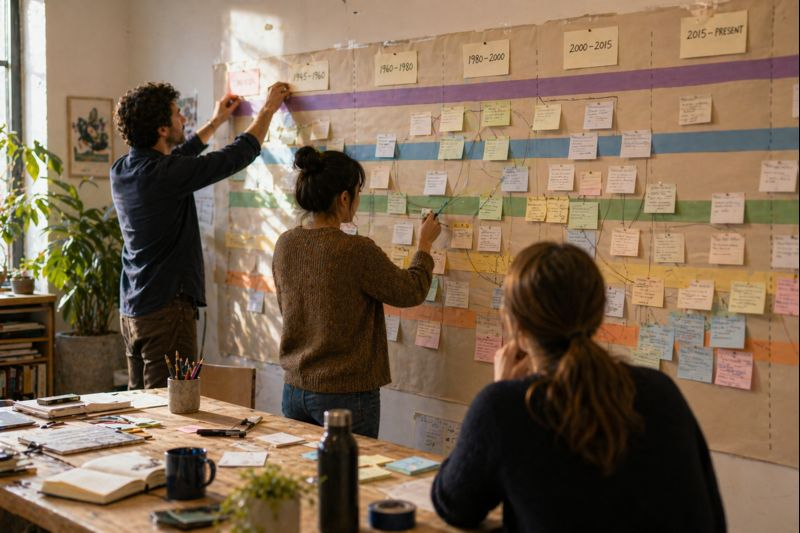
Timelines are powerful tools for making historical change visible and understandable. They help audiences see sequence, causation, and continuity in a compact format. Successful timelines balance scope, detail, and narrative so users can find both facts and meaning. This guide outlines practical choices for building timelines that serve public audiences and researchers alike.
Define Scope and Audience
Begin by clarifying the temporal and topical boundaries of your timeline and who will use it. A local community timeline requires different granularity than a thematic survey, and beginner and specialist audiences expect different levels of context. Establish clear goals: is the timeline meant to orient, to argue, or to document comprehensively? Those decisions shape which events, dates, and side narratives you prioritize.
Keep selection criteria transparent and consistent so users can understand omissions and emphases. Short explanatory notes about inclusion criteria improve trust and usability.
Structure for Clarity and Narrative
Organize entries to support a readable flow that highlights cause-and-effect and thematic threads. Use consistent date formats and grouping conventions to avoid confusion, and consider layers or lanes to separate politics, culture, and daily life. Sequence matters: arranging events by thematic arcs can reveal patterns that raw chronology conceals. Balance summary entries with occasional extended entries that provide essential context where needed.
Provide connective text or brief synthesis sections at key junctures to guide interpretation. These small narrative anchors help non-specialist readers follow complexity without extensive prior knowledge.
Visual and Accessibility Considerations
Design choices influence comprehension: color, spacing, and typography should support legibility and hierarchical emphasis. Ensure sufficient contrast, readable font sizes, and predictable visual cues so users can scan effectively across a timeline. For digital timelines, responsive layouts and keyboard navigation expand access, while alternative text and plain-text exports support assistive technologies. Visual simplicity often aids understanding more than decorative complexity.
Test design decisions with representative users to catch accessibility gaps and refine emphasis. Iterative feedback typically yields clearer, more inclusive displays.
Research, Sourcing, and Iteration
Accurate, well-documented content is the backbone of any historical timeline. Cite primary and secondary sources clearly and include brief notes for contested dates or interpretations. Build a workflow that separates research, verification, and editorial selection to reduce errors. Treat the timeline as a living resource: new evidence or community input may warrant adjustments over time.
Maintain versioning or update logs so users can track changes and understand evolving interpretations. Openness about revisions strengthens credibility.
Conclusion
Thoughtful timelines combine clear scope, deliberate structure, and accessible design. They pair reliable sourcing with narrative cues that help readers find meaning. With iterative testing and transparent choices, timelines become both informative records and engaging interpretive tools.