Uncover History’s Secrets with Daily Updates!
Daily News Entertainment
  • Home
  • History
  • Biographies
  • Eras
  • Regions
  • Timeline
No Result
View All Result
History Ours
  • Home
  • History
  • Biographies
  • Eras
  • Regions
  • Timeline
No Result
View All Result
History Ours
No Result
View All Result
Home Timeline

Visual Hierarchy and Context in Historical Timelines

in Timeline
Visual Hierarchy and Context in Historical Timelines

Timelines are more than sequences of dates; they are visual narratives that guide readers through change over time. A clear visual hierarchy helps audiences identify major turning points, supporting events, and background context without overwhelming detail. Thoughtful choices in scale, grouping, and annotation let creators balance depth with readability for general audiences. This article outlines practical design principles and a compact workflow for building effective public historical timelines.

Establishing a Clear Visual Hierarchy

Start by deciding which events will occupy primary, secondary, and tertiary tiers on the timeline. Use size, color contrast, and spatial placement to signal importance: larger elements and stronger contrast indicate focal events, while subtler tones and smaller marks suggest supporting details. Consistent typography and iconography reduce cognitive load and let readers scan quickly for anchors in the narrative. Avoid decorative treatments that compete with informational elements, and reserve emphasis for genuinely significant moments.

Hierarchy also guides users across different time scales and densities. When decades compress into compact segments, prioritize representative milestones rather than every date. Maintain clear rules for what moves between tiers so the timeline stays coherent as content grows.

Layering Context and Scale

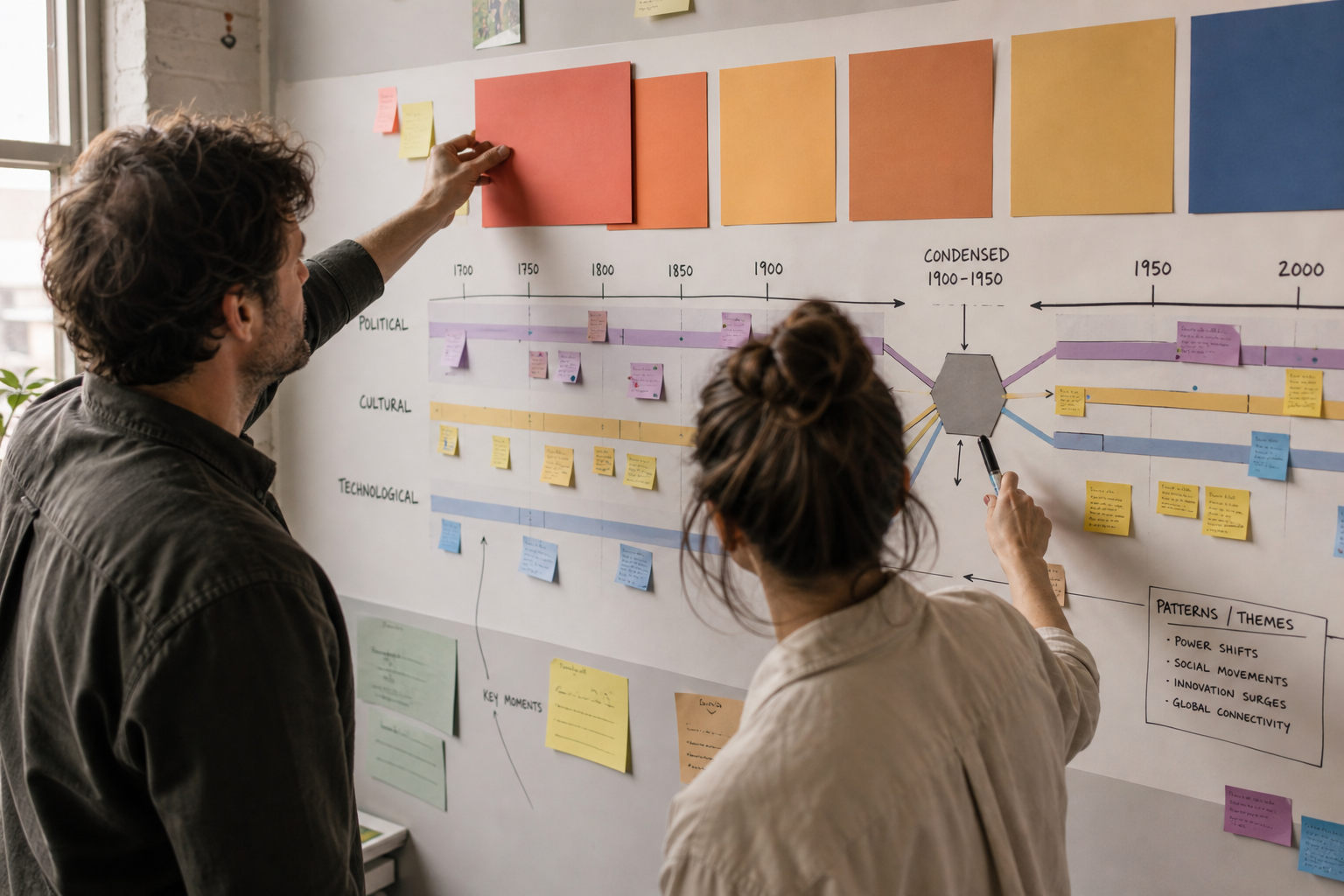
Contextual layers help audiences understand causation and continuity without cluttering the main sequence. Integrate parallel tracks for political events, cultural shifts, and technological change, and align them vertically or using color bands to show intersections. Use scale breaks or summary nodes where long periods of relative stability warrant condensation, and expand sections where rapid change or dense interaction occurs. Annotations, short captions, and small-callout details provide necessary context without breaking the visual flow.

Make sure contextual layers remain optional to inspect so casual readers see the broad arc while interested users can dive deeper. Interactive or physical foldouts are useful when space and medium allow.

Workflow, Testing, and Accessibility

Adopt a workflow that separates research, selection, and visual prototyping. Begin with a vetted list of events, group them thematically, and sketch multiple layouts to test different hierarchies and scales. Conduct quick usability tests with representative users to reveal confusing labels, misleading scales, or inaccessible contrasts. Iterate with clear versioning so changes in research or interpretation are documented and reversible.

Accessibility should shape color choices, label sizes, and alternate text for digital versions. Ensure high contrast, readable fonts, and keyboard or tactile navigation where relevant to broaden audience reach.

Conclusion

Effective historical timelines pair disciplined selection with purposeful design choices to make history legible and engaging. Prioritize a clear visual hierarchy, layered context, and iterative testing to address both novice and expert users. Thoughtful timelines communicate connections across time while remaining navigable and informative.


Previous Post

How Seasonal Work Shapes Regional Cultural Traditions

Next Post

Integrating Primary Sources into Readable Historical Timelines

Related Posts

How Haiti Broke Its Chains: A 1791–1804 Timeline
Timeline

How Haiti Broke Its Chains: A 1791–1804 Timeline

September 15, 2026
From Horses to Wires: How the Pony Express Met the Telegraph
Timeline

From Horses to Wires: How the Pony Express Met the Telegraph

September 15, 2026
From Swamps to Shortcut: A Timeline of the Panama Canal
Timeline

From Swamps to Shortcut: A Timeline of the Panama Canal

September 15, 2026
1815–1818: The Tambora Eruption and the Year Without a Summer
Timeline

1815–1818: The Tambora Eruption and the Year Without a Summer

September 15, 2026
Next Post
Integrating Primary Sources into Readable Historical Timelines

Integrating Primary Sources into Readable Historical Timelines

Search..

No Result
View All Result

Recent Articles

The Disguise That Broke Chains: Ellen and William Craft

The Disguise That Broke Chains: Ellen and William Craft

September 15, 2026
Bass Reeves: The Marshal Who Hunted Outlaws in Indian Territory

Bass Reeves: The Marshal Who Hunted Outlaws in Indian Territory

September 15, 2026
How the Crystal Palace Turned Glass and Iron into a Modern Stage

How the Crystal Palace Turned Glass and Iron into a Modern Stage

September 15, 2026
Anne Bonny: The Pirate Who Broke Rules and Expectations

Anne Bonny: The Pirate Who Broke Rules and Expectations

September 15, 2026
How Haiti Broke Its Chains: A 1791–1804 Timeline

How Haiti Broke Its Chains: A 1791–1804 Timeline

September 15, 2026

Subscribe Us

By clicking submit, I authorize History Ours and its affiliated companies to: (1) use, sell, and share my information for marketing purposes, including cross-context behavioral advertising, as described in our Terms of Service and Privacy Policy, (2) supplement the information that I provide with additional information lawfully obtained from other sources, like demographic data from public sources, interests inferred from web page views, or other data relevant to what might interest me, like past purchase or location data, (3) contact me or enable others to contact me by email with offers for goods and services from any category at the email address provided, and (4) retain my information while I am engaging with marketing messages that I receive and for a reasonable amount of time thereafter. I understand I can opt out at any time through an email that I receive, or by clicking here

Subscribe To Our Newsletter

By clicking submit, I authorize History Ours and its affiliated companies to: (1) use, sell, and share my information for marketing purposes, including cross-context behavioral advertising, as described in our Terms of Service and Privacy Policy, (2) supplement the information that I provide with additional information lawfully obtained from other sources, like demographic data from public sources, interests inferred from web page views, or other data relevant to what might interest me, like past purchase or location data, (3) contact me or enable others to contact me by email with offers for goods and services from any category at the email address provided, and (4) retain my information while I am engaging with marketing messages that I receive and for a reasonable amount of time thereafter. I understand I can opt out at any time through an email that I receive, or by clicking here.

© 2026 History Ours | All Rights Reserved

  • Contact Us
  • Privacy Policy
  • Terms of Service
  • Unsubscribe
  • Privacy Choices
  • Contact Us
  • Privacy Policy
  • Terms of Service
  • Unsubscribe
  • Privacy Choices

© 2026 History Ours | All Rights Reserved

No Result
View All Result
  • Home
  • History
  • Biographies
  • Eras
  • Regions
  • Timeline

© 2026 History Ours | All Rights Reserved

Skip to content
Open toolbar Accessibility Tools

Accessibility Tools

  • Increase TextIncrease Text
  • Decrease TextDecrease Text
  • GrayscaleGrayscale
  • High ContrastHigh Contrast
  • Negative ContrastNegative Contrast
  • Light BackgroundLight Background
  • Links UnderlineLinks Underline
  • Readable FontReadable Font
  • Reset Reset