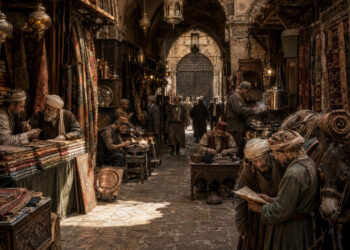


Regions are not simply bounded territories on a map; they emerge through repeated movements and shared routines that create a sense of place. Everyday corridors of travel, patterns of work, and regular exchanges weave people and landscapes into enduring connections. Paying attention to both visible infrastructure and ordinary behavior reveals how regional identities form and persist. This article explores the interplay between movement, practice, and material traces in the making of regional history.
Infrastructure and Movement
Roads, waterways, and trails often provide the earliest frameworks on which regions develop, channeling trade, migration, and communication across decades. Their placement shapes economic opportunity and social interaction, directing where markets cluster and where communities align. Over time these transportation routes accumulate meanings, serving as markers of belonging or exclusion for different groups. Studying the physical traces of movement helps historians understand not only connectivity but also the uneven effects of access within a region.
- Major trade paths that became urban corridors.
- Seasonal routes used for pastoral or ritual movement.
Infrastructure is therefore both practical and symbolic, influencing the rhythm of daily life while anchoring longer narratives of regional change. Even modest paths can become central to local memory and identity.
Daily Practices and Collective Identity
Routine activities—markets, religious observances, crafts, and communal labor—cement social networks and create recurring encounters that define a region’s character. These practices transmit skills, values, and relationships between generations, making cultural continuity visible in ordinary life. Patterns of exchange, whether material or ceremonial, map out alliances and distinctions across space. Paying attention to quotidian habits reveals how belonging is produced through doing rather than declared on paper.
Ethnographic and archival approaches together can surface these patterns, showing how daily routines contribute to long-term cohesion. Capturing these practices helps reconstruct the social fabric of historical regions.
Material Traces and Local Archives
Buildings, boundary stones, household objects, and local records hold layered evidence of regional formation, often surviving where written grand narratives do not. These material traces give insight into economic life, property relations, and the negotiation of space over time. Local archives—ledgers, parish registers, or oral collections—complement material study by linking objects to people and events. Together they allow historians to read the small-scale details that make up larger regional stories.
- Household inventories and market accounts as everyday records.
- Maps and cadastral notes that reflect changing land use.
Engaging with these sources uncovers the incremental work of region-building and offers a grounded account of change. Material evidence thus remains essential for reconstructing layered local histories.
Conclusion
Understanding regions requires looking beyond borders to the routines and routes that bind places together. Movement, practice, and material traces offer a combined lens for tracing how regional identities take shape. Attending to these elements yields richer, more grounded histories of place.