

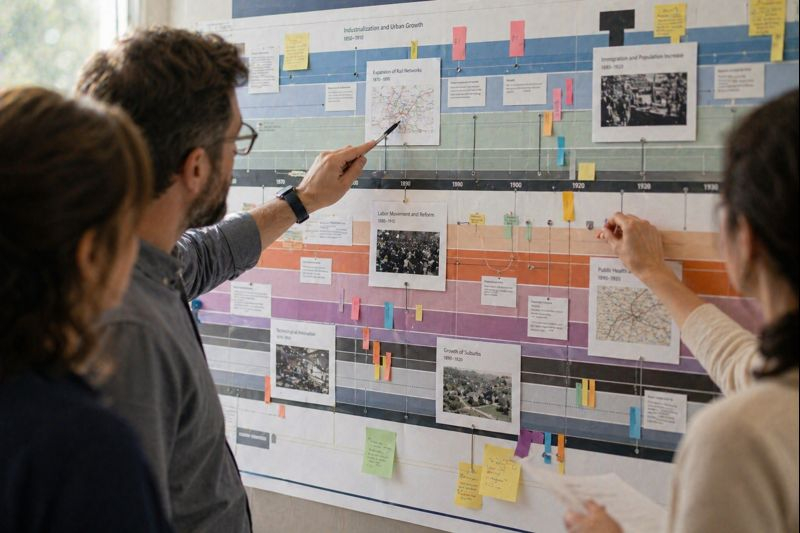
Building a timeline that spans decades or centuries demands careful choices about clarity and scale.
Start by deciding the audience and the core story you want the timeline to tell.
Limit the initial scope to a manageable set of events that illustrate change over time.
A clear organizing principle helps readers navigate complexity without losing context.
Planning the Narrative Thread
Begin with a concise narrative that ties selected events to a central theme or question. Identify pivotal moments and recurring patterns that support that narrative, and treat those as anchors. Use primary sources and reliable secondary accounts to confirm dates and significance before committing to placement. This groundwork reduces ambiguity and prevents the timeline from becoming an undifferentiated list of dates.
Keep event descriptions short and focused, emphasizing cause and consequence where relevant. A single line of explanatory text per entry often preserves readability while conveying meaning.
Managing Scale and Granularity
Multi-scale timelines must balance overview and detail by grouping events into temporal bands or collapsible layers. Scale decisions determine whether a decade, a year, or a day is the primary unit, and that choice should align with the story you are telling. For periods with dense activity, consider nested timelines or zoom features that reveal more information on demand. Avoid presenting every minor occurrence at the same level as transformative events.
Use consistent intervals and visual cues to indicate shifts in granularity. That consistency helps users anticipate what level of detail to expect as they move through time.
Creating a Clear Visual Hierarchy
Visual design guides interpretation: color, size, and placement signal importance and relationships. Reserve bolder treatments for anchor events and subtler tones for supporting items, so readers can scan for significance. Ensure typography and spacing maintain legibility across devices and at different zoom levels. Incorporate legends and concise labels to reduce cognitive load when multiple themes or actors appear simultaneously.
Accessible color contrasts and clear fonts support inclusivity and usability. Simple icons or markers can indicate event type without lengthy text.
Workflow for Construction and Review
Establish an iterative workflow that moves from research and selection to prototype and testing. Early mock-ups help reveal gaps in narrative flow and problems with scale before production. Solicit feedback from intended users and subject-matter reviewers to correct factual or interpretive errors. Revision cycles should focus on pruning extraneous entries and clarifying ambiguous descriptions.
Document decisions about inclusion criteria and sources so future editors can maintain coherence. A version history preserves how the timeline evolved and why particular choices were made.
Conclusion
Prioritizing clarity in multi-scale timelines means making deliberate choices about scope, hierarchy, and audience.
Iterative testing and concise event treatment preserve readability while allowing depth where it matters.
A well-structured timeline communicates change clearly and invites further exploration.