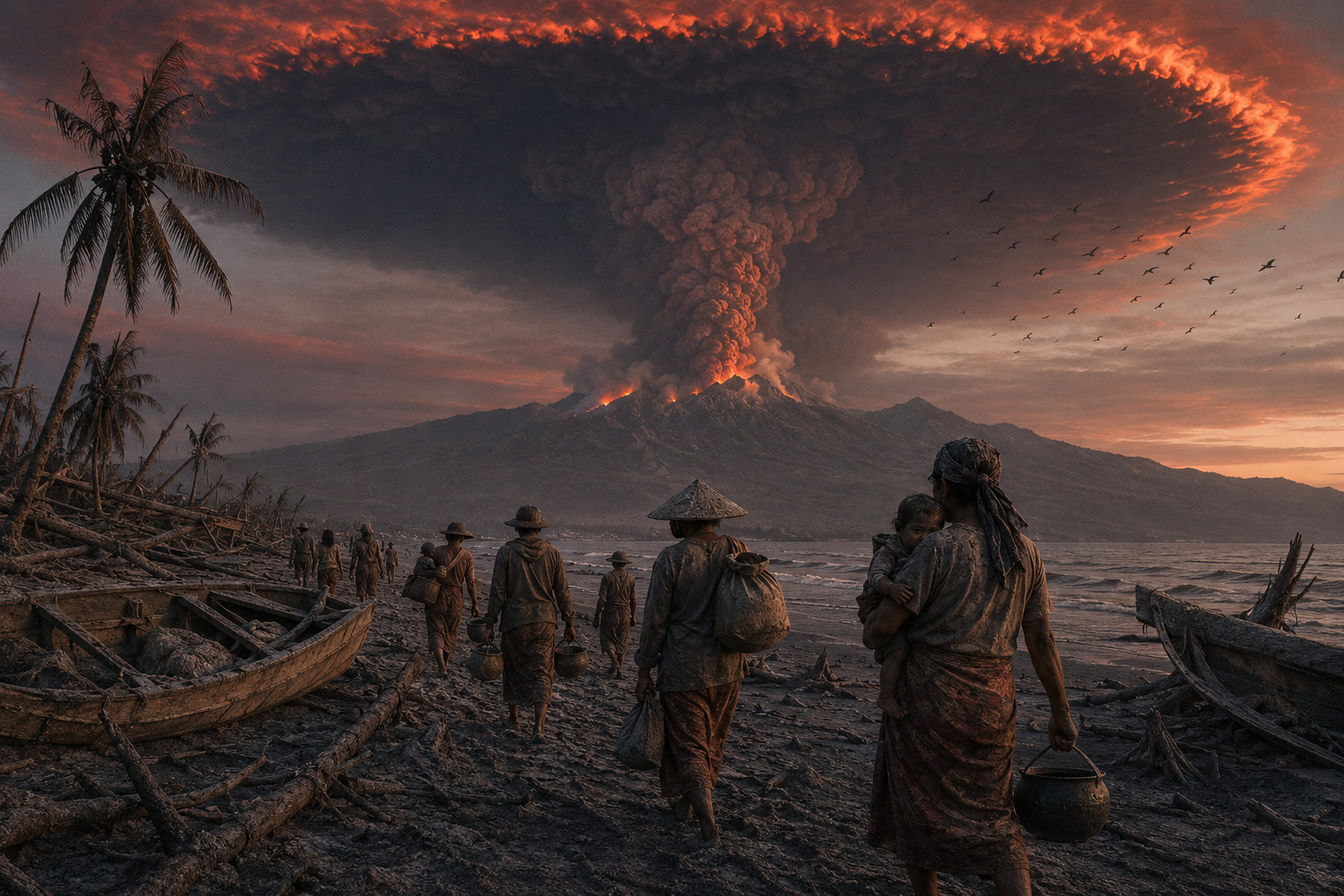
On April 10, 1815, Mount Tambora on Sumbawa Island (now part of Indonesia) erupted with a force rarely seen in human memory. The mountain’s summit largely collapsed in a colossal explosion classified today as one of the largest volcanic events in recorded history. Pyroclastic flows, ash, and tsunamis devastated nearby islands and killed tens of thousands of people where the eruption struck directly.
Beyond the immediate destruction, Tambora lofted so much sulfur-rich ash into the stratosphere that sunlight reaching the planet was measurably reduced. The atmosphere carried those particles around the globe over the following months, setting off climate anomalies far from the eruption site.
1816: The Year Without a Summer
By the spring and summer of 1816, Europe, North America, and parts of Asia were experiencing unusual cold, relentless storms, and late frosts. In New England, snow fell in June; fields flooded and wheat failed in many regions. Rural communities faced spoiled harvests and rising food prices. In Europe, persistent gloom and crop shortages produced bread riots and hardship in already fragile economies.
Scientists estimate the eruption produced a global cooling of roughly half a degree Celsius or more for a year or two—enough, in agrarian societies, to tip harvests into failure. The suspended aerosols gradually settled out over two to three years, but the acute social effects concentrated in 1816 and the following seasons.
Culture, migration, and unexpected consequences
Not all ripple effects were strictly material. The incessant rain that summer kept a group of English writers—Lord Byron, Percy Shelley, Mary Godwin (later Mary Shelley), and others—indoors at Lake Geneva. Bored and unsettled by the weather, they challenged one another to write ghost stories; Mary Shelley began the tale that became Frankenstein during that gloomy retreat.
Elsewhere, the extraordinary sunsets and pale skies produced by volcanic aerosols found their way into painters’ canvases. Artists such as J.M.W. Turner later captured luminous, blood-red horizons that some historians link to post-1815 atmospheric conditions.
On a longer scale, repeated crop failures pushed some families to move, accelerating westward migration in North America and intensifying social strains in Europe. Public health crises, price shocks, and disrupted trade all trace part of their cause to the climatic disruptions that began with Tambora’s blast.
Conclusion
Tambora’s eruption is a reminder that a single event on a remote island can ripple through climate, economy, culture, and movement of people. The immediate human toll in the Indonesian archipelago was terrible; the wider, quieter effects—failed harvests, altered art, an unseasonable summer that inspired a gothic novel—persist as a vivid example of how connected the world’s systems already were in the early nineteenth century.