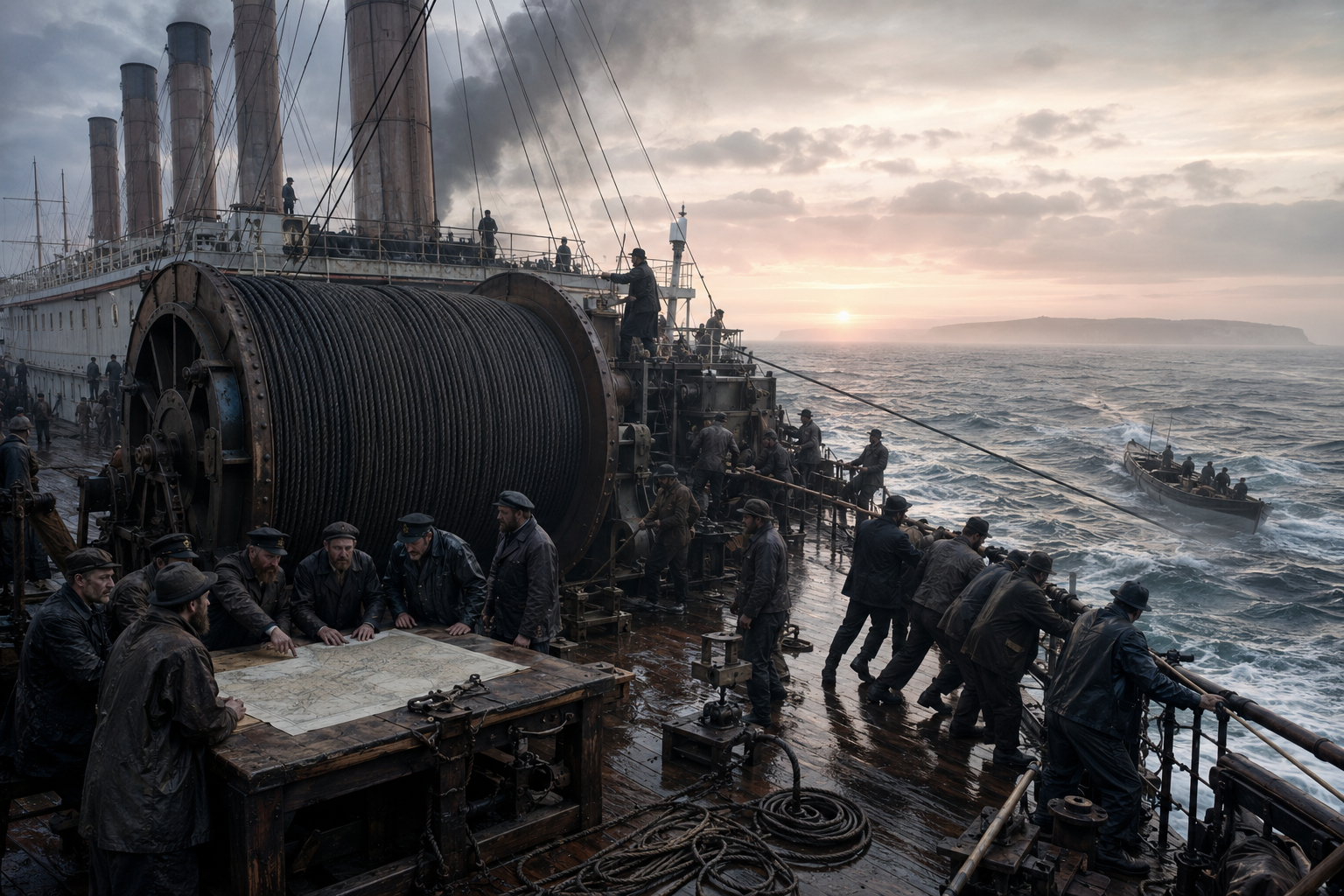
The idea of instant communication across the Atlantic was reckless and irresistible. In the mid‑1850s a Boston businessman, Cyrus W. Field, galvanized investors on both sides of the ocean. They formed the Atlantic Telegraph Company and set out to string a telegraph cable from Ireland to Newfoundland — a distance of roughly 1,800 miles across deep, stormy water.
After experiments in shallower waters and problems with insulation and cable engineering, ships laid a full link in 1858. For a few weeks the cable worked: news that had once taken days or weeks now crossed the ocean in minutes. Heads of state exchanged congratulatory messages, and investors celebrated a supposed technological triumph.
Collapse and a second effort (late 1858–1865)
The victory was short‑lived. The 1858 cable soon failed, its insulation and conductors damaged by the primitive voltages and the stresses of the ocean. Critics declared the project hubris; backers lost money. But the failure didn’t end the push. Engineers learned from the mistakes: stronger armoring, better insulating gutta‑percha, and improved paying‑out methods were developed over the following years.
Multiple attempts followed, and in 1865 another cable was being laid using the giant steamship Great Eastern, the only vessel large enough to carry the enormous length of cable. That year a cable broke and was lost to the ocean depths — a humiliating setback that nevertheless taught teams how to handle and retrieve heavy cable in deep water.
Success at last and its ripple effects (1866)
July 1866 finally brought a dependable link. The Great Eastern completed the lay and the new cable proved durable. Telegraphic messages between Europe and North America ceased to be a matter of days and became a matter of minutes and hours. Newspapers updated transatlantic news cycles; markets across two continents began to move in near‑real time. Maritime navigation, diplomacy, and business were all altered by the speed of information.
Beyond the practical gains, the transatlantic telegraph reshaped how people imagined distance. The ocean remained vast and dangerous, but the sense of separation diminished: finance and politics tightened into a transatlantic conversation.
Conclusion
The transatlantic telegraph was not a single flawless achievement but a threaded story of persistence: invention, costly failure, and incremental improvement. The breakthrough in 1866 stands as a clear milestone — the moment the globe felt noticeably smaller. Its legacy lives on in every instant message that crosses an ocean today.