
Uncover History’s Secrets with Daily Updates!
Daily News Entertainment
  • Home
  • History
  • Biographies
  • Eras
  • Regions
  • Timeline
No Result
View All Result
History Ours
  • Home
  • History
  • Biographies
  • Eras
  • Regions
  • Timeline
No Result
View All Result
History Ours
No Result
View All Result
Home Timeline

Mapping the Arc of Civilizations Through Timelines

in Timeline
Mapping the Arc of Civilizations Through Timelines

Introduction

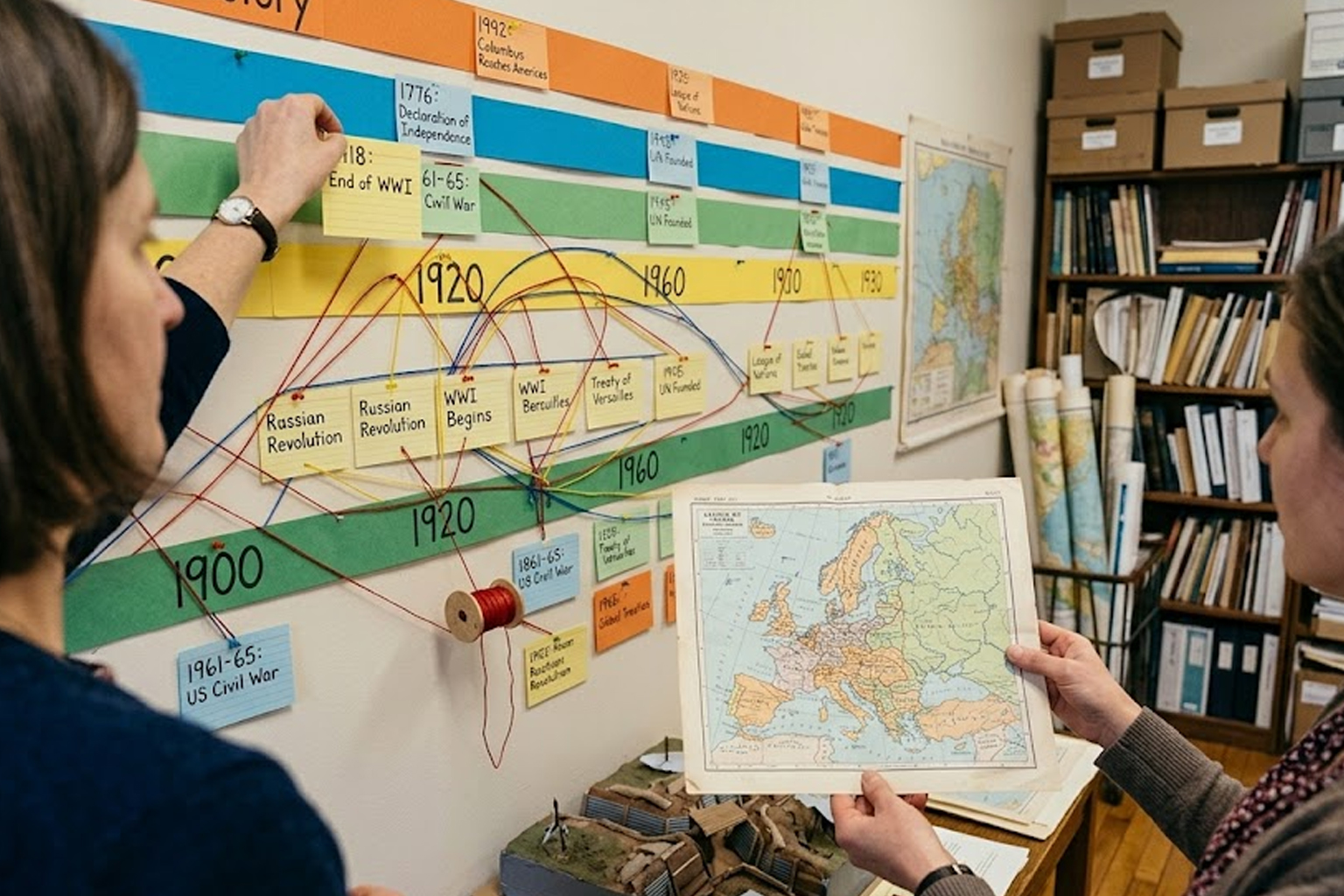
Timelines are one of the clearest ways to present complex historical change in a compact format. They condense sequences, show causation, and reveal patterns that prose alone can obscure. When well designed, a timeline helps readers move from isolated facts to an integrated narrative. This article outlines practical approaches to building timelines that communicate context and continuity.

Why timelines matter for historical understanding

Timelines offer a visual grammar for cause and effect, making it easier to compare developments across different regions or themes. They encourage readers to situate events relative to one another and to spot long-term trends such as technological diffusion, cultural exchange, or political consolidation. For educators and writers, timelines provide scaffolding that supports comprehension and retention. They are also versatile tools for both high-level overviews and detailed chronological exploration.

By clarifying sequence and simultaneity, timelines reduce ambiguity in complex stories. They create a shared reference that guides subsequent analysis and discussion.

Designing a useful timeline

Start by defining the scope: temporal range, geographic focus, and the types of events to include, such as political, social, economic, or cultural markers. Choose a scale that balances granularity with readability, deciding whether decades, years, or centuries best serve the narrative. Select consistent labeling and a limited color palette to indicate categories without overwhelming the viewer. Include brief annotations that explain why particular items matter rather than merely stating dates or names.

  • Decide scope and scale before plotting entries.
  • Group related events with color or icons.
  • Add short annotations for clarity.

Thoughtful design turns a list of dates into an interpretive framework that highlights significance. Iteration and feedback help refine which items belong and how they are presented.

Common pitfalls and how to avoid them

Overcrowding is a frequent problem when creators try to include every possible event, which can defeat the timeline’s purpose. Avoid selecting entries solely on popularity; instead prioritize events that illustrate the story you intend to tell. Beware of anachronistic labels and ensure sources are reliable and explicitly cited where necessary. Balance detail with digestibility so that the timeline remains a navigable guide rather than a dense archive.

Maintaining clarity often means choosing interpretive focus over exhaustive coverage. Clear legends and visual hierarchy mitigate confusion and aid user navigation.

Using timelines to tell complex stories

Timelines are especially effective when paired with short essays, maps, or multimedia that deepen context for key moments. Layering thematic threads—political change, economic shifts, and cultural movements—allows readers to trace intersections and divergences over time. Interactive timelines can invite exploration, letting users filter by theme or zoom into particular decades. Whether printed or digital, timelines should guide a reader from chronology to insight.

When integrated into a broader narrative, timelines act as both roadmap and reference. They encourage readers to move beyond isolated facts toward richer historical synthesis.

Conclusion

Timelines distill complexity into accessible chronologies that reveal relationships and long-term patterns. Careful scope, consistent design, and selective curation make them powerful tools for teaching and storytelling. Thoughtful timelines transform dates into meaningful history.


Previous Post

A Practical Timeline Framework for Historical Storytelling

Next Post

Cobblestones and Conversations: Social Networks of Town Streets

Related Posts

How Haiti Broke Its Chains: A 1791–1804 Timeline
Timeline

How Haiti Broke Its Chains: A 1791–1804 Timeline

September 15, 2026
From Horses to Wires: How the Pony Express Met the Telegraph
Timeline

From Horses to Wires: How the Pony Express Met the Telegraph

September 15, 2026
From Swamps to Shortcut: A Timeline of the Panama Canal
Timeline

From Swamps to Shortcut: A Timeline of the Panama Canal

September 15, 2026
1815–1818: The Tambora Eruption and the Year Without a Summer
Timeline

1815–1818: The Tambora Eruption and the Year Without a Summer

September 15, 2026
Next Post
Cobblestones and Conversations: Social Networks of Town Streets

Cobblestones and Conversations: Social Networks of Town Streets

Search..

No Result
View All Result

Recent Articles

Edo: Japan’s Urban Revolution of Lanterns and Printshops

Edo: Japan’s Urban Revolution of Lanterns and Printshops

September 16, 2026
How the Little Ice Age Changed Everyday Life in Europe

How the Little Ice Age Changed Everyday Life in Europe

September 16, 2026
The Disguise That Broke Chains: Ellen and William Craft

The Disguise That Broke Chains: Ellen and William Craft

September 15, 2026
Bass Reeves: The Marshal Who Hunted Outlaws in Indian Territory

Bass Reeves: The Marshal Who Hunted Outlaws in Indian Territory

September 15, 2026
How the Crystal Palace Turned Glass and Iron into a Modern Stage

How the Crystal Palace Turned Glass and Iron into a Modern Stage

September 15, 2026

Subscribe Us

By clicking submit, I authorize History Ours and its affiliated companies to: (1) use, sell, and share my information for marketing purposes, including cross-context behavioral advertising, as described in our Terms of Service and Privacy Policy, (2) supplement the information that I provide with additional information lawfully obtained from other sources, like demographic data from public sources, interests inferred from web page views, or other data relevant to what might interest me, like past purchase or location data, (3) contact me or enable others to contact me by email with offers for goods and services from any category at the email address provided, and (4) retain my information while I am engaging with marketing messages that I receive and for a reasonable amount of time thereafter. I understand I can opt out at any time through an email that I receive, or by clicking here

Subscribe To Our Newsletter

By clicking submit, I authorize History Ours and its affiliated companies to: (1) use, sell, and share my information for marketing purposes, including cross-context behavioral advertising, as described in our Terms of Service and Privacy Policy, (2) supplement the information that I provide with additional information lawfully obtained from other sources, like demographic data from public sources, interests inferred from web page views, or other data relevant to what might interest me, like past purchase or location data, (3) contact me or enable others to contact me by email with offers for goods and services from any category at the email address provided, and (4) retain my information while I am engaging with marketing messages that I receive and for a reasonable amount of time thereafter. I understand I can opt out at any time through an email that I receive, or by clicking here.

© 2026 History Ours | All Rights Reserved

  • Contact Us
  • Privacy Policy
  • Terms of Service
  • Unsubscribe
  • Privacy Choices
  • Contact Us
  • Privacy Policy
  • Terms of Service
  • Unsubscribe
  • Privacy Choices

© 2026 History Ours | All Rights Reserved

No Result
View All Result
  • Home
  • History
  • Biographies
  • Eras
  • Regions
  • Timeline

© 2026 History Ours | All Rights Reserved

Skip to content
Open toolbar Accessibility Tools

Accessibility Tools

  • Increase TextIncrease Text
  • Decrease TextDecrease Text
  • GrayscaleGrayscale
  • High ContrastHigh Contrast
  • Negative ContrastNegative Contrast
  • Light BackgroundLight Background
  • Links UnderlineLinks Underline
  • Readable FontReadable Font
  • Reset Reset