
Uncover History’s Secrets with Daily Updates!
Daily News Entertainment
  • Home
  • History
  • Biographies
  • Eras
  • Regions
  • Timeline
No Result
View All Result
History Ours
  • Home
  • History
  • Biographies
  • Eras
  • Regions
  • Timeline
No Result
View All Result
History Ours
No Result
View All Result
Home Timeline

Balanced Chronologies: Building Timelines for Everyday Audiences

in Timeline
Balanced Chronologies: Building Timelines for Everyday Audiences

Timelines turn sequences of dates into accessible stories that help people understand change over time. When designed with clear focus and thoughtful detail, a chronology can guide curiosity without overwhelming readers. This piece outlines practical choices around scope, layout, annotation, and testing that make timelines usable for broad public audiences. It is geared toward educators, curators, and community groups who must translate research into readable displays.

Clarify Scope and Narrative Focus

Begin by defining the time span and the specific narrative you want the timeline to support. Narrower scopes let you include richer detail and personal stories, while broader spans emphasize long-term trends and comparisons. Decide whether the timeline is event-driven, theme-driven, or layered by categories such as social, economic, and cultural developments. Clear scope prevents feature creep and helps prioritize which events and voices to include.

  • Choose a clear temporal window to keep density manageable.
  • Select one or two thematic lenses to guide inclusion.
  • Identify representative events rather than every possible date.

These choices shape both research needs and visual design. Establishing them early saves revision time and focuses interpretation for your audience.

Scale, Layout, and Visual Hierarchy

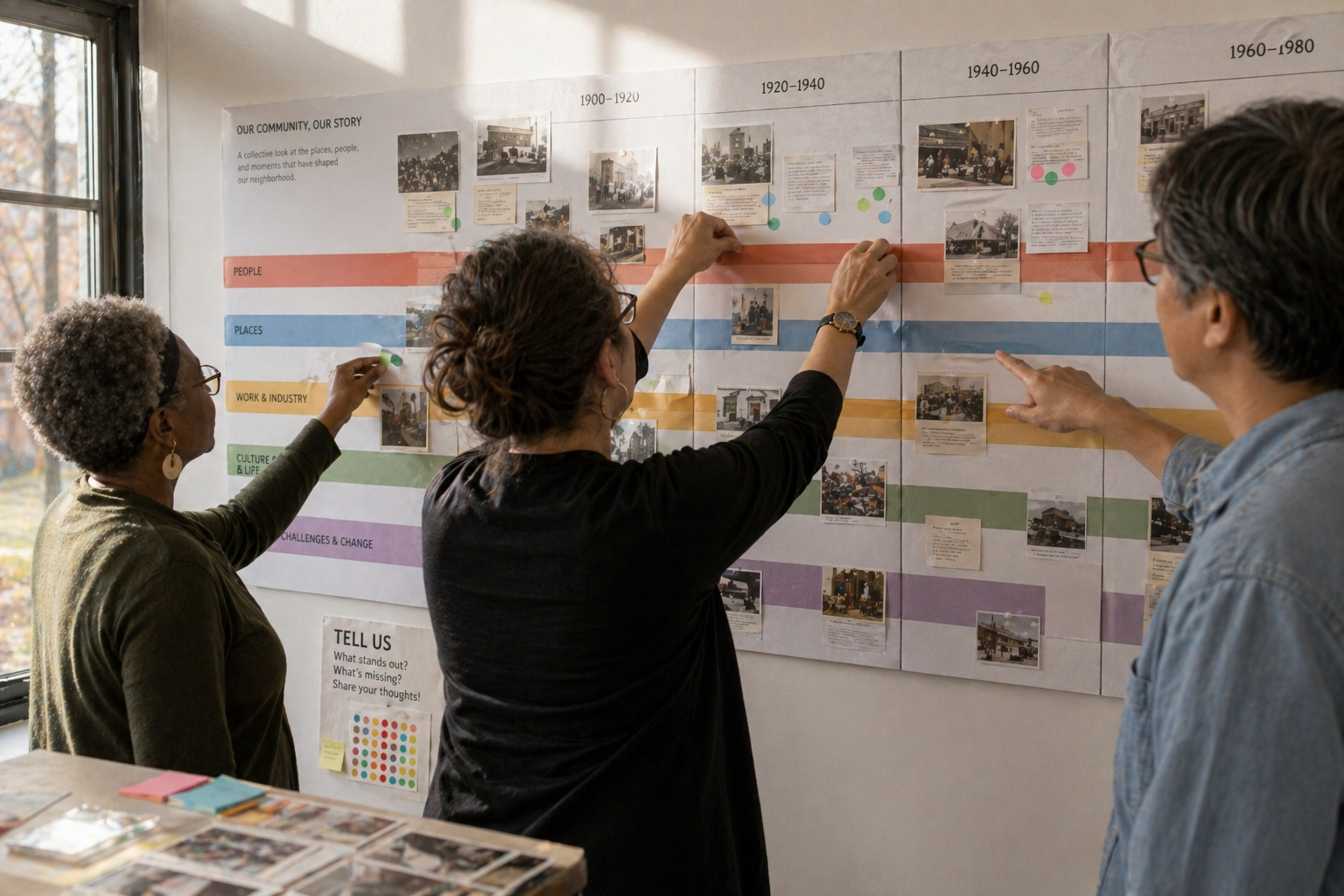
Decide on orientation and scale that suit the display context: long horizontal bands work for galleries, modular panels for touring exhibits, and vertical or zoomable digital layouts suit different audiences. Use visual hierarchy—size, color, and spacing—to distinguish major milestones from secondary notes. Maintain consistent markers for dates and units of time so viewers can read the sequence at a glance. Balance decorative elements with clarity to avoid distracting from the historical narrative.

  • Use larger blocks or color accents for anchor events.
  • Keep typography legible at expected viewing distances.
  • Provide a clear legend for symbols and color codes.

Good layout choices reduce cognitive load and encourage exploration. A readable visual order invites visitors to make connections on their own.

Annotation, Sources, and Interactive Prompts

Annotations turn bare dates into meaningful context: brief captions, images, or primary-source excerpts illuminate why an event matters. Cite sources succinctly and offer deeper references via QR codes or companion guides for visitors who want more. Use prompts and questions to nudge interpretation without dictating conclusions, and avoid jargon that alienates general readers. Thoughtful annotation respects both accuracy and accessibility.

  • Keep captions short and focused on significance.
  • Include clear source attributions for credibility.
  • Add interactive links for layered investigation.

Annotations bridge curiosity and scholarship, making timelines both engaging and trustworthy. They help audiences move from noticing to understanding.

Test, Iterate, and Respect Diverse Perspectives

Usability testing with representative users reveals where timelines confuse or inspire. Track which elements attract attention and which get ignored, then revise scale, wording, or layout accordingly. Engage community stakeholders to surface overlooked perspectives and ensure the timeline reflects diverse experiences and interpretations. Iteration turns an initial draft into a more resonant public resource.

  • Conduct short walkthrough sessions with different audience groups.
  • Collect feedback on clarity, balance, and emotional tone.
  • Make incremental changes and retest until goals are met.

Testing and community input increase relevance and trust. Regular revision keeps timelines accurate and responsive to audience needs.

Conclusion

Effective public timelines combine clear scope, intentional layout, and concise annotation to make history approachable. Iterative testing and stakeholder input ensure the chronology resonates with diverse audiences. With disciplined design choices, timelines can invite discovery rather than simply list dates.

Previous Post

Layered Landscapes: Interpreting Regional Histories Through Everyday Places

Next Post

Planning Timeline Narratives to Illuminate Historical Change

Related Posts

How Haiti Broke Its Chains: A 1791–1804 Timeline
Timeline

How Haiti Broke Its Chains: A 1791–1804 Timeline

September 15, 2026
From Horses to Wires: How the Pony Express Met the Telegraph
Timeline

From Horses to Wires: How the Pony Express Met the Telegraph

September 15, 2026
From Swamps to Shortcut: A Timeline of the Panama Canal
Timeline

From Swamps to Shortcut: A Timeline of the Panama Canal

September 15, 2026
1815–1818: The Tambora Eruption and the Year Without a Summer
Timeline

1815–1818: The Tambora Eruption and the Year Without a Summer

September 15, 2026
Next Post
Planning Timeline Narratives to Illuminate Historical Change

Planning Timeline Narratives to Illuminate Historical Change

Search..

No Result
View All Result

Recent Articles

Edo: Japan’s Urban Revolution of Lanterns and Printshops

Edo: Japan’s Urban Revolution of Lanterns and Printshops

September 16, 2026
How the Little Ice Age Changed Everyday Life in Europe

How the Little Ice Age Changed Everyday Life in Europe

September 16, 2026
The Disguise That Broke Chains: Ellen and William Craft

The Disguise That Broke Chains: Ellen and William Craft

September 15, 2026
Bass Reeves: The Marshal Who Hunted Outlaws in Indian Territory

Bass Reeves: The Marshal Who Hunted Outlaws in Indian Territory

September 15, 2026
How the Crystal Palace Turned Glass and Iron into a Modern Stage

How the Crystal Palace Turned Glass and Iron into a Modern Stage

September 15, 2026

Subscribe Us

By clicking submit, I authorize History Ours and its affiliated companies to: (1) use, sell, and share my information for marketing purposes, including cross-context behavioral advertising, as described in our Terms of Service and Privacy Policy, (2) supplement the information that I provide with additional information lawfully obtained from other sources, like demographic data from public sources, interests inferred from web page views, or other data relevant to what might interest me, like past purchase or location data, (3) contact me or enable others to contact me by email with offers for goods and services from any category at the email address provided, and (4) retain my information while I am engaging with marketing messages that I receive and for a reasonable amount of time thereafter. I understand I can opt out at any time through an email that I receive, or by clicking here

Subscribe To Our Newsletter

By clicking submit, I authorize History Ours and its affiliated companies to: (1) use, sell, and share my information for marketing purposes, including cross-context behavioral advertising, as described in our Terms of Service and Privacy Policy, (2) supplement the information that I provide with additional information lawfully obtained from other sources, like demographic data from public sources, interests inferred from web page views, or other data relevant to what might interest me, like past purchase or location data, (3) contact me or enable others to contact me by email with offers for goods and services from any category at the email address provided, and (4) retain my information while I am engaging with marketing messages that I receive and for a reasonable amount of time thereafter. I understand I can opt out at any time through an email that I receive, or by clicking here.

© 2026 History Ours | All Rights Reserved

  • Contact Us
  • Privacy Policy
  • Terms of Service
  • Unsubscribe
  • Privacy Choices
  • Contact Us
  • Privacy Policy
  • Terms of Service
  • Unsubscribe
  • Privacy Choices

© 2026 History Ours | All Rights Reserved

No Result
View All Result
  • Home
  • History
  • Biographies
  • Eras
  • Regions
  • Timeline

© 2026 History Ours | All Rights Reserved

Skip to content
Open toolbar Accessibility Tools

Accessibility Tools

  • Increase TextIncrease Text
  • Decrease TextDecrease Text
  • GrayscaleGrayscale
  • High ContrastHigh Contrast
  • Negative ContrastNegative Contrast
  • Light BackgroundLight Background
  • Links UnderlineLinks Underline
  • Readable FontReadable Font
  • Reset Reset