
Uncover History’s Secrets with Daily Updates!
Daily News Entertainment
  • Home
  • History
  • Biographies
  • Eras
  • Regions
  • Timeline
No Result
View All Result
History Ours
  • Home
  • History
  • Biographies
  • Eras
  • Regions
  • Timeline
No Result
View All Result
History Ours
No Result
View All Result
Home Timeline

The Evolution of Science: Milestones of Discovery

in Timeline
The Evolution of Science: Milestones of Discovery

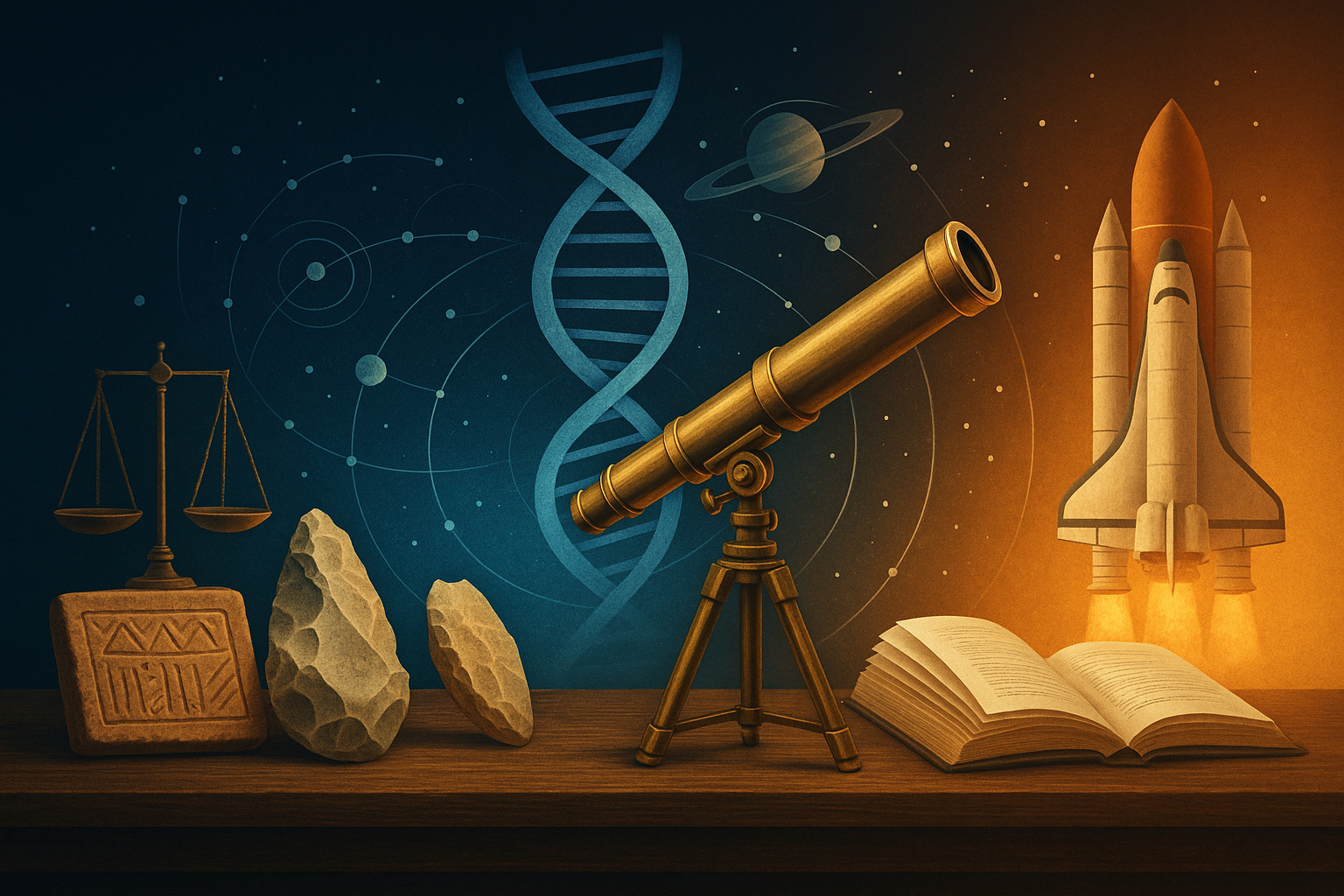
Science has always been humanity’s greatest tool for understanding the world — a continuous journey from curiosity to comprehension. Every discovery, from the earliest use of fire to the latest breakthroughs in genetics and space exploration, represents a step forward in how we see ourselves and the universe around us. The evolution of science is not just a story of inventions and theories, but of persistence, imagination, and the timeless human drive to know more.

The Dawn of Curiosity: Ancient Foundations

The roots of scientific thought reach back thousands of years. Ancient civilizations like Egypt, Mesopotamia, India, China, and Greece laid the groundwork for mathematics, astronomy, and medicine. The Babylonians tracked celestial movements, the Egyptians mastered engineering for their monumental architecture, and Greek thinkers such as Aristotle and Archimedes pioneered logic and experimentation. Science in this era was deeply tied to philosophy and observation — a way to make sense of nature’s patterns and mysteries.

The Renaissance: A New Age of Inquiry

The Renaissance reignited humanity’s passion for discovery. Between the 14th and 17th centuries, Europe saw a cultural rebirth that encouraged questioning, experimentation, and creativity. Figures like Leonardo da Vinci, Galileo Galilei, and Nicolaus Copernicus redefined humanity’s understanding of the cosmos and its place in it. The invention of the printing press accelerated the spread of knowledge, while telescopes and microscopes opened new dimensions of exploration. Science evolved from speculation to evidence — marking the birth of modern scientific thinking.

The Scientific Revolution: Reason and Experiment

The 17th and 18th centuries saw the formalization of the scientific method — a process of hypothesis, testing, and observation that became the foundation of modern research. Isaac Newton’s laws of motion and gravity unified the physics of the heavens and Earth, while advances in chemistry and biology revealed the hidden mechanisms of nature. This period transformed science from a collection of observations into a structured, global pursuit of truth — one that relied on proof rather than belief.

The Industrial and Technological Transformations

The 19th and 20th centuries witnessed unprecedented acceleration in scientific progress. The Industrial Revolution turned theories into technologies, driving innovation in energy, transport, and communication. Meanwhile, breakthroughs in medicine — such as vaccines, antiseptics, and antibiotics — extended human life and improved quality of living. The discovery of electricity, the telephone, and the light bulb illuminated the modern age. Later, the Theory of Evolution by Charles Darwin reshaped biology, challenging and expanding our understanding of life itself.

The Modern Frontier: Space, Genes, and Artificial Intelligence

The 20th and 21st centuries ushered in new frontiers. Humanity reached beyond Earth, explored the atom, and decoded the building blocks of life. The space race led to moon landings and planetary exploration, while advances in genetics unlocked the mysteries of DNA. Today, artificial intelligence, quantum computing, and renewable energy are redefining what is possible. Science continues to evolve — not just to explain the world, but to sustain it.

Conclusion
The evolution of science is a story of discovery, courage, and curiosity — one that continues to unfold with every experiment and every question asked. From ancient thinkers gazing at the stars to modern scientists unlocking the secrets of the universe, the milestones of discovery remind us that progress begins with wonder. Science is not a destination but a journey — a shared quest to understand, innovate, and improve the world for generations to come.
Previous Post

South America’s Incan and Mayan Marvels

Next Post

A Chronology of Political Revolutions Across Centuries

Related Posts

How Haiti Broke Its Chains: A 1791–1804 Timeline
Timeline

How Haiti Broke Its Chains: A 1791–1804 Timeline

September 15, 2026
From Horses to Wires: How the Pony Express Met the Telegraph
Timeline

From Horses to Wires: How the Pony Express Met the Telegraph

September 15, 2026
From Swamps to Shortcut: A Timeline of the Panama Canal
Timeline

From Swamps to Shortcut: A Timeline of the Panama Canal

September 15, 2026
1815–1818: The Tambora Eruption and the Year Without a Summer
Timeline

1815–1818: The Tambora Eruption and the Year Without a Summer

September 15, 2026
Next Post
The Evolution of Science: Milestones of Discovery

A Chronology of Political Revolutions Across Centuries

Search..

No Result
View All Result

Recent Articles

The Disguise That Broke Chains: Ellen and William Craft

The Disguise That Broke Chains: Ellen and William Craft

September 15, 2026
Bass Reeves: The Marshal Who Hunted Outlaws in Indian Territory

Bass Reeves: The Marshal Who Hunted Outlaws in Indian Territory

September 15, 2026
How the Crystal Palace Turned Glass and Iron into a Modern Stage

How the Crystal Palace Turned Glass and Iron into a Modern Stage

September 15, 2026
Anne Bonny: The Pirate Who Broke Rules and Expectations

Anne Bonny: The Pirate Who Broke Rules and Expectations

September 15, 2026
How Haiti Broke Its Chains: A 1791–1804 Timeline

How Haiti Broke Its Chains: A 1791–1804 Timeline

September 15, 2026

Subscribe Us

By clicking submit, I authorize History Ours and its affiliated companies to: (1) use, sell, and share my information for marketing purposes, including cross-context behavioral advertising, as described in our Terms of Service and Privacy Policy, (2) supplement the information that I provide with additional information lawfully obtained from other sources, like demographic data from public sources, interests inferred from web page views, or other data relevant to what might interest me, like past purchase or location data, (3) contact me or enable others to contact me by email with offers for goods and services from any category at the email address provided, and (4) retain my information while I am engaging with marketing messages that I receive and for a reasonable amount of time thereafter. I understand I can opt out at any time through an email that I receive, or by clicking here

Subscribe To Our Newsletter

By clicking submit, I authorize History Ours and its affiliated companies to: (1) use, sell, and share my information for marketing purposes, including cross-context behavioral advertising, as described in our Terms of Service and Privacy Policy, (2) supplement the information that I provide with additional information lawfully obtained from other sources, like demographic data from public sources, interests inferred from web page views, or other data relevant to what might interest me, like past purchase or location data, (3) contact me or enable others to contact me by email with offers for goods and services from any category at the email address provided, and (4) retain my information while I am engaging with marketing messages that I receive and for a reasonable amount of time thereafter. I understand I can opt out at any time through an email that I receive, or by clicking here.

© 2026 History Ours | All Rights Reserved

  • Contact Us
  • Privacy Policy
  • Terms of Service
  • Unsubscribe
  • Privacy Choices
  • Contact Us
  • Privacy Policy
  • Terms of Service
  • Unsubscribe
  • Privacy Choices

© 2026 History Ours | All Rights Reserved

No Result
View All Result
  • Home
  • History
  • Biographies
  • Eras
  • Regions
  • Timeline

© 2026 History Ours | All Rights Reserved

Skip to content
Open toolbar Accessibility Tools

Accessibility Tools

  • Increase TextIncrease Text
  • Decrease TextDecrease Text
  • GrayscaleGrayscale
  • High ContrastHigh Contrast
  • Negative ContrastNegative Contrast
  • Light BackgroundLight Background
  • Links UnderlineLinks Underline
  • Readable FontReadable Font
  • Reset Reset