Uncover History’s Secrets with Daily Updates!
Daily News Entertainment
  • Home
  • History
  • Biographies
  • Eras
  • Regions
  • Timeline
No Result
View All Result
History Ours
  • Home
  • History
  • Biographies
  • Eras
  • Regions
  • Timeline
No Result
View All Result
History Ours
No Result
View All Result
Home Timeline

Building Timelines to Highlight Connections and Continuity

in Timeline
Building Timelines to Highlight Connections and Continuity

Timelines are more than sequences of dates; they are tools for revealing relationships and continuity across time.
A well-constructed timeline helps audiences see cause, consequence, and concurrent developments at a glance.
Clarity of scope and a thoughtful visual structure make complex histories approachable without oversimplifying them.
This article outlines practical steps to design timelines that communicate connections while preserving nuance.

Starting with clear objectives and an audience focus keeps design choices grounded in purpose.
Throughout the process, balance detail with readability so users can both scan and explore.

Defining Scope and Audience

Begin by deciding the temporal span and the intended audience for the timeline. Narrow scopes let you present detail, while broader spans require aggregation and thematic framing. Consider the knowledge level and interests of your audience to choose labels, explanations, and technical language. Identifying primary questions you want users to answer guides selection and prioritization of events.

Setting these constraints early prevents later revisions that compromise clarity. A targeted scope also helps determine what contextual materials or sidebars are necessary for interpretation.

Designing Visual Hierarchy and Layers

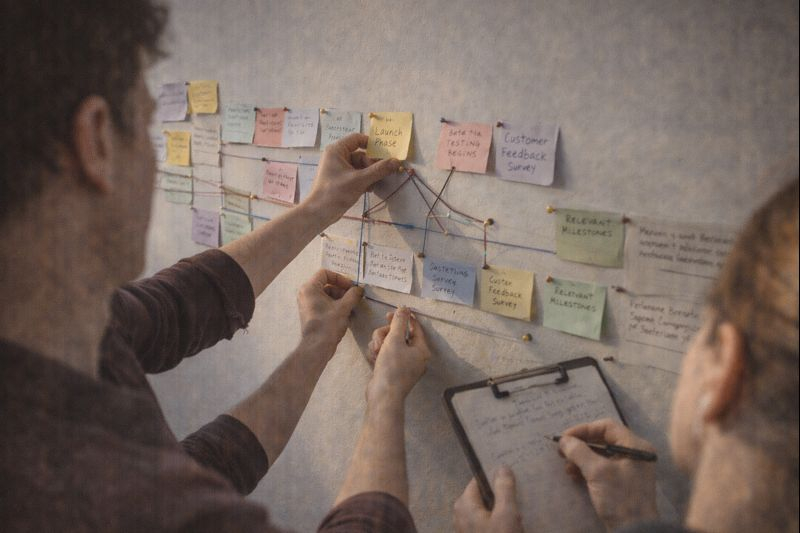
Create a visual system that distinguishes different kinds of information: major milestones, supporting events, and long-term trends. Use spacing, line weight, and distinct lanes to separate themes or actors without overwhelming the reader. Color can link related items across the timeline, but limit palettes to maintain accessibility and legibility. Consider interactive layers for digital timelines to let users toggle detail on and off.

  • Primary timeline: core events and dates.
  • Secondary tracks: thematic or regional developments.
  • Contextual band: long-term trends or background data.

These layers let audiences grasp overarching continuity while exploring specific threads. Clear legends and consistent symbols reduce cognitive load and support interpretation.

Data, Sourcing, and Prioritization

Accurate sourcing is essential: each entry should be verifiable and, where necessary, annotated with references. Prioritize events that illuminate your narrative or answer the research question behind the timeline. Avoid exhaustive lists unless the goal is archival completeness; curated selections often provide more meaningful insight. When dates are uncertain, indicate ranges or levels of confidence to preserve transparency.

Document selection criteria and keep a versioned record of sources to support future updates. This practice strengthens trust and makes the timeline a living resource.

Testing, Accessibility, and Iteration

Prototype early and test with representative users to identify assumptions about navigation and comprehension. Check color contrast, font sizes, and keyboard accessibility for digital timelines, and ensure text alternatives for non-text content. Use feedback to simplify labels, adjust pacing, and clarify relationships that users find confusing. Iteration based on real use will reveal which explanatory elements are necessary.

Regular reviews and updates keep the timeline accurate and relevant as new research emerges. Treat the timeline as a communicative project that evolves with audience needs.

Conclusion

Design timelines to foreground relationships, not just dates.
Prioritize scope, hierarchy, and clear sourcing to support interpretation.
Iterate with users to ensure the timeline remains accessible and meaningful.


Previous Post

Layers of Regional Identity Across Changing Historical Landscapes

Next Post

A Practical Framework for Public Historical Timelines

Related Posts

How Haiti Broke Its Chains: A 1791–1804 Timeline
Timeline

How Haiti Broke Its Chains: A 1791–1804 Timeline

September 15, 2026
From Horses to Wires: How the Pony Express Met the Telegraph
Timeline

From Horses to Wires: How the Pony Express Met the Telegraph

September 15, 2026
From Swamps to Shortcut: A Timeline of the Panama Canal
Timeline

From Swamps to Shortcut: A Timeline of the Panama Canal

September 15, 2026
1815–1818: The Tambora Eruption and the Year Without a Summer
Timeline

1815–1818: The Tambora Eruption and the Year Without a Summer

September 15, 2026
Next Post
A Practical Framework for Public Historical Timelines

A Practical Framework for Public Historical Timelines

Search..

No Result
View All Result

Recent Articles

Edo: Japan’s Urban Revolution of Lanterns and Printshops

Edo: Japan’s Urban Revolution of Lanterns and Printshops

September 16, 2026
How the Little Ice Age Changed Everyday Life in Europe

How the Little Ice Age Changed Everyday Life in Europe

September 16, 2026
The Disguise That Broke Chains: Ellen and William Craft

The Disguise That Broke Chains: Ellen and William Craft

September 15, 2026
Bass Reeves: The Marshal Who Hunted Outlaws in Indian Territory

Bass Reeves: The Marshal Who Hunted Outlaws in Indian Territory

September 15, 2026
How the Crystal Palace Turned Glass and Iron into a Modern Stage

How the Crystal Palace Turned Glass and Iron into a Modern Stage

September 15, 2026

Subscribe Us

By clicking submit, I authorize History Ours and its affiliated companies to: (1) use, sell, and share my information for marketing purposes, including cross-context behavioral advertising, as described in our Terms of Service and Privacy Policy, (2) supplement the information that I provide with additional information lawfully obtained from other sources, like demographic data from public sources, interests inferred from web page views, or other data relevant to what might interest me, like past purchase or location data, (3) contact me or enable others to contact me by email with offers for goods and services from any category at the email address provided, and (4) retain my information while I am engaging with marketing messages that I receive and for a reasonable amount of time thereafter. I understand I can opt out at any time through an email that I receive, or by clicking here

Subscribe To Our Newsletter

By clicking submit, I authorize History Ours and its affiliated companies to: (1) use, sell, and share my information for marketing purposes, including cross-context behavioral advertising, as described in our Terms of Service and Privacy Policy, (2) supplement the information that I provide with additional information lawfully obtained from other sources, like demographic data from public sources, interests inferred from web page views, or other data relevant to what might interest me, like past purchase or location data, (3) contact me or enable others to contact me by email with offers for goods and services from any category at the email address provided, and (4) retain my information while I am engaging with marketing messages that I receive and for a reasonable amount of time thereafter. I understand I can opt out at any time through an email that I receive, or by clicking here.

© 2026 History Ours | All Rights Reserved

  • Contact Us
  • Privacy Policy
  • Terms of Service
  • Unsubscribe
  • Privacy Choices
  • Contact Us
  • Privacy Policy
  • Terms of Service
  • Unsubscribe
  • Privacy Choices

© 2026 History Ours | All Rights Reserved

No Result
View All Result
  • Home
  • History
  • Biographies
  • Eras
  • Regions
  • Timeline

© 2026 History Ours | All Rights Reserved

Skip to content
Open toolbar Accessibility Tools

Accessibility Tools

  • Increase TextIncrease Text
  • Decrease TextDecrease Text
  • GrayscaleGrayscale
  • High ContrastHigh Contrast
  • Negative ContrastNegative Contrast
  • Light BackgroundLight Background
  • Links UnderlineLinks Underline
  • Readable FontReadable Font
  • Reset Reset