Uncover History’s Secrets with Daily Updates!
Daily News Entertainment
  • Home
  • History
  • Biographies
  • Eras
  • Regions
  • Timeline
No Result
View All Result
History Ours
  • Home
  • History
  • Biographies
  • Eras
  • Regions
  • Timeline
No Result
View All Result
History Ours
No Result
View All Result
Home Timeline

Creating Timelines to Illuminate Historical Change and Context

in Timeline
Creating Timelines to Illuminate Historical Change and Context

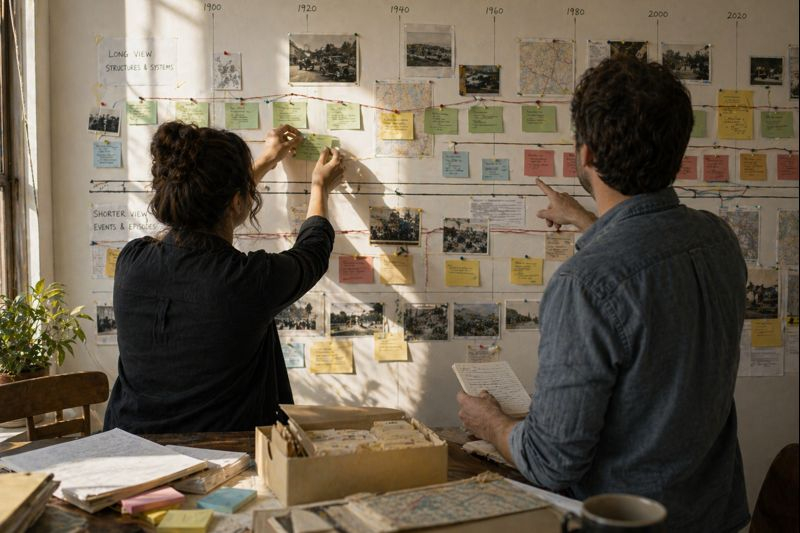
Timelines are powerful tools for turning scattered events into coherent historical narratives that readers can follow and reflect on. A well-crafted timeline balances breadth and depth so that patterns, turning points, and continuities emerge without overwhelming the audience. Effective timelines orient readers by providing clear temporal anchors, concise context, and a structure that highlights relationships among events. This article outlines practical steps for planning, curating, designing, and maintaining timelines that communicate historical meaning.

Define scope and audience

Begin by clarifying the timeline’s scope: chronological span, thematic focus, and intended audience. Establish whether the timeline targets specialists, students, or a general public, and adjust language, level of detail, and visual complexity accordingly. Define core questions the timeline should answer, such as causation, continuity, or comparison across places and institutions. These initial decisions guide research priorities and design constraints throughout the project.

Be realistic about resources and scale from the outset, setting limits on the number of events and the depth of annotation. A focused timeline with well-chosen entries often communicates more effectively than an exhaustive chronology that buries key patterns.

Curate events and provide context

Selection is interpretive: choose entries that serve the timeline’s questions and contribute to a readable narrative rather than listing every date. Prioritize events that reveal change, represent turning points, or illuminate sustained processes, and include contextual notes to connect isolated entries to broader trends. Where necessary, add short explanatory labels or one-sentence summaries that clarify significance without crowding the layout. Cite sources or link to expanded entries to support credibility and allow deeper exploration.

Consistency in how events are described—dates, actors, and outcomes—helps readers compare items across the timeline. Regular review with subject experts reduces bias and increases accuracy.

Design hierarchy and visual clarity

Use visual hierarchy to guide attention: size, color, and placement should distinguish focal events from supporting information. Group related events along lanes or bands, and consider nested layers for long-term developments versus episodic incidents. Keep typography legible and avoid dense blocks of text; white space improves comprehension and reduces cognitive load. Interactive timelines can reveal layers progressively, but static displays require careful pruning and emphasis to remain accessible.

  • Use contrast for key milestones.
  • Limit palette and typefaces.
  • Provide scale markers and legends.

Test designs with representative users to confirm the intended reading path and revise based on feedback. Responsive layouts and clear printable versions extend usability across platforms.

Conclusion

Thoughtful timelines combine selective curation, clear context, and purposeful design to make historical change intelligible and meaningful. Iterative testing and transparent sourcing strengthen trust and usability. With attention to audience, scope, and visual hierarchy, timelines can turn dates into compelling narratives that encourage further inquiry.


Previous Post

Everyday Infrastructures and the Long History of Place

Next Post

From Scope to Surface: A Guide to Timeline Composition

Related Posts

How Haiti Broke Its Chains: A 1791–1804 Timeline
Timeline

How Haiti Broke Its Chains: A 1791–1804 Timeline

September 15, 2026
From Horses to Wires: How the Pony Express Met the Telegraph
Timeline

From Horses to Wires: How the Pony Express Met the Telegraph

September 15, 2026
From Swamps to Shortcut: A Timeline of the Panama Canal
Timeline

From Swamps to Shortcut: A Timeline of the Panama Canal

September 15, 2026
1815–1818: The Tambora Eruption and the Year Without a Summer
Timeline

1815–1818: The Tambora Eruption and the Year Without a Summer

September 15, 2026
Next Post
From Scope to Surface: A Guide to Timeline Composition

From Scope to Surface: A Guide to Timeline Composition

Search..

No Result
View All Result

Recent Articles

The Disguise That Broke Chains: Ellen and William Craft

The Disguise That Broke Chains: Ellen and William Craft

September 15, 2026
Bass Reeves: The Marshal Who Hunted Outlaws in Indian Territory

Bass Reeves: The Marshal Who Hunted Outlaws in Indian Territory

September 15, 2026
How the Crystal Palace Turned Glass and Iron into a Modern Stage

How the Crystal Palace Turned Glass and Iron into a Modern Stage

September 15, 2026
Anne Bonny: The Pirate Who Broke Rules and Expectations

Anne Bonny: The Pirate Who Broke Rules and Expectations

September 15, 2026
How Haiti Broke Its Chains: A 1791–1804 Timeline

How Haiti Broke Its Chains: A 1791–1804 Timeline

September 15, 2026

Subscribe Us

By clicking submit, I authorize History Ours and its affiliated companies to: (1) use, sell, and share my information for marketing purposes, including cross-context behavioral advertising, as described in our Terms of Service and Privacy Policy, (2) supplement the information that I provide with additional information lawfully obtained from other sources, like demographic data from public sources, interests inferred from web page views, or other data relevant to what might interest me, like past purchase or location data, (3) contact me or enable others to contact me by email with offers for goods and services from any category at the email address provided, and (4) retain my information while I am engaging with marketing messages that I receive and for a reasonable amount of time thereafter. I understand I can opt out at any time through an email that I receive, or by clicking here

Subscribe To Our Newsletter

By clicking submit, I authorize History Ours and its affiliated companies to: (1) use, sell, and share my information for marketing purposes, including cross-context behavioral advertising, as described in our Terms of Service and Privacy Policy, (2) supplement the information that I provide with additional information lawfully obtained from other sources, like demographic data from public sources, interests inferred from web page views, or other data relevant to what might interest me, like past purchase or location data, (3) contact me or enable others to contact me by email with offers for goods and services from any category at the email address provided, and (4) retain my information while I am engaging with marketing messages that I receive and for a reasonable amount of time thereafter. I understand I can opt out at any time through an email that I receive, or by clicking here.

© 2026 History Ours | All Rights Reserved

  • Contact Us
  • Privacy Policy
  • Terms of Service
  • Unsubscribe
  • Privacy Choices
  • Contact Us
  • Privacy Policy
  • Terms of Service
  • Unsubscribe
  • Privacy Choices

© 2026 History Ours | All Rights Reserved

No Result
View All Result
  • Home
  • History
  • Biographies
  • Eras
  • Regions
  • Timeline

© 2026 History Ours | All Rights Reserved

Skip to content
Open toolbar Accessibility Tools

Accessibility Tools

  • Increase TextIncrease Text
  • Decrease TextDecrease Text
  • GrayscaleGrayscale
  • High ContrastHigh Contrast
  • Negative ContrastNegative Contrast
  • Light BackgroundLight Background
  • Links UnderlineLinks Underline
  • Readable FontReadable Font
  • Reset Reset